It is always a pleasure to visit the Karlsruhe Institute of Technology (KIT), on this occasion for the 10th International Workshop on High Precision for Hard Processes at the LHC (HP2 2026), one of the main venues for scientific exchange among experts in precision, multi-loop and multi-leg calculations in Quantum Field Theory.
Faced with the impossible task of reviewing progress in parton distribution functions (PDFs) in just 30 minutes, I chose to focus on two specific aspects in my talk.
First, how to use Neural Simulation-Based Inference (NSBI) to constrain proton structure from unbinned multivariate observables at the LHC. Major improvements in our knowledge of proton structure can be achieved, but only if QCD and electroweak theoretical calculations of realistic final states reach the target precision: an important message for the loop experts attending this conference.
Second, how to exploit the information provided by LHC neutrinos and muons, detected at the FASER and SND@LHC far-forward detectors, to inform nucleon and nuclear structure, investigate hadron fragmentation, and search for novel QCD phenomena in the essentially unexplored forward region of LHC collisions, for example via charm production. Here too, this potential can only be realised if our simulations of TeV lepton scattering and of forward hadron production keep pushing the precision frontier, again an apt message for this audience.
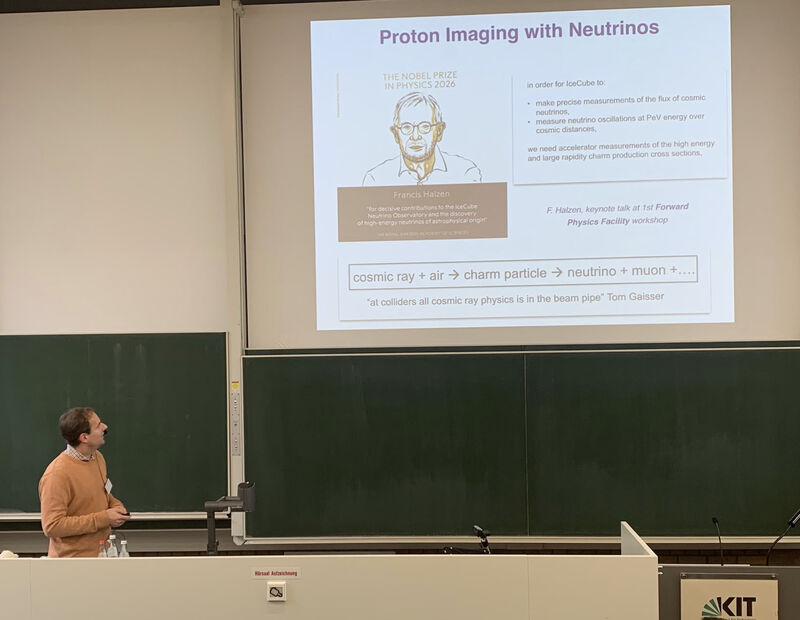
I could not resist quoting Francis Halzen, laureate of the 2026 Nobel Prize in Physics, who at the first Forward Physics Facility workshop in 2020 emphasised the deep connection between neutrino astronomy at IceCube (and other neutrino telescopes such as KM3NeT) and collider neutrino physics at the LHC. As I illustrated in my talk, this connection is being realised as we speak.
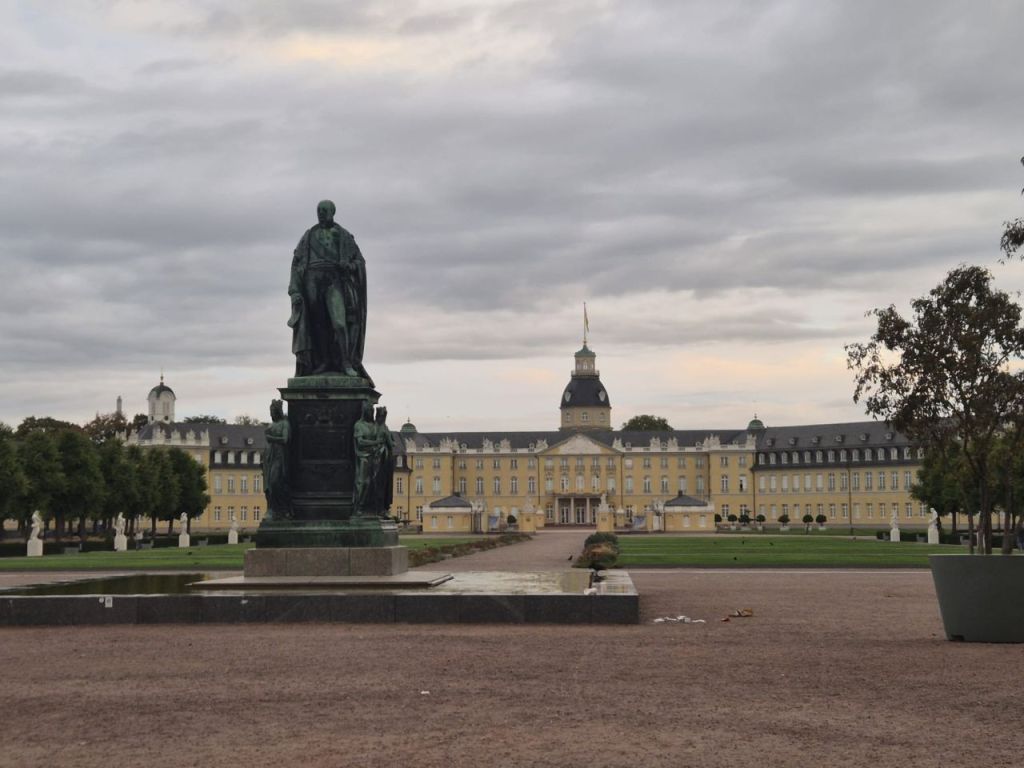
Many thanks to the HP2 2026 organisers for their kind invitation to give this talk. I look forward to returning soon to beautiful Karlsruhe!


Leave a Reply