What does CERN’s proposed future flagship collider have to do with nuclear physics? At first sight, nothing at all. Yet Quantum Field Theory tells us otherwise: low-energy observables such as the beta decays of radioactive nuclei, involving momentum transfers of a few MeV, are intrinsically linked through quantum effects to collider observables probing energies of several TeV, a million times larger.
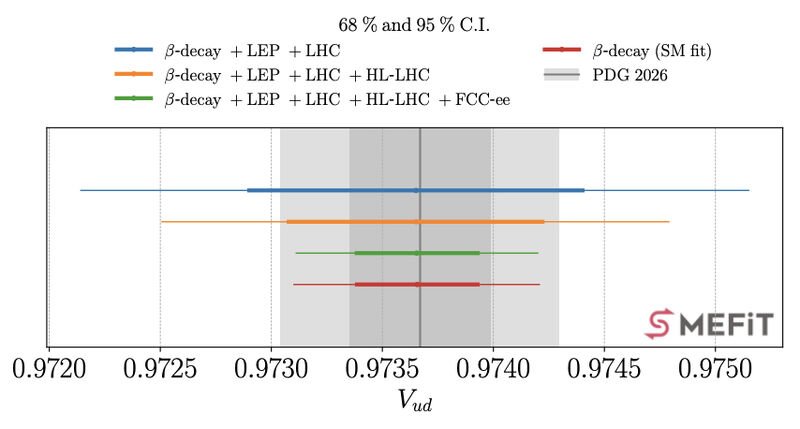
In our new paper, we exploit this connection to show how the ultra-precise measurements expected at the Future Circular Collider (FCC-ee) can tightly constrain New Physics effects that would otherwise distort the determination of the CKM matrix element Vud from superallowed beta decays.
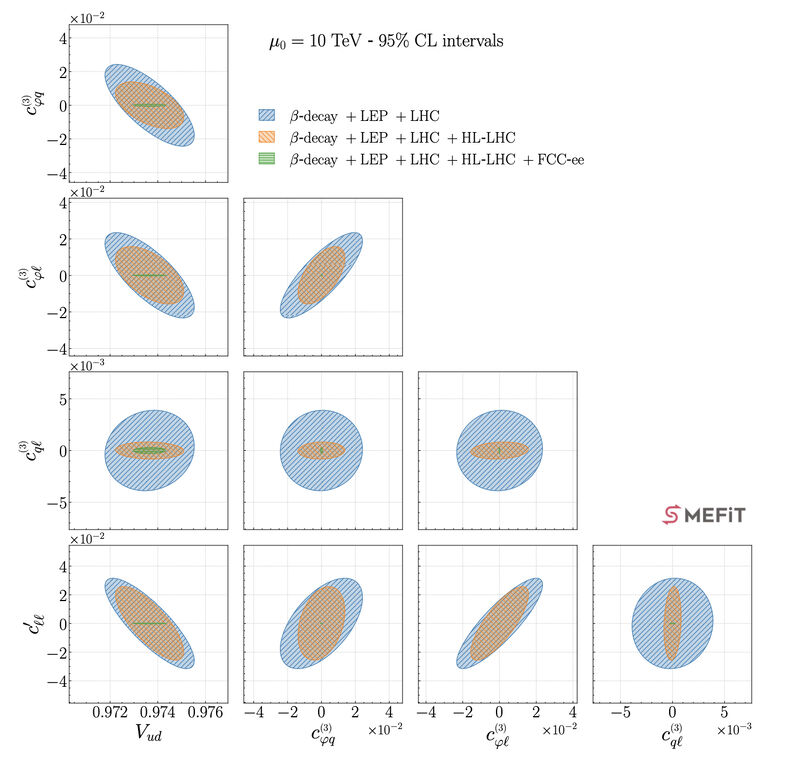
From low-energy data alone, CKM elements and possible New Physics contributions cannot be disentangled, and current collider constraints are not sufficient to fully break this degeneracy. This ambiguity is at the heart of proposed explanations of the Cabibbo Angle Anomaly. Once FCC-ee projections are included in a global SMEFT analysis of low-energy and collider data, the degeneracy is lifted, and Vud can be cleanly extracted from beta decays, even assuming greatly improved theoretical calculations of nuclear and hadronic radiative corrections.
This work is the result of an in-house collaboration within the Nikhef Theory Group. Jordy de Vries and his PhD candidates Lemonia Gialidi and Vaisakh Plakkot contributed their expertise on low-energy and nuclear physics observables, while the SMEFiT team, with Elie Hammou and Kamil Laurent, provided the (future) collider know-how and computational infrastructure.
Our analysis also highlights many synergies between the FCC-ee and low-energy data, most of them still unexplored, which can be exploited by combining the full power of Quantum Field Theory, precision calculations and advanced numerical tools.
Read the paper: INSPIRE-HEP


Leave a Reply