My research group at the Department of Physics and Astronomy of the VU Amsterdam, embedded into the Nikhef Theory group brings together PhD candidates, postdoctoral researchers, and bachelor and master students working at the interface of Quantum Chromodynamics, effective field theories, high-energy neutrinos, and machine learning / artificial intelligence. Below are the current members of the group, followed by former members together with the titles of their theses or research projects. Prospective students and researchers interested in joining our group are encouraged to consult the Vacancies page or to contact me directly at j.rojo@vu.nl.
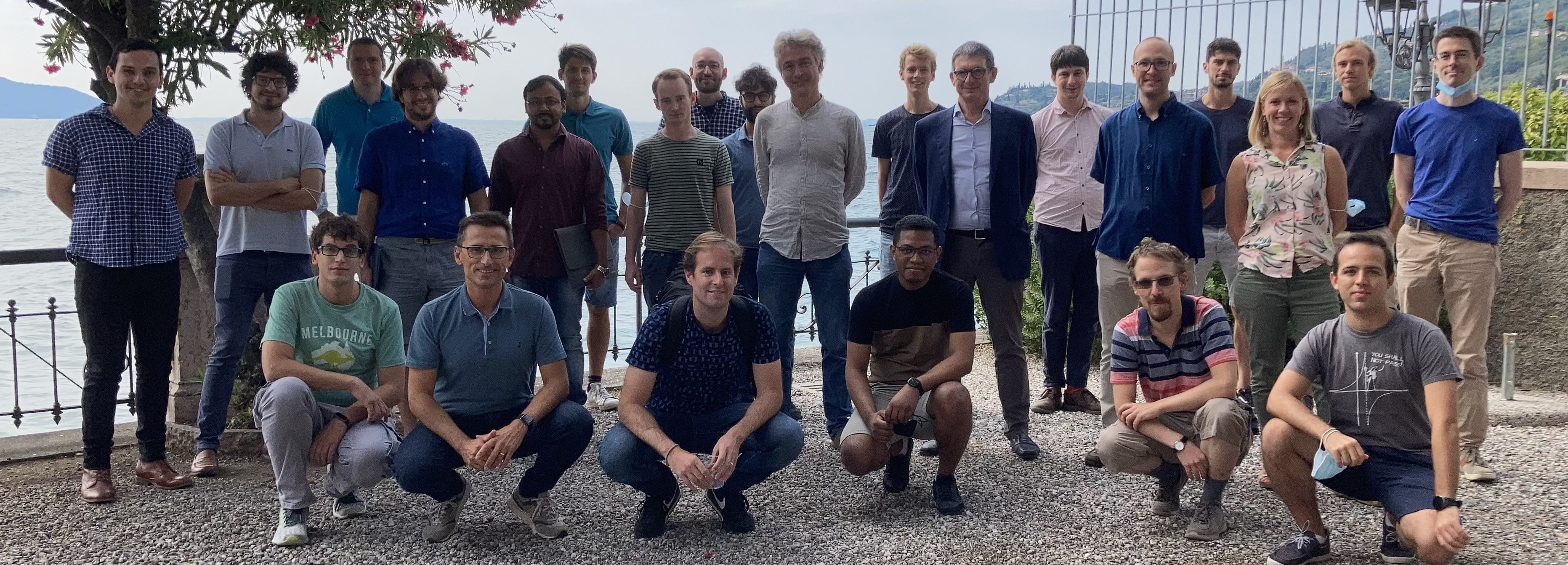
Current group members
PhD candidates and postdoctoral researchers
- Dr. Elie Hammou (postdoctoral researcher): LHC neutrinos, effective field theories, AI for high-energy physics.
- Maryam Mourad (PhD candidate, 2026–2030, jointly with the Nikhef KM3NeT and Pierre Auger programmes): Modelling of high-energy hadronic interactions at Auger, KM3NeT, and FASER.
- Kamil Laurent (PhD candidate, 2025–2029): The structure of the proton from precision LHC measurements.
- Jelle Koorn (PhD candidate, 2025–2029): Quantum Chromodynamics with high-energy neutrinos at the LHC. MSc thesis (2025): The First Extraction of the LHC Forward Neutrino Flux from FASER Data: A Phenomenological Study of Far-Forward Neutrinos [thesis].
- Peter Krack (PhD candidate, 2022–2026): A Monte Carlo generator for neutrino production at the LHC.
Bachelor and master students
- Paulina Hernandez Sainz (MSc, 2026): Precise QCD event generation for neutrino astronomy.
- Rowan van der Brink (MSc, 2026–2027): Disentangling New Physics at the LHC from QCD Uncertainties with SIMUnet.
- Khoi Pham (MSc, 2026–2027): Neural Simulation-Based Inference with LHC neutrinos at FASER.
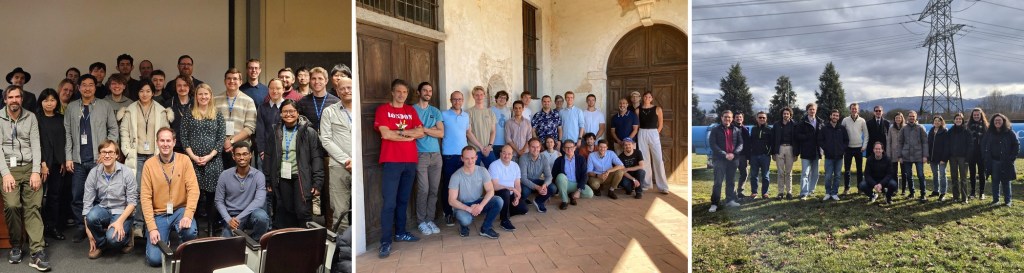
Former group members
PhD candidates and postdoctoral researchers
- Tanjona Rabemananjara (postdoc, 2021–2025): QCD resummation, machine learning for particle physics, and proton structure with hyperoptimised machine learning.
- Tommaso Giani (PhD candidate and postdoc, 2018–2024): nuclear parton distributions and SMEFT interpretations of LHC data.
- Jaco ter Hoeve (PhD candidate, 2020–2024): Fingerprinting New Physics with Effective Field Theories [PhD thesis].
- Giacomo Magni (PhD candidate, 2020–2024, Cum Laude): A High Resolution Imaging of the Collinear Substructure of the Proton [PhD thesis].
- Rhorry Gauld (postdoc, 2018–2021, NWO Veni): QCD, heavy-flavour production, and high-energy neutrino fluxes.
- Jacob Ethier (postdoc, 2018–2021): nuclear parton distributions, proton spin, and hadronization.
- Rabah Abdul Khalek (PhD candidate, 2017–2021, Cum Laude): Exploring the Substructure of Nucleons and Nuclei with Machine Learning [PhD thesis].
- Emma Slade (PhD candidate @ Oxford, 2016–2019): Precision fits at the LHC and beyond [PhD thesis].
- Emanuele Roberto Nocera (PhD candidate @ Milano, 2010–2014; postdoc 2015–2017 @ Oxford and 2018–2020 @ Nikhef): Unbiased spin-dependent Parton Distribution Functions [PhD thesis].
- Valerio Bertone (postdoc, 2015–2017): parton distributions and QCD evolution.
- Nathan P. Hartland (postdoc, 2014–2017): parton distributions and SMEFT global fits.
- Francesco Giuli (PhD candidate @ Oxford, 2014–2018, with A. Cooper-Sarkar): Study of the Drell-Yan process with the ATLAS detector at the LHC [PhD thesis].
- Luca Rottoli (PhD candidate @ Oxford, 2014–2018): Precision QCD at the LHC: from the structure of the proton to all-order resummations [PhD thesis] [arXiv].
- Marco Bonvini (postdoc, 2014–2016): high-energy (small-x) resummation and proton structure.
- Francesco Cerutti (PhD candidate @ Barcelona, 2009–2013, with J. I. Latorre): Neural network parton distributions for the LHC.
Bachelor and master students
- Wopke Telman (MSc, 2026): Discovering New Physics at the FCC-ee with SMEFT Fits [thesis].
- Jukka John (MSc, 2025): A data-driven determination of the forward neutrino fluxes at the LHC from Machine Learning.
- Roan van Brussel (BSc, 2024): Fingerprinting New Physics at the FCC-ee with the SMEFT [thesis].
- Thomas Spreen (BSc, 2024): Event generators for LHC neutrino experiments [thesis].
- Wouter Prommel (BSc, 2024): Neutrino Scattering Cross-sections at High-Energies.
- Gijs van Seeventer (MSc @ Utrecht, 2024): Proton structure analyses with normalised flows.
- Valentina Schütze Sanchez (MSc, 2024): NLO predictions for neutrino Deep Inelastic Scattering at the future Forward Physics Facility [thesis].
- Eva Groenendijk (MSc, 2024): Predictions for High-Energy Neutrino Scattering at the Large Hadron Collider [thesis]. Currently a PhD candidate at the University of Milan under the supervision of Prof. Stefano Forte.
- Toon Hasenack (MSc @ Utrecht, 2024): Unraveling the proton spin structure with machine learning.
- Anezka Bos (BSc, 2023): A determination of polarised proton structure from machine learning.
- Wolf Gautier (BSc, 2023): Optimal observables for Effective Field Theory interpretations [thesis].
- Philip Fredriksz (MSc @ TU Delft, 2023, with S. Conesa-Boj): Denoising of high-resolution transmission electron microscopy images with deep learning.
- Stijn van der Lippe (MSc @ TU Delft, 2023, with S. Conesa-Boj): Automation of electron energy gain spectroscopy data analysis.
- Steven Niedenzu (MSc, 2023): Constraining the low-x gluon PDF using far-forward neutrinos produced in proton-proton collisions [thesis].
- Maaike Bakker (MSc, 2023): The Impact of the High Luminosity LHC on the SMEFT Parameter Space.
- Adrianne Schaus (MSc, 2023): Polarized Structure Functions with Heavy Flavor Corrections for Neutral Current Deep Inelastic Scattering at Next-to-Next-to-Leading Order [thesis].
- Pim Herbschleb (MSc, 2023): Generating hadron level unbinned multivariate observables for EFT fits at the LHC from Machine Learning [thesis].
- Josep Sola Cava (MSc, 2023): The effect of the FPF@LHC on the high-x charm PDF [thesis].
- Nusch Mortazavi (BSc, 2022): Towards predicting low Q² structure functions in neutrino scattering using machine learning [thesis].
- Charlie Bender (MSc, 2022): Combined EFT interpretation of flavour data and high-pT observables at the LHC.
- Isabel Postmes (MSc @ TU Delft, 2021, with S. Conesa-Boj): Automated pattern recognition for EELS spectral images.
- Jochem Bakker (BSc, 2021): SMEFT constraints from Vector-Boson-Fusion processes.
- Duncan Pelan (BSc, 2021): Heavy Majorana neutrino mass constraints from an Effective Field Theory on the Type I seesaw mechanism [thesis].
- Laurien Roest (MSc @ TU Delft, 2020, with S. Conesa-Boj): Machine Learning for Electron Energy Loss Spectroscopy.
- Gijs van Weelden (MSc @ Leiden, 2020): Perturbative QCD calculations for heavy quark hadrons in cosmic ray collisions.
- Ferran Faura Iglesias (MSc, 2020): Impact of the NOMAD data on the strangeness in the proton [thesis].
- Samuel van Beek (MSc, 2019): Stress-testing the Standard Model at the High-Energy Frontier with Bayesian inference.
- Manuel Wierda (MSc, 2018): Charm production in proton-nuclear collisions at the LHC and constraining the small-x gluon in a nuclear NNPDF analysis.
- Marco Bout (BSc, 2018): A three-dimensional imaging of the proton with Artificial Neural Networks [thesis].
- Sanne Vergouwen (BSc, 2018): Constraining the Standard Model Effective Field Theory with top quark measurements [thesis].
- Paul Gorris (BSc, 2018): Z boson production in Pb-p collisions at 5.02 TeV [thesis].
- Emanuel Hoogeveen (BSc, 2017): Higgs pair production at a 100 TeV hadron collider.
- Daniel Shipley (MPhys @ Oxford, 2016): Searches for New Physics beyond the Standard Model at the LHC using ratios of cross-sections.
- Miriam Kuenzel (MMathPhys @ Oxford, 2016): New Physics searches at the LHC with Higgs pair production.
- Carmen Gigliotti (MSc @ Milano, 2011): The impact of new theory into a global PDF analysis using Bayesian inference.
- Giulia Calzolaio (MSc @ Milano, 2011): The impact of high energy resummation on Parton Distributions and LHC phenomenology.
- Luca Rottoli (BSc @ Milano, 2011): PDF systematic uncertainties for the determination of forward-backward asymmetry at the Large Hadron Collider.
- Simone Lionetti (BSc @ Milano, 2010): Dataset dependence of alphas determinations in global PDF analysis.
- Marco Zaro (MSc @ Milano, 2009): kt factorization in inclusive jet production.
- Alice Donati (BSc @ Milano, 2009): Statistical aspects of the NNPDF determination of parton distributions.
- Elisa Mariani (BSc @ Milano, 2009): Determination of the QCD strong coupling constant in the NNPDF approach.

