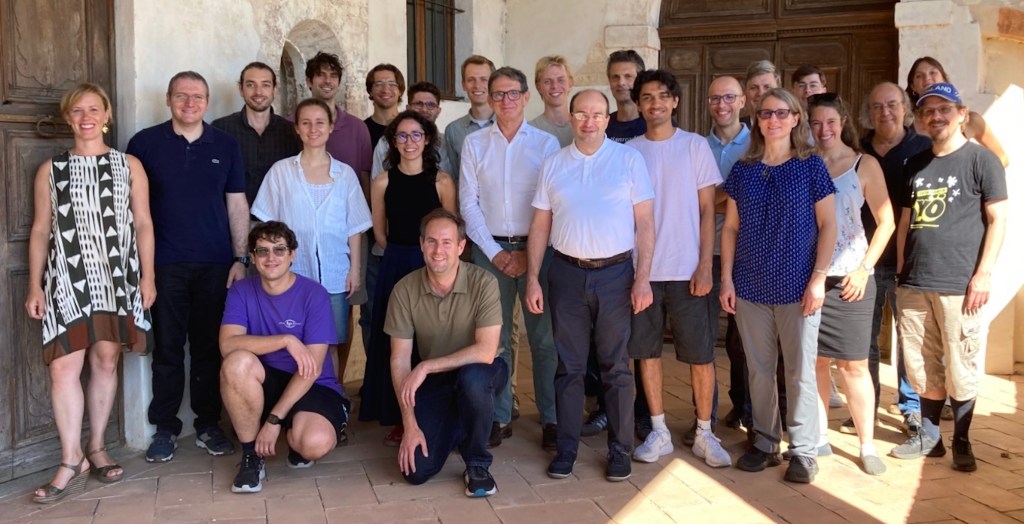
Another successful and productive edition of the yearly NNPDF Collaboration meeting in Milano has just wrapped up. Over three days we discussed cutting-edge perturbative calculations; the intricacies of the recent precision measurements from ATLAS, CMS, LHCb and ALICE, which will be used in our upcoming global determination of proton structure; new ideas in uncertainty-aware machine learning and AI for QCD studies; and how our ever-growing open-source NNPDF software stack will develop in the coming period.
The success of these meetings would be impossible without the participation of external colleagues, who provide us with plenty of inspiration and new ideas to think outside the (PDF) box. Over the years we have been fortunate to welcome leading experts in theoretical and experimental high-energy physics, who are also frequently at the forefront of developments in data science, advanced statistical methods, machine learning and AI for particle physics.
Many thanks to Michael Spannowsky, Lydia Brenner and Christine Aidala for their wonderful and inspiring talks this year.
Michael Spannowsky (Karlsruhe Institute of Technology) challenged us to go beyond traditional statistics and goodness-of-fit metrics with new ideas to assess how well our theory predictions agree with the LHC data, how robust our uncertainties are, and whether we can be fully confident that we are not hiding a New Physics anomaly in our global PDF fits. His ideas, centred on ML-based conformal prediction as a calibration standard for high-energy physics, suggest a pathway towards improved statistical diagnostics in global PDF determinations.
Lydia Brenner, colleague and friend from Nikhef, provided an excellent review of unfolding procedures in particle physics, a topic in which she is one of the leading experts, and reminded us that no measurement is pure or assumption-free. Understanding the translation from experimentally accessible quantities to theory-friendly particle-level distributions is crucial to fully exploit the PDF sensitivity available in LHC data, especially for the latest measurements, which are often limited by systematic uncertainties.
Last but not least, Christine Aidala gave a comprehensive overview of the past, present and future of QCD, from its “R&D” period to the current era of quantitative, precision explorations. She made the case for the upcoming Electron-Ion Collider, expected to see first light in 2035 at Brookhaven National Laboratory, to become the ultimate facility for QCD and nucleon structure studies, answering questions that until recently we did not even know we could formulate, with enormous synergies with the experiments at CERN, including the rich QCD programme of LHCb.
Looking forward to the 2027 meeting, always one of the high points of our year.


Leave a Reply