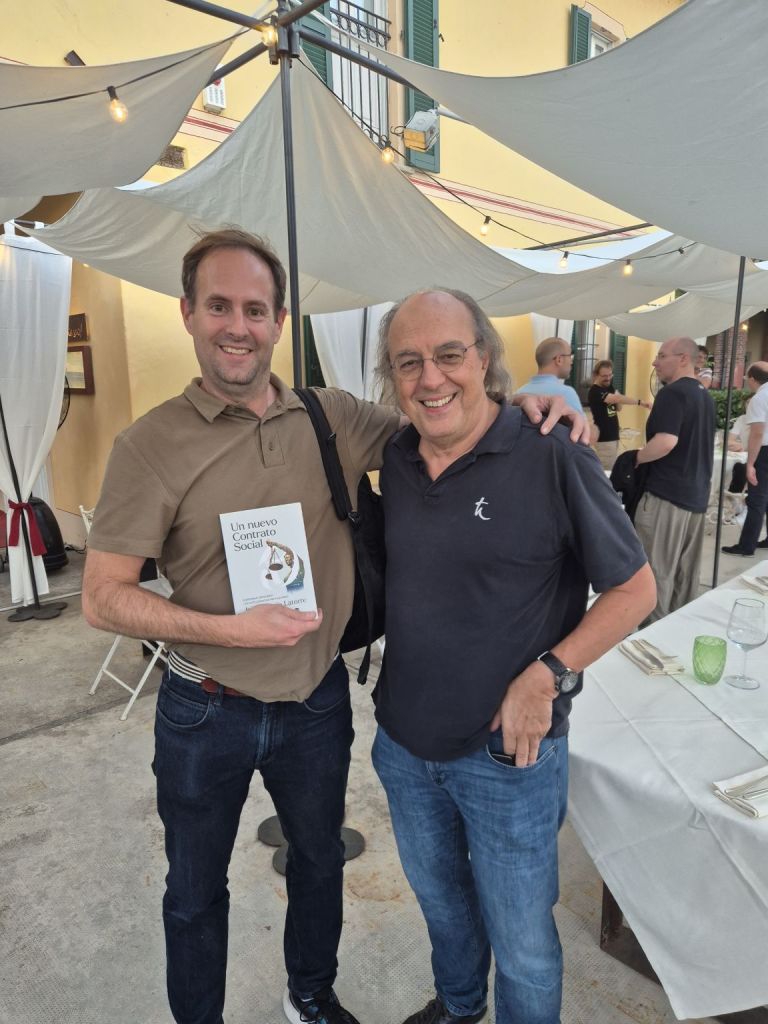
One of the best things about the yearly NNPDF Collaboration meeting is catching up with friends and colleagues, and if my PhD supervisor José Ignacio Latorre is around, this can only mean really exciting stuff.
José Ignacio is a true modern-day polymath: from particle physics to quantum information, from founding the Centro de Ciencias de Benasque Pedro Pascual to directing the Centre for Quantum Technologies in Singapore, from winemaking to outreach and science communication at the highest level.
As a passionate communicator and science advocate, José Ignacio has written several books on topics ranging from quantum mechanics to the ethics of AI. These are all subjects he pioneered well before the hype: we started training neural networks for particle physics 25 years ago, when they were considered a very niche, non-physics topic that arguably should not even be allowed in a physics department (the same criticism was levelled at quantum information and quantum technologies, and look where we are now).
José Ignacio has always had an incredible forward-looking vision, so when he writes about what is to come, people should listen. He anticipated, for instance, that ideas from quantum information would become a core ingredient of model building in particle physics. When we wrote a paper showing that quantum entanglement could play a central role in the quantum field theories of particle physics (Maximal Entanglement in High Energy Physics, SciPost Phys. 3 (2017) 036), it was dismissed as irrelevant, not even wrong, and proved very difficult to publish. It is now one of the main references of the blooming field of quantum information for high-energy physics.
In his latest book, Un nuevo contrato social. Gobernar un mundo con inteligencias no humanas, José Ignacio reflects on the possible technological singularity arising from generative AI. He argues that a new social contract is not an option but an urgency: for the first time in history, humans share the world with an entity capable of learning, deciding and acting autonomously.
What will be the place of human beings in a world shared with an AI that may be faster, more precise and perhaps wiser than we are? Between scientific reasoning and humanistic reflection, he proposes a new social contract built on three inseparable dimensions, the natural, the civil and the intelligent, without falling into either paralysing fear or naive faith in new technology. AI is not only a technological challenge. Above all, it is a political and ethical question.
Many thanks, José Ignacio, for the book and for your insights!


Leave a Reply