I had the pleasure of visiting two great scientific institutions in Abu Dhabi, on a trip that brought together particle physics, astroparticle physics, and quantum science.
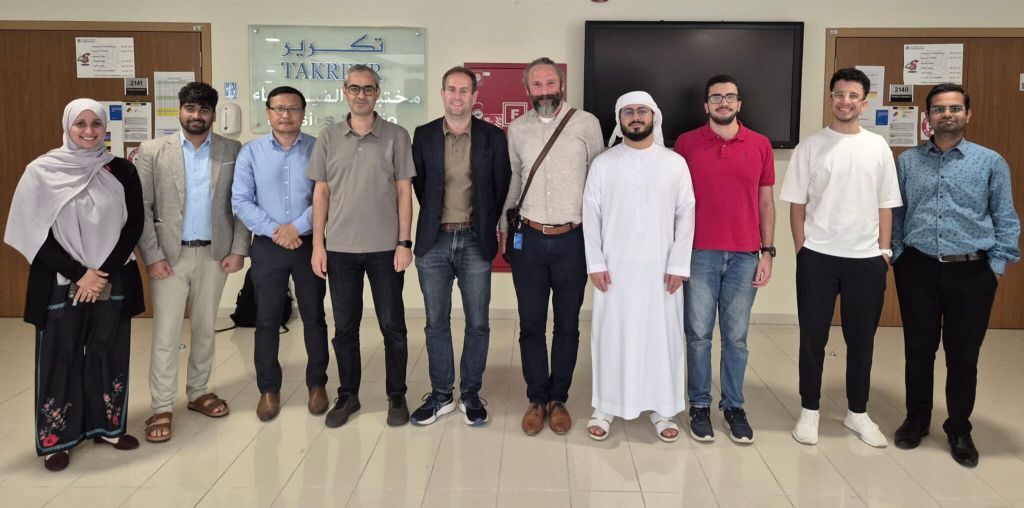
At Khalifa University I was warmly hosted by the (astro-)particle physics groups of Arjen van Vliet, Rachik Soualah, and colleagues. Although a relative newcomer to high-energy physics, Khalifa University already has active groups in major particle and astroparticle physics experiments, from ATLAS to KM3NeT, and is involved in CERN’s efforts towards future colliders such as the Future Circular Collider. I gave the Physics department colloquium on recent progress in particle physics, with a focus on collider neutrinos at FASER and its planned upgrades, which open new windows onto the neutrino sector, hadron structure, and quantum chromodynamics, and which inform theoretical predictions and simulations for astroparticle physics experiments.
I also visited, one day before, the Center for Quantum Research at the Technology Innovation Institute, a centre set up just a few years ago, in part from scratch, by my PhD advisor José Ignacio Latorre, and which now hosts outstanding groups across quantum software, computing, communication, and sensing. In my colloquium there, “HEP meets Quantum science and technology”, I presented recent developments at the interface between particle physics and quantum science: quantum-information ideas as new guiding principles in particle physics, such as the maximal entanglement principle proposed a few years ago together with José Ignacio Latorre, Alba Cervera-Lierta, and Luca Rottoli; tests of quantum mechanics at the energy frontier through entanglement in top-quark pair production at ATLAS and CMS; and the intrinsic charm content of the proton, where machine learning lets us probe the quantum wave function of the proton.
These visits were full of stimulating discussions, and they left me optimistic about the future of quantum science and high-energy and astroparticle physics in the United Arab Emirates: with continued investment in fundamental science and technology, the local institutes are well placed to play an important role in global efforts in the coming years. I am grateful to my hosts at Khalifa University and the Technology Innovation Institute for their warm welcome, and I look forward to returning to visit these groups again.


Leave a Reply