Effective Field Theories such as the SMEFT and HEFT have become an almost unavoidable component of the modern particle physicist’s toolbox. They provide access to New Physics at high scales, beyond the direct reach of particle colliders, by exploiting the subtle quantum effects that connect processes taking place at very different energies. At the LHC, EFT-based analyses are already becoming competitive with direct (resonance) searches for new physics, and at future facilities — such as the Future Circular Collider (FCC-ee) operating in its electron–positron mode — they will provide a unique microscope (or better, attoscope) in the quest to find what lies beyond the Standard Model.
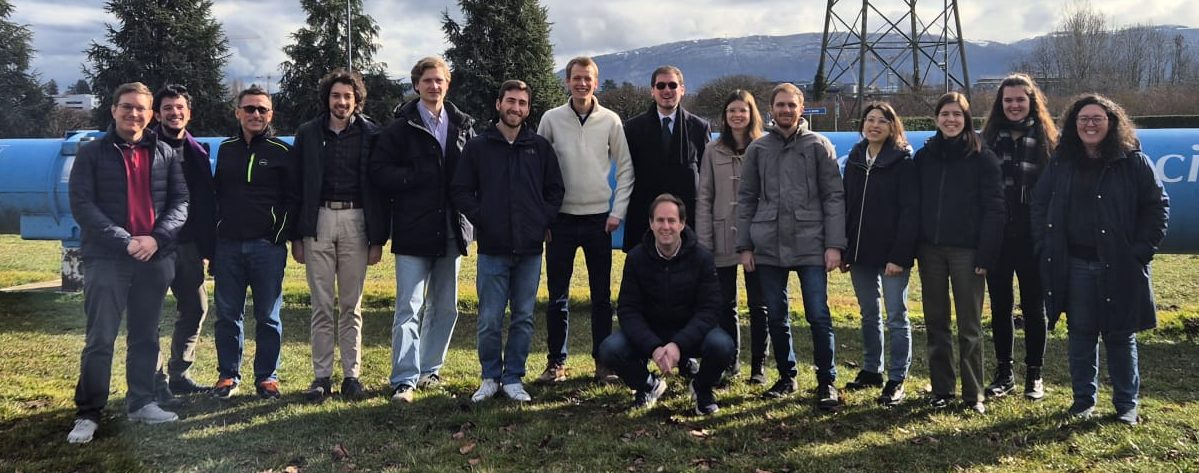
This week the SMEFiT Collaboration held a long-overdue general meeting at CERN to review recent progress, assess the status of ongoing projects, and plan the next steps. SMEFiT is a global analysis framework, with strong contributions from Nikhef and VU Amsterdam, that interprets measurements from LEP and the LHC within the SMEFT and in terms of UV completions of the Standard Model matched onto it. Much of our recent work has focused on comparative studies of future colliders — quantifying their reach for key targets such as the self-interactions of the Higgs boson — and on deploying state-of-the-art theory calculations, including renormalisation-group-evolution effects that produce an even richer, and often counter-intuitive, pattern of correlations between processes and the parameters of the EFT.
Over two days of energetic discussion we addressed which datasets should take highest priority; how to go beyond dimension-six operators; how best to use the SMEFT to fingerprint possible BSM anomalies; how to connect with low-energy data; how to interface AI-assisted optimal observables; and how to extend SMEFiT to further targets such as the global electroweak fit — alongside the technical but essential matters of code development, improvements, and speed-ups, since exploring a parameter space of more than 60 dimensions is no walk in the park.
It was especially encouraging to see the PhD candidates and postdocs in the collaboration take the lead in many of the discussions, communicating a clear and ambitious vision for the EFT program at the LHC and beyond. I learned a great deal, and look forward to seeing which projects come to light in the coming months.
Many thanks to Fabio Maltoni and the CERN-TH secretariat for their help with the local organisation.


Leave a Reply