Thrilled to share that my ERC Advanced Grant project UNICORN “UNlocking the strong Interactions with COllideR Neutrinos” has been awarded. The five-year project will be hosted at the VU Amsterdam and embedded in the Nikhef Theory Group, and will support a team of several PhD candidates postdoctoral researchers starting in late 2026.
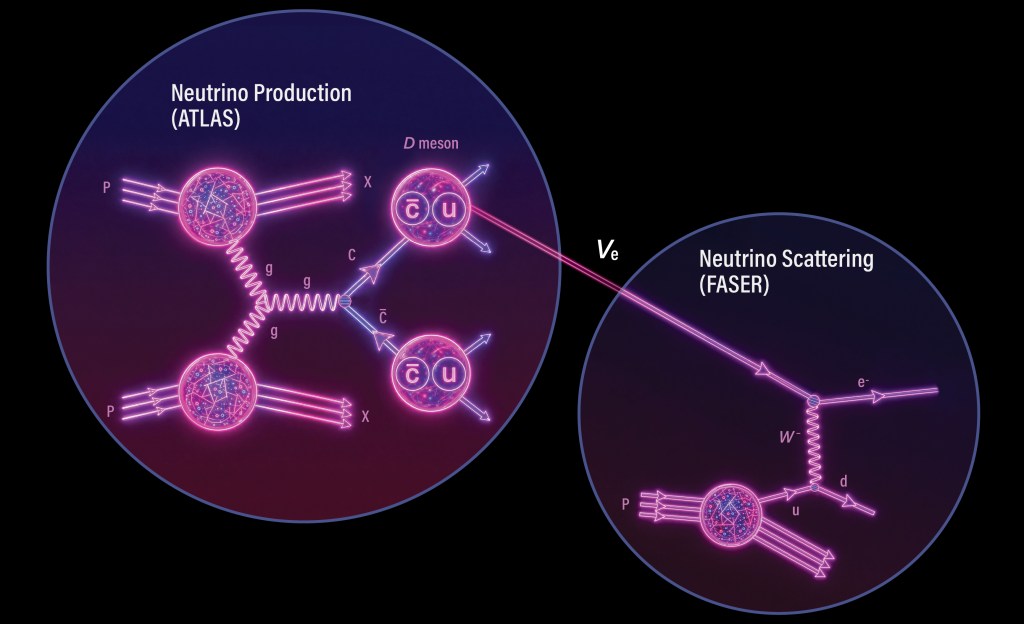
For 15+ years, the intense flux of high-energy neutrinos produced in the forward direction at the LHC went undetected. Their observation in 2023 by the FASER and SND@LHC experiments opened a new “collider neutrino” era, giving access to the highest-energy neutrinos ever produced in a laboratory. UNICORN will build a comprehensive theoretical framework needed to model their production and scattering, combining state-of-the-art QCD calculations, Monte Carlo simulations, and machine learning, and apply it to the full FASER and SND@LHC Run 3 datasets, as well as laying the groundwork for a thriving LHC neutrino program at the High-Luminosity LHC. In a nutshell, UNICORN will transform FASER and SND@LHC into precision microscopes to unravel proton structure. Exploiting LHC neutrinos now is a once-in-a-lifetime opportunity, with no comparable experiment expected before the 2070s.
The scientific payoff of UNICORN reaches well beyond the strong interactions. Sharper knowledge of proton structure feeds directly into precision predictions for Higgs and electroweak physics at the High-Luminosity LHC and into searches for New Physics, while data-driven control of the prompt atmospheric flux supports the interpretation of neutrino telescope observations such as the 120 PeV event recorded by KM3NeT, the most energetic particle ever detected.
With UNICORN, I will:
- carry out a data-driven extraction of the LHC forward neutrino fluxes, with full energy and rapidity dependence, to stress-test QCD models of forward particle production and validate explanations of the cosmic-ray muon puzzle;
- turn the neutrino fluxes from charm decays into high-resolution probes of small-x QCD, constraining the gluon down to momentum fractions of x around ten to the minus seven, searching for non-linear and BFKL dynamics, and delivering precise predictions for the prompt atmospheric flux at neutrino telescopes;
- measure neutrino and muon deep-inelastic scattering structure functions at TeV energies and includes them in the NNPDF global analysis of proton structure, yielding improved predictions for Higgs and electroweak observables and PDFs tailored to New Physics searches; and
- develop state-of-the-art event generators for neutrino and muon DIS combining higher perturbative accuracy with data-driven tunes, and integrates it with Neural Simulation-Based Inference techniques to extract optimally sensitive, unbinned observables from FASER data.
Join the team
Vacancies for PhD candidates and postdoctoral researchers supported by UNICORN will be announced soon on the Nikhef jobs portal. Stay tuned!


Leave a Reply