Can we discover New Physics through Precision at Future Colliders such as CERN’s Future Circular Collider?
We can but we need to use a multi-pronged approach, since searching for new physics at the FCC-ee will be very different than at the (HL-)LHC!
With the European Strategy for Particle Physics 2026 now concluded and the FCC-ee emerging as the preferred candidate for the next major collider, quantifying its physics potential in a rigorous and reproducible way has never been more important. That is exactly what our new paper sets to do:
https://inspirehep.net/literature/3147037
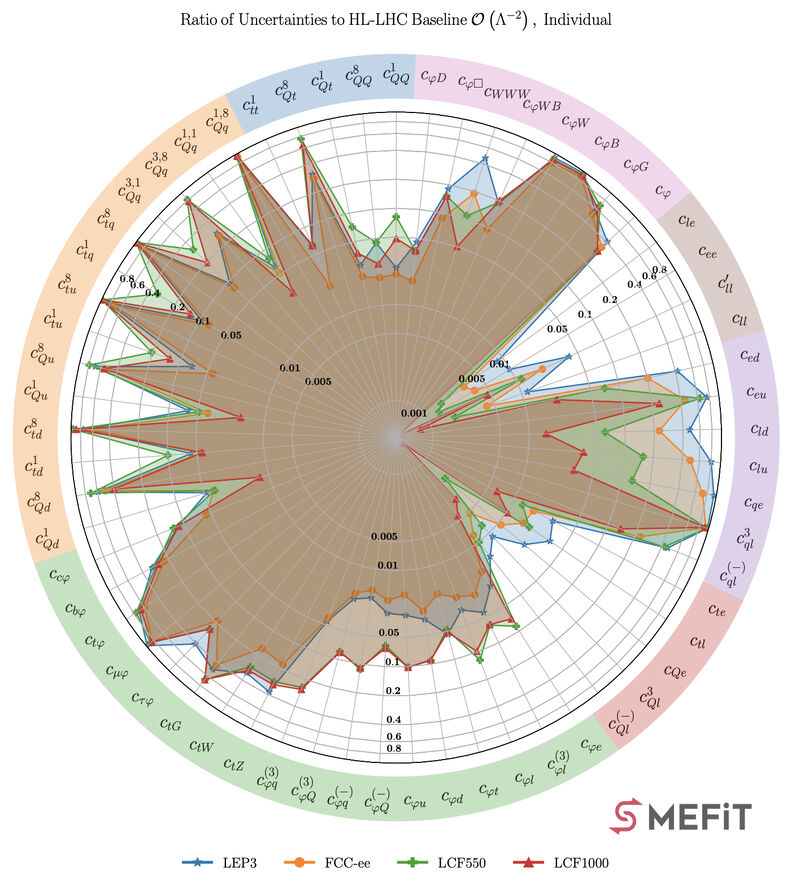
Together with my amazing #SMEFiT collaborators Tommaso Armadillo, Eugenia Celada, Jaco ter Hoeve Fabio Maltoni Luca Mantani Alejo Rossia Simone Tentori Marion Thomas and Eleni Vryonido, we present a state-of-the-art global analysis of the new physics reach of FCC-ee, benchmarked against other future colliders options such as LEP3 and the Linear Collider Facility. Results in the global SMEFT fit, coupling modifiers, and effective couplings are presented, as well as exclusion bounds for representative UV complete models matched to the SMEFT.
Along with the physics results, we release an updated version of the open source SMEFiT framework (https://smefit.science/) that allows every result in this paper to be fully reproduced, extended, and customised. Users can add new collider options, observables, or UV models with minimal effort. If you work on future collider phenomenology, this framework may be interesting for you for you!
The headline physics message: FCC-ee is a uniquely powerful machine for new physics searches, driven by the extraordinary precision of its Tera-Z run and the combination with the 240 and 365 GeV runs through quantum EFT effects.
A big shout out also to Jorge de Blas for many illuminating discussions about the corresponding HEPfit studies, to CERN Theory Division for their support while part of this work was being carried out, to Nikhef (National Institute for Subatomic Physics) for many exciting discussions on future collider, and to many other colleagues for suggestions and encouragement.
A milestone for the FCC-ee physics program – laying the groundwork for a new generation of future collider studies.


Leave a comment