Category: News

  • SMEFiT Collaboration meeting at CERN

    Effective Field Theories such as the SMEFT and HEFT have become an almost unavoidable component of the modern particle physicist’s toolbox. They provide access to New Physics at high scales, beyond the direct reach of particle colliders, by exploiting the subtle quantum effects that connect processes taking place at very different energies. At the LHC, EFT-based analyses are already becoming competitive with direct (resonance) searches for new physics, and at future facilities — such as the Future Circular Collider (FCC-ee) operating in its electron–positron mode — they will provide a unique microscope (or better, attoscope) in the quest to find what lies beyond the Standard Model.

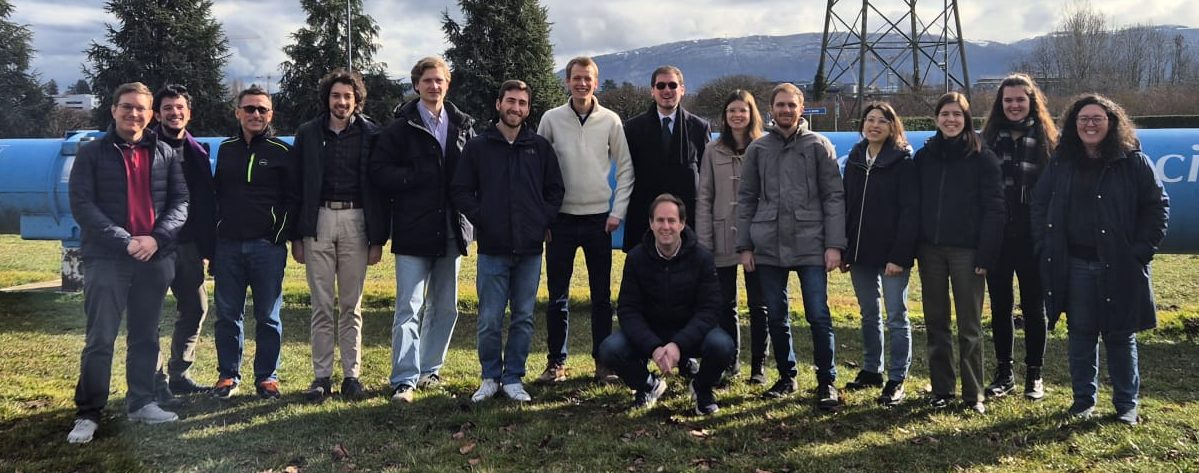
    This week the SMEFiT Collaboration held a long-overdue general meeting at CERN to review recent progress, assess the status of ongoing projects, and plan the next steps. SMEFiT is a global analysis framework, with strong contributions from Nikhef and VU Amsterdam, that interprets measurements from LEP and the LHC within the SMEFT and in terms of UV completions of the Standard Model matched onto it. Much of our recent work has focused on comparative studies of future colliders — quantifying their reach for key targets such as the self-interactions of the Higgs boson — and on deploying state-of-the-art theory calculations, including renormalisation-group-evolution effects that produce an even richer, and often counter-intuitive, pattern of correlations between processes and the parameters of the EFT.

    Over two days of energetic discussion we addressed which datasets should take highest priority; how to go beyond dimension-six operators; how best to use the SMEFT to fingerprint possible BSM anomalies; how to connect with low-energy data; how to interface AI-assisted optimal observables; and how to extend SMEFiT to further targets such as the global electroweak fit — alongside the technical but essential matters of code development, improvements, and speed-ups, since exploring a parameter space of more than 60 dimensions is no walk in the park.

    It was especially encouraging to see the PhD candidates and postdocs in the collaboration take the lead in many of the discussions, communicating a clear and ambitious vision for the EFT program at the LHC and beyond. I learned a great deal, and look forward to seeing which projects come to light in the coming months.

    Many thanks to Fabio Maltoni and the CERN-TH secretariat for their help with the local organisation.
  • From HEP to Quantum Science in Abu Dhabi

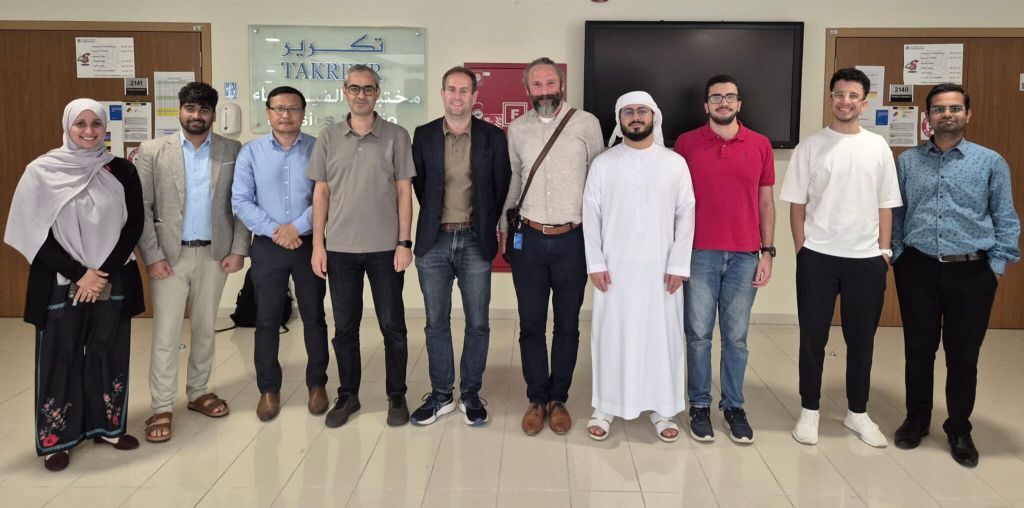
    I had the pleasure of visiting two great scientific institutions in Abu Dhabi, on a trip that brought together particle physics, astroparticle physics, and quantum science.

    At Khalifa University I was warmly hosted by the (astro-)particle physics groups of Arjen van Vliet, Rachik Soualah, and colleagues. Although a relative newcomer to high-energy physics, Khalifa University already has active groups in major particle and astroparticle physics experiments, from ATLAS to KM3NeT, and is involved in CERN’s efforts towards future colliders such as the Future Circular Collider. I gave the Physics department colloquium on recent progress in particle physics, with a focus on collider neutrinos at FASER and its planned upgrades, which open new windows onto the neutrino sector, hadron structure, and quantum chromodynamics, and which inform theoretical predictions and simulations for astroparticle physics experiments.

    I also visited, one day before, the Center for Quantum Research at the Technology Innovation Institute, a centre set up just a few years ago, in part from scratch, by my PhD advisor José Ignacio Latorre, and which now hosts outstanding groups across quantum software, computing, communication, and sensing. In my colloquium there, “HEP meets Quantum science and technology”, I presented recent developments at the interface between particle physics and quantum science: quantum-information ideas as new guiding principles in particle physics, such as the maximal entanglement principle proposed a few years ago together with José Ignacio Latorre, Alba Cervera-Lierta, and Luca Rottoli; tests of quantum mechanics at the energy frontier through entanglement in top-quark pair production at ATLAS and CMS; and the intrinsic charm content of the proton, where machine learning lets us probe the quantum wave function of the proton.

    These visits were full of stimulating discussions, and they left me optimistic about the future of quantum science and high-energy and astroparticle physics in the United Arab Emirates: with continued investment in fundamental science and technology, the local institutes are well placed to play an important role in global efforts in the coming years. I am grateful to my hosts at Khalifa University and the Technology Innovation Institute for their warm welcome, and I look forward to returning to visit these groups again.

  • SEARCH2025 at CERN

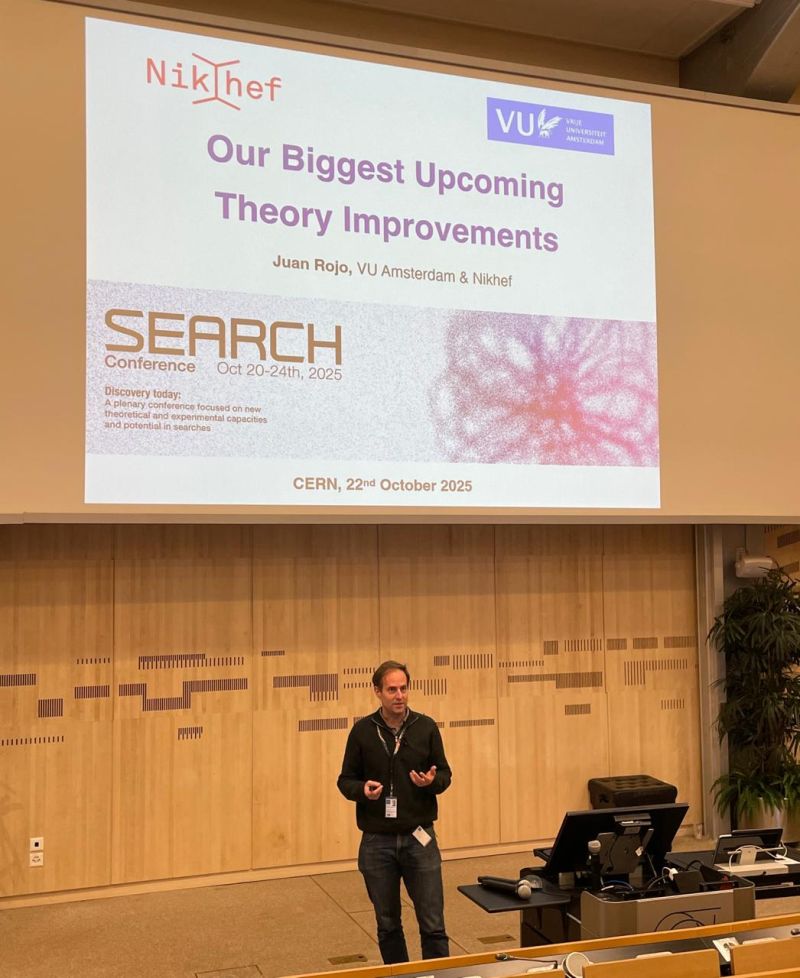
    This week I had the pleasure of participating in the new edition of the SEARCH 2025 conference at CERN, a stimulating event exploring the discovery potential and breakthroughs of high-energy physics experiments such as the Large Hadron Collider and its High-Luminosity upgrade, with ample time for joint brainstorming and discussion among the participants.

    As part of the “Putting precision and searches together” session, I shared some thoughts on how theory, understood in the broad sense, is shaping the future of particle physics searches. I discussed how the boundary between measurements and searches is increasingly blurred, and how we should exploit this to our advantage. Advances in precision QCD, parton distributions, SMEFT interpretations, and AI-driven observables all play a key role in pushing the LHC’s discovery reach, in most cases well beyond the wildest projections that were on the table when the LHC was first conceived. These are exciting times for high-energy physics, as theory and experiment work more closely than ever to bridge precision and discovery in both directions.

    Many thanks to the SEARCH 2025 organizers for an inspiring meeting, and in particular to Monica Dunford and Maurizio Pierini for their kind invitation!

  • NNPDF Collaboration Meeting: Morimondo 2025

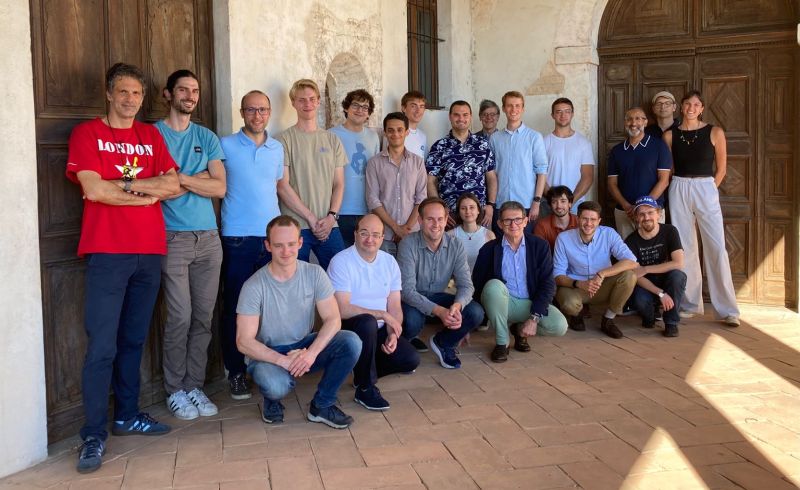
    I had a wonderful time at the yearly NNPDF Collaboration meeting, held in the beautiful abbey of Morimondo. It was a stimulating few days discussing recent progress and future plans within the NNPDF framework, ranging from the implementation of new datasets from ATLAS, CMS, and LHCb, to higher-order theoretical calculations and the development of novel machine learning techniques to keep unraveling the fascinating inner world of proton structure.

    Special thanks to our invited speakers for their great and inspiring talks: Tilman Plehn (on accurate and uncertainty-aware ML for LHC physics), Robert Schöfbeck (on unbinned measurements for optimal parameter inference), and Eram Rizvi (on precision PDFs at ATLAS for electroweak and EFT analyses). Their lively contributions brought many new ideas to the discussion, and as usual the challenge will be to decide which ones to pursue.

    We also welcomed many new colleagues to the NNPDF community, in particular our two new PhD candidates at Nikhef and VU Amsterdam, Jelle Koorn and Kamil Laurent. Welcome to the team, and looking forward to lots of great QCD and ML science together. The study of QCD and proton structure remains utterly fascinating, and the best may be yet to come.