As I discussed in a previous post, the precision mapping of the properties of the Higgs boson should be, without the shade of a doubt, one of the main scientific drivers of any future high-energy collider that might operate in the post-LHC era. Powerful as the LHC is, and despite remarkable breakthroughs both from the theory and experimental sides in recent years, there is a limit to how well we can probe the Higgs boson sector at the LHC: proton-proton collisions are messy, and here one is aiming at per-mille level measurements of the Higgs boson interactions, at least an order of magnitude improved as compared to what the LHC can provide. The goal of this post is an attempt to summarise the main pros and cons of one of the possible options to fingerprint the Higgs particle with unprecedented precision: a high-energy, high-luminosity electron-positron collider.
In this respect, there exist basically two main ways which one can consider to improve our understanding of the mysteries of the Higgs boson, as compared to what will be the legacy results of the LHC (including its upcoming High-Luminosity upgrade). The first way would be to adopt the same strategy of the LHC, namely to collide energetic beams of protons among them, but this time increasing the total available energy as well as the number of collisions that take place in a given interval of time (the so-called luminosity). This approach would ensures that a sufficiently high number of Higgs bosons would be produced, allowing physicists to study its properties in great detail. However, this high-energy hadron collider road is a difficult one to travel, requiring significant investments both in the development of high-field magnet technology and in civil engineering. In the latter case, the reason being that such extreme energies would require a much larger tunnel, of the order of 100 kilometers, dwarfing the already huge LHC tunnel with its 27 km of circumference.
The option of a high-energy proton-proton collider is being considered both at CERN, in the context of the Future Circular Colliders (FCC) study, and in China, in the framework of the CEPC/SppC collider project. The powerful physics case of the FCC has been spelled out in great detail here, and the one for the Chinese project shares many similarities. In addition to a significantly extended reach for the production of new heavy particles at high energies, these machines have a solid program of guaranteed deliverables, including the demonstration beyond any doubt that the Higgs boson gives mass to the fermions of the second generation and that it interacts with itself as predicted by the Standard Model, discovering or excluding thermally-produced WIMPs (weakly-interacting matter particles) as the dominant component or Dark Matter, and understanding what was the order of the electroweak phase transition of the early Universe.


As mentioned above, one limitation that affects the ultimate potential of proton-proton colliders for high-precision measurements of the Higgs boson properties is that often the processes of interest (which physicists call their signal) are buried into an overwhelming amount of other processes (known as background or noise) that muddle the interpretation of the results. For example, at the LHC these background processes can be found to happen thousands or even millions of time more frequently that the sought-for signal processes. In particular, the fact that the LHC is actually a quark and gluon collider (protons themselves are not fundamental objects, but instead composed by quarks and gluons) implies that processes driven by the strong interaction will appear frequently, complicating the study of those particles that are produced at a much slower rate such as the Higgs boson.
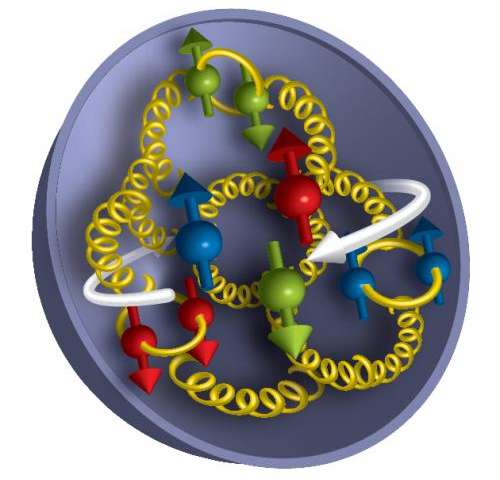
However, in the collisions between electrons and their antiparticles, the positrons, the situation turns out to be rather different. Electrons and positrons are fundamental particles, without any (at least that we know!) internal substructure. Moreover, electrons and positrons interact only via the electromagnetic and weak forces, implying that the background process arising from the strong force that are ubiquitous at the LHC will be now less important when colliding electrons with positrons. Electrons and positrons, as well as their heavier siblings the muons and tauons and the ghostly neutrinos, belong to the class of so-called lepton particles, from the Greek term for small. Of course, the fact that lepton colliders are excellent machines for particle physics has been known for a long time, and they have a long story of momentous discoveries, such as that of the gluon in DESY’s PETRA accelerator for which we are today celebrating its 40th anniversary.
CERN’s Large Electron Positron collider (LEP), the predecessor of the LHC, is to date the highest energy lepton collider that has ever operated, reaching a world-record center of mass energy of 209 GeV. I think it is fair to say that LEP discovered the Standard Model (SM) of particle physics, in particular establishing that the structure of the interactions between the W and Z bosons is indeed the one tightly predicted by the gauge symmetries of the SM, and demonstrating beyond any doubt that the strong interactions are indeed described by a quantum field theory, Quantum Chromodynamics (QCD).
Concerning the production of Higgs bosons at electron-positron colliders, there are different processes that can lead to these elusive particles appearing in the detectors of the experiment. Depending on the specific centre of mass energy of the collision, some of these production modes will dominate with respect to the others. A particularly sweet spot appears at an energy of around 250 GeV (around twice the Higgs mass, which is mH=125 GeV), where the cross-section for the production of a Higgs boson in association with a Z boson has the largest possible value, implying that the number of produced particles will be maximised. This process, depicted schematically in the figure below, is very interesting for many reasons. Perhaps the most important factor is that if one observes a Z boson in the detector with a specific value of its energy, it is possible to determine that also a Higgs boson was produced in the same event, without the need of actually detecting it. This crucial feature allows lepton colliders to carry out unique model-independent measurements of the Higgs properties. One important example of such is to assess whether or not the Higgs boson sometimes decay into invisible particles beyond the Standard Model (something that would be almost impossible in the much messier environment of proton-proton collisions).

Interestingly, this sweet spot with a collision energy of 250 GeV is only a bit above the 208 GeV that LEP achieved at the end of its operations, and indeed a somewhat more powerful version of LEP might have been able to discover the Higgs boson before ATLAS and CMS did in 2012. Actually, in the last year of LEP’s operations, there were claims that the Higgs boson might already have been observed, and some people even proposed to delay the LHC to further investigate this possibility. As it turned out, these claims were based on a fluke (statistical fluctuations based on low number of events) and with hindsight it was the right decision back then to dismantle LEP to allow the installation of the LHC.
Given the very strong scientific motivation to build and operate a high-energy lepton collider (first and foremost as a Higgs factory, but also to produce and test at extreme levels the other heavy particles of the Standard Model such as the W and Z bosons and the top quark), several groups and collaborations have put forward more or less detailed plans for such a machine. Perhaps the most advanced proposal is the International Linear Collider (ILC), to be built in Japan and for which the technology is readily available – the ILC tunnel could start to be built tomorrow (to first approximation) if the project was funded. The ILC is now under intense scrutiny by the Japanese government and its scientific agencies, and a final decision about whether or not the project will go ahead or will be scrapped could take place any time now. Given the hefty price tag of the ILC (although not particularly different from other Big Science projects in physics and astronomy), it is highly unlikely that Japan would carry all the financial burden of this project by itself and most likely a cooperation with international parties, CERN in primis, will be required if the ILC is ever to become a reality. The ILC would be a staged collider, starting with an energy of 250 GeV which can be upgraded by up to 1 TeV by increasing the length of its tunnel.
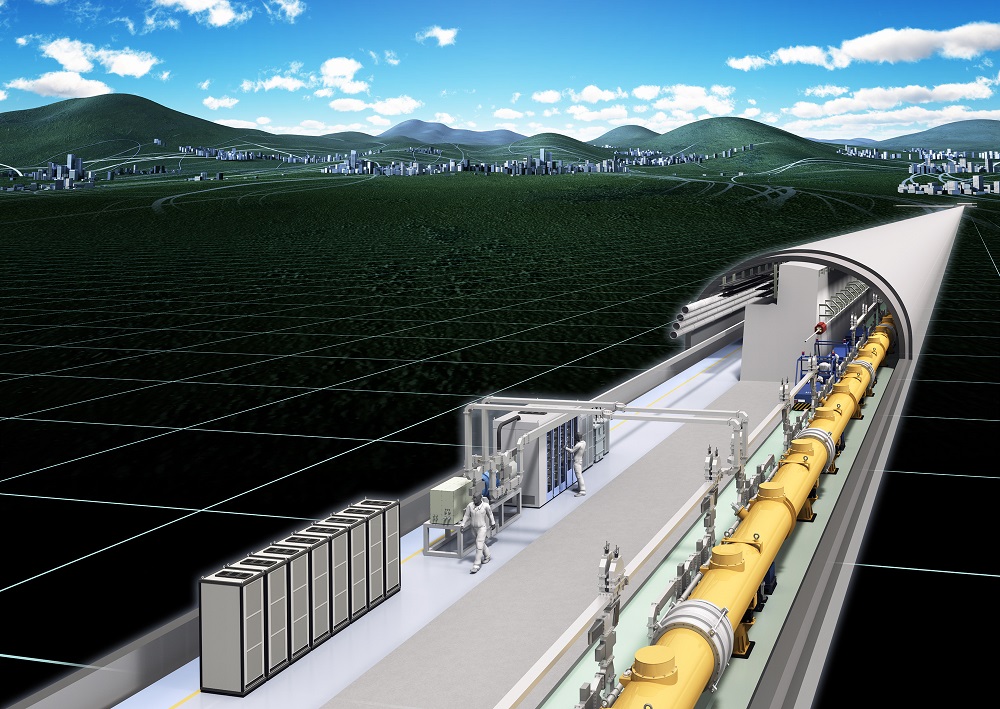
As the attentive reader might have noticed, the main difference between LEP and the ILC is the geometrical configurations of their tunnels: while LEP operated in a circular tunnel (again, the same as where the LHC operates now), the ILC would be based on a linear tunnel. Each configuration has pros and cons: circular colliders can achieve higher luminosities and have multiple interaction points (where detectors are actually installed), but the maximum energy they can reach is limited by synchrotron radiation. Linear colliders instead have somewhat smaller luminosities and at most two detectors can be accommodated, but on the other hand they can be easily extended to increase the centre of mass energy.
Another proposal for a linear collider, similar in spirit to that of the ILC but based on a rather different technology, is the Compact Linear Collider (CLIC). The compact adjective in its name needs to be taken with a (big) grain of salt though, since in its most powerful incarnation, able to collide electrons and positrons at energies of 3 TeV, CLIC would require a 50-kilometer tunnel running alongside the Jura mountains and connecting to first approximation the cities of Geneva and Lausanne. In terms of energy reach, CLIC is by far the most powerful proposal on the table, achieving a factor 10 more energetic collisions that the initial phase of the ILC. This said, unless we discover evidence for new weakly interacting particles at the few TeV scale, for example from the analysis of the LHC data, being able to eventually probe the such high scales might not add much to the overall physics results of the collider. In terms of guaranteed returns, as for the other lepton colliders, the main scientific goals of CLIC would be to accurately probe the behaviour of the Higgs bosons and of the other heavy SM particles such as the top quark.

The main alternative to a linear lepton collider would be the circular configuration, which so succesful was at LEP and other previous colliders. However, as mentioned above, at LEP the maximum energy that could be achieved was ultimately limited by a fundamental factor such as synchrotron radiation. This implies in turn that the only way to further increase the energy of a lepton collider in a circular configuration as compared to LEP would be to increase its size rather dramatically, in other words, having some sort of LEP on steroids. One difficulty here is that building a sufficiently large tunnel would have a price tag of several billion Swiss francs, and it is thus an investment which is challenging to justify by itself. This is way the two high-energy circular electron-positron colliders that have been proposed, CERN’s FCC-ee and the Chinese CEPC, would operate in the same 100 km tunnel that would be used subsequently to host a 100 TeV proton-proton machine. Both colliders have a similar physics program as their linear counterparts, and while they benefit from higher luminosities (remember, this is a measure of how many collisions take place in a given time) they are ultimately restricted on how far they can go in energy. According to the proponents of these circular machines, the increase in total luminosity offsets the benefits of an increased center of mass energy that (eventually) can be made available in linear colliders. Indeed, if your main physics goal is to indirectly probe tiny distances by means of precision measurements of the properties of the Higgs and W,Z bosons and of the top quark, a very high number of collisions (the luminosity) matters more than the total energy, provided you are above the corresponding production thresholds.

Taking into account all these various considerations, I would say that there is a clear consensus in the community that a high-energy high-luminosity electron-positron collider is crucial for the future of high-energy physics. The question of course is which one, where, and when? Again, there are pros and cons of each proposal, and the ultimate decision will have to weight not only scientific factors but also financial and political ones. For instance, the FCC-ee proponents advocate that their project paves the way to the 100 TeV hadron collider, since then the tunnel will be already built, and that operations can start as soon as the HL-LHC data-taking is complete, ensuring thus a continuity in the energy-frontier accelerator program at CERN. But the Japanese option could also start construction as soon as the project is approved, and this approval will most likely require investments (either in cash or in kind) of other partners such as CERN. And then one has the Chinese wild card: they might have the financial capability to push forward this project (both the lepton collider CEPC and its hadron successor SppC) on their own, but it remains to be seen that all the required infrastructure (basically recreating CERN from scratch) can be assembled in time. What would then be best option for the global high-energy physics community and for fundamental science in general? This is the million-dollar question, and like all complex questions, there is no easy and quick answer, and all points of views and arguments need to be carefully considered.
To summarise, the lepton collider debates are a fascinating discussion and we should stay tuned for news, since crucial developments and decisions are expected to take place in the next few months in one direction or the other. In this context, the discussion of the various options is deeply intertwined, since while there is a clear and significant physics potential for building a high-energy lepton collider, once one of such facilities becomes available then the interest for a second one would decrease considerably. Therefore, as in Highlander, I would say that at the end of the day only one of these proposals can remain and be realised (of course, if we end up with more than one it would be even better). Irrespective of what option is ultimately selected, it would be a tremendous success for high-energy physics and for fundamental science that we, as a global community, are able to agree and realise such machine, and thus crack open the mysteries of the Higgs boson and hopefully unlock the way to a deeper theory that addresses some of the shortcomings of the Standard Model.





 can be probed in two different ways, as shown schematically below. On the one hand, one can access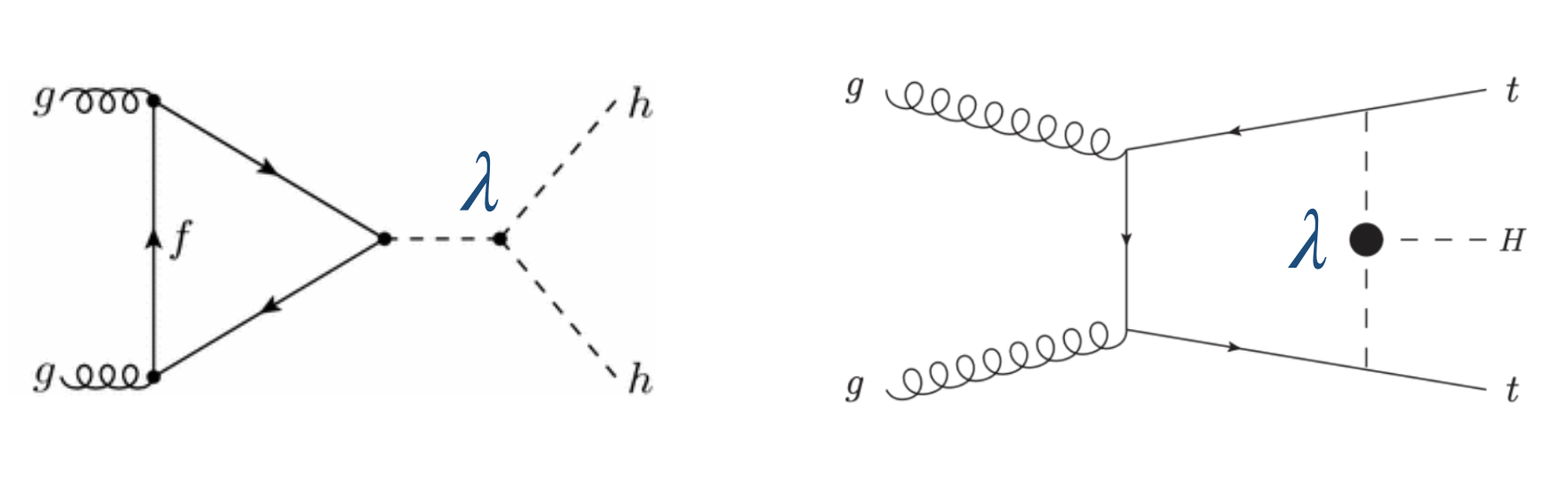




 ) improves at the post-fit level, that is, once the PDFs are readjusted to match the change in underlying theory as compared to the SM assumption. The effect is not dramatic but noticeable, showing that yes, indeed, partially new physics effects can be absorbed into the PDFs.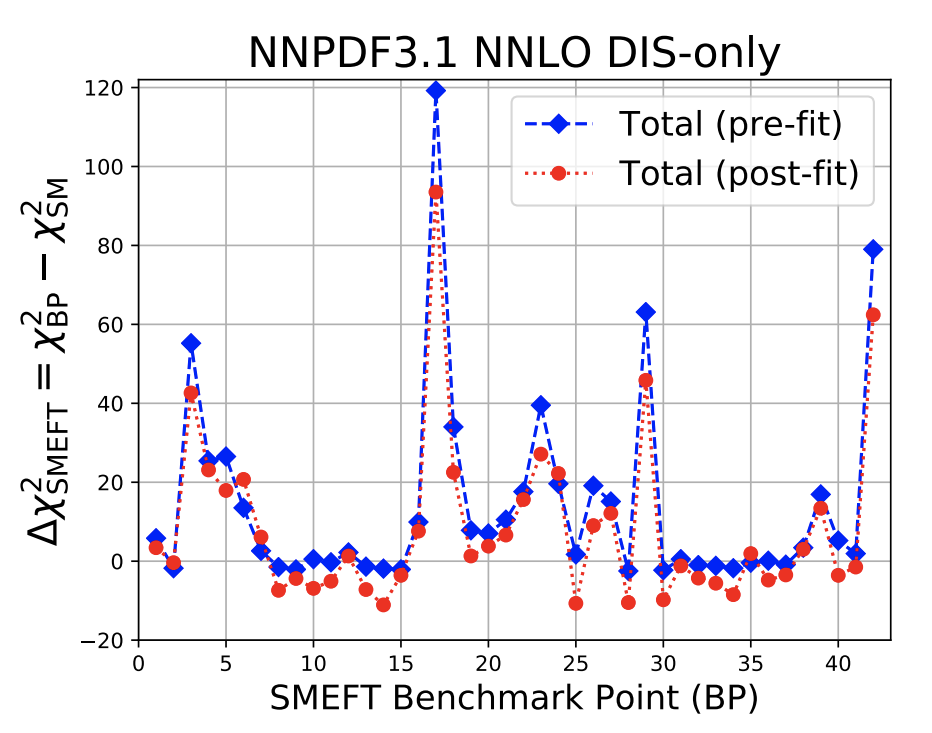
 we expect differences that scale as
  , while in the case of SMEFT corrections, they scale as
  . In the previous equations,
  is the typical mass scale of the strong interactions (basically one third of the proton mass) while
  is the (unknown) energy scale where new physics beyond the SM appear. And indeed, if one plots the fit quality as a function of the energy of the process, one observes a very different trend in the case of the Standard Model (feeble dependence with the energy) and in the SMEFT case (strong sensitivity to changes in the energy). Such trend would be the smoking gun to disentangle QCD and new physics effects within the global fit.