Author: Juan Rojo

  • Should I stay or should I go (after the PhD)? Some reflections on the post-PhD life in particle physics.

    These are certainly complicated times for early career researchers (ECRs) in all domains of science. To begin with, the ongoing COVID-19 pandemic has slowed, when not ground to a halt, a significant fraction of all research activities, and has affected in particular laboratory-based work. These COVID-related restrictions will inevitably cause important delays in the ECR careers, whom by definition struggle with temporary contracts and job insecurity. A delay of a few months (in the best case) might leave students without the necessary research time to wrap up their PhD theses or to prevent postdocs to publish that landmark paper that would increase their chances of finding the next academic position. To make things worse, many universities and research institutions have put in place a staff hiring freeze that could remain for months or years. Such hiring freeze further diminishes the chances of landing one of the few, extremely competitive, and coveted tenure-track positions available. And this goes without mentioning the associated travel restrictions, which might make attending a job interview all but impossible depending on the countries involved.

    And it does not end up here. Despite all the praise and commendation about the crucial role that research and innovation should play to address the ongoing pandemic (and to prevent the next one) as well as to contribute to the economic rebound by bolstering a knowledge-based society, R&D investments remain far from being a top priority for politicians at all levels. This unfortunate state of affairs has been again confirmed recently by the output of the negotiations for the new EU budget, which have slashed the R&D spending by an unprecedented amount, with potential long-lasting consequences for the European research and innovation ecosystem. While these dismal developments hurt of course the whole scientific community, they are specially harmful for ECRs, whom more often than not rely on external funding to kick-start their careers as independent PIs and to carry out their research programs. The plummeting success rate of grant applications is already one of the major problems affecting science, and this problem is bound only to get only worse in Europe, at least if the proposed cuts to the EU research budget are not reverted by the European Parliament.

    Given this apparently gloomy situation, why on Earth would someone attempt to pursue a career in science? What is this motivation that still pushes brilliant and energetic students to start a PhD and then follow a scientific career? What are the reasons that justify such decision and overcome the many concerns related to the dismal prospects of the academic job market and the ever-thinning chances of being able to secure research funding?

    I thought that this was the kind of question that we as scientists should attempt to answer in a (somehow) quantitative way. Fortunately, a valuable statistical sample was already available that provided some interesting information about the question raised in the title of this post. In December 2019, during the traditional yearly get-together of Nikhef (the Dutch Institute of Subatomic Physics), also known as the Nikhef Jamboree, the members of the PhD council arranged an interesting survey among our student population. The goal of this survey was to collect their views over the perspectives (or the lack thereof) of a career in science, the pleasures and pitfalls of the PhD supervision process, and their perspectives concerning the general picture of science organisation nowadays.

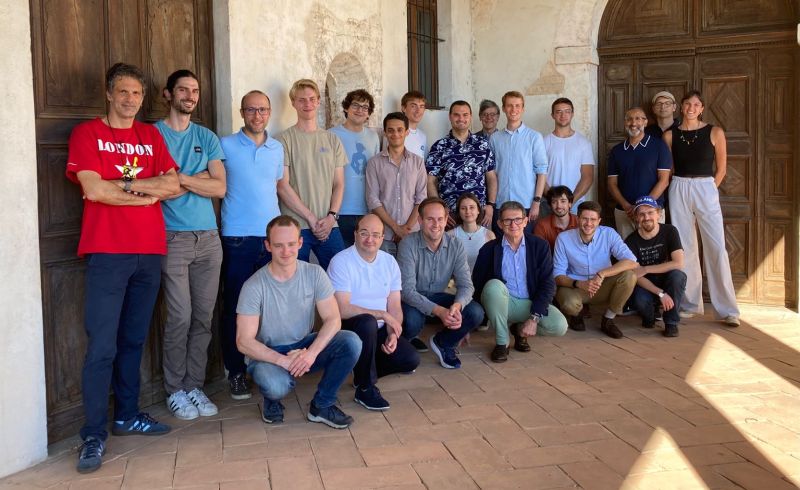
    The Nikhef community in full during its last year general assembly, the Jamboree, back in those by now almost-forgotten times where hanging out together in densely-packed gatherings was the traditional convention about how this kind of scientific meetings should be held.

    With the authorisation of the Nikhef PhD Council, I reproduce here some of the representative results of this survey and comment on their main findings, together with some personal reflections based on my experience and anecdotal evidence (needless to say, this is not an scholarly analysis, so bear with me for the lack of references 😉 ). More than half of our large student population answered the survey, which provides some sensible degree of representativeness to the results (I have seen published scientific papers with smaller sample sizes!). While of course this sample corresponds to a very specific research field (particle physics), I believe that the general conclusions would not be too different were PhD students of other disciplines to be consulted.

    The first question was the money question: would you like to continue in science after your PhD? Traditionally, such question would have seemed laughable, since the only reason one would ever do a PhD was to attempt a subsequent career in science. The situation is completely different nowadays, with follow-up careers in (academic) science being the exception rather than the norm for PhD graduates. While around 40% of the surveyed students declared an interest to continue in science after their graduation, 18% on the other hand were done with research and planned to do something else. Everyone else, 42% of our PhD students, was still undecided, which implies that they were still considering academic research as a sensible way forward for their careers. All in all, for more than 80% of the respondents there was the possibility of (scientific) life after the PhD.

    When asked about the reasons for why they would like to stay in science (note that multiple answers were allowed), more than 75% of the respondents replied that the love of physics was the main driver of their decision. And this is not completely unsurprising: with all the challenges and difficulties associated to the scientific adventure, being able to peer every day into the inner fabric of the Universe, discover genuinely new aspects of the fundamental laws of Nature, and contribute to the corpus of legacy human knowledge is certainly a most exhilarating experience. In short, science is fun, and the results of the survey indicate clearly that most of Nikhef’s PhD students thoroughly enjoy what they do for a living (at least so far). Other reasons that motivate a possible post-PhD career in science for which a majority of the survey respondents agreed were the intellectual challenges provided by their research environment and the flexibility of the working hours. Interestingly enough, grandiose (and pompous) visions of being the next Einstein (or its more realistic equivalent of ending up as a university professor with their own research group) were by far less popular. So in summary, physics is cool, intellectually challenging, and benefits from a freedom of inquiry that also brings logistical freedom to organise their own work.

    Physics is cool and challenging are the two main reasons why Nikhef’s PhD students would consider a follow-up career in research.

    From the answers above, I find particularly interesting that our PhD students mentioned the intellectual challenges of their research work as one of the main reasons that motivates them to attempt to stay in science. I raise this point since I often talk to former colleagues that have transitioned from academia to a career in consulting or commercial data science, and it is frequently pointed out to me that they miss the challenges of working in the really difficult problems, at the boundaries of human knowledge, literately trying to get where no one has reached before. Due to fully understandable constraints, data science work in companies (as an example of a popular non-academic career for STEM PhD graduates) often focuses on low-lying fruits and on lines of research that can provide quantifiable returns in the near (rather than the asymptotically far) future. Which is perfectly fine, and as far as the people I know one can pursue an extremely satisfactory and fulfilling career as commercial data scientist, but it is also true that the spark and thrill of discovering little by little new fundamental aspects of Nature is missing in that context.

    Remarkably, the importance of this factor (the intellectual challenge) to attract the best scientific minds (and thus achieve real breakthroughs) appears to have also been picked up by big companies such as Google, Facebook, or Amazon. Indeed, these behemoths are since recently basically recruiting shooting stars of the academic world (from AI to quantum computing) and paying them (a lot) to pursue their own research interests, with little to none restrictions from the upper management. The idea here being that if you have really brilliant and motivated (and of course also well funded) people around, the best way to ensure benefits for your company is leaving them alone to pursue what they believe is scientifically most interesting, and avoiding at all costs to micromanage them.

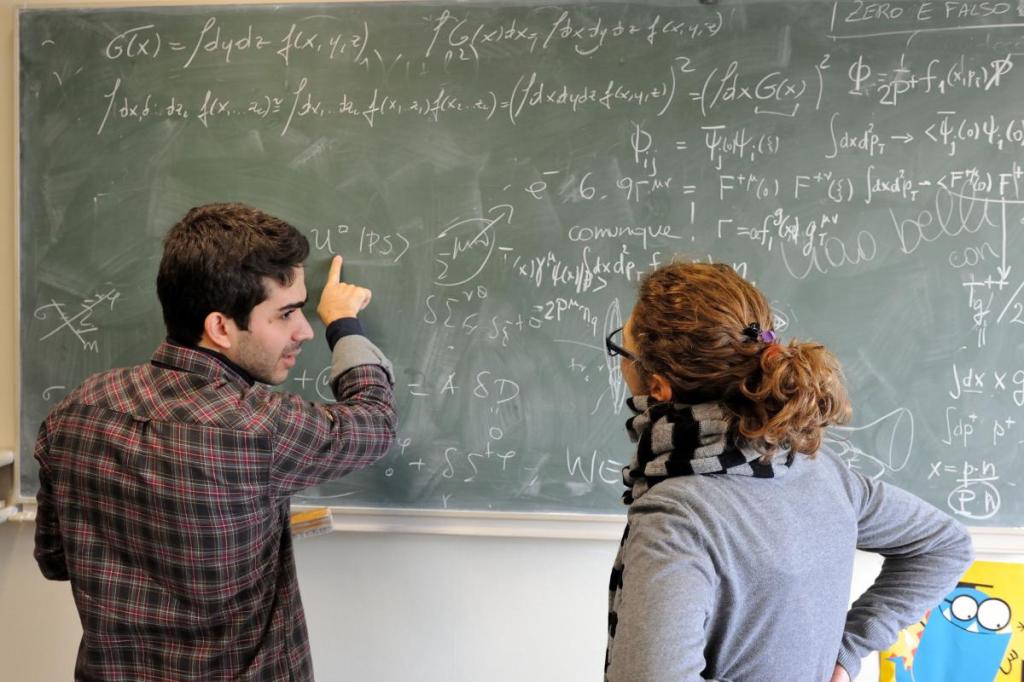
    Nothing embodies the idea of fun for (theoretical) particle physicists as lengthy scientific discussions in front of a large blackboard. Stereotypes notwithstanding, this is actually true. Photo credit: Nikhef.

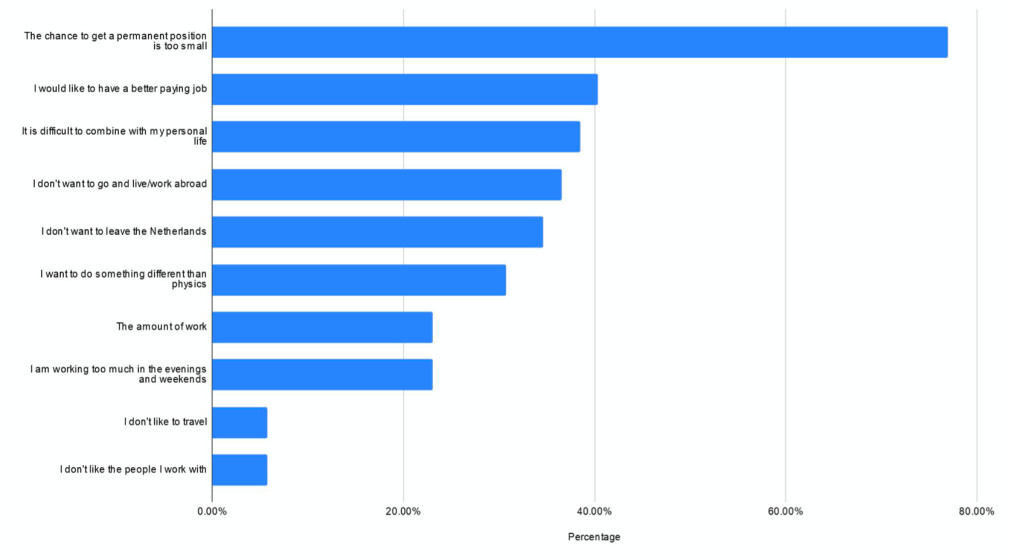
    Now, the above considerations applied for those of our PhD students that were planning to try to stay in science. What about, on the contrary, those 20% of students that had already decided to quit science as soon as they were done with their PhD, or perhaps earlier? Unsurprisingly, the overwhelming justification quoted by the respondents is the sheer lack of career perspectives in academia, namely the very limited chances of eventually securing a permanent job in science. And this is of course a very sensible consideration. Given that the number of tenure-track jobs has more or less remained unchanged (and in some countries even decreased) while the number of PhD graduates has been growing steadily, basic maths tells you that the competition for academic jobs is becoming fiercer and fiercer.

    What are the reasons PhD students have decided to drop science? First and foremost, the lack of career perspectives.

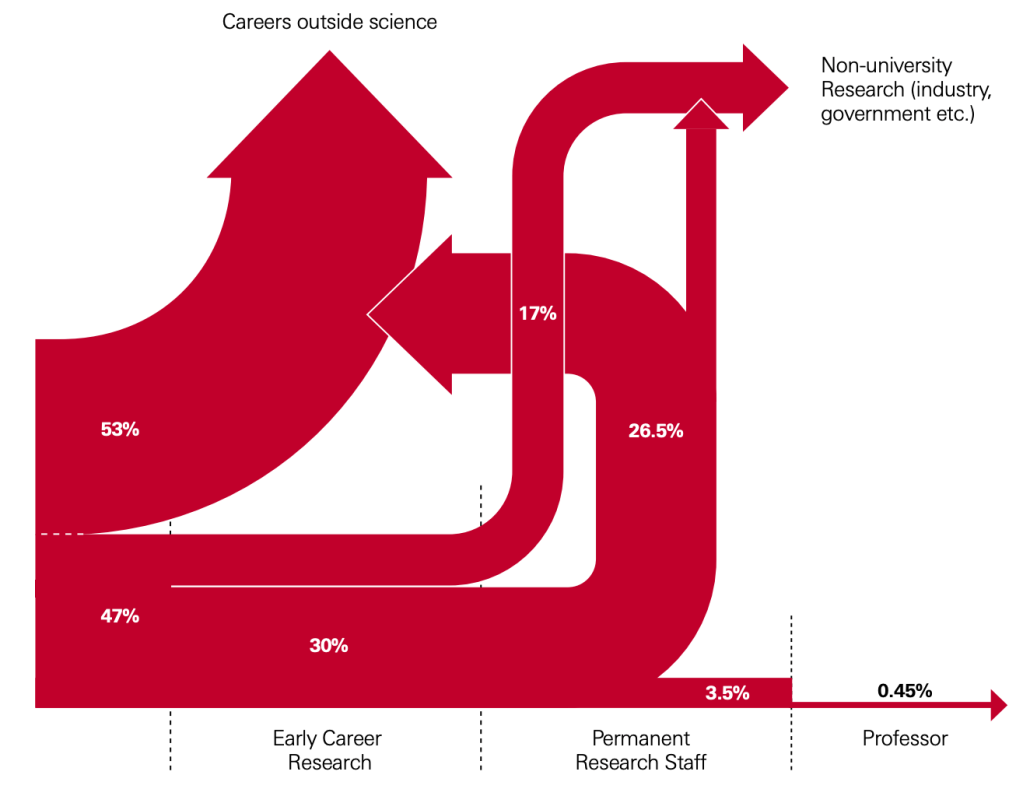
    There are different estimates and large variations by country and discipline (see also the Royal Society chart below) about the chances of getting a permanent job. However, one sensible ball park estimate is that no more than 10% of the PhD graduates will end up landing a permanent research position, and perhaps only 2% or 3% will ever each the university professor level. The fact that chances are not that great rings true even for graduates of world-leading universities: a survey of PhD graduates from the theoretical condensed matter group of the University of Oxford revealed that less than one third of their students ended up in academic jobs (source: informal discussions with a local academic colleague while we monitored our kids playing in the park). Actually, these career perspectives are even gloomier if one considers that after the PhD comes typically a long string of temporary research gigs (postdocs) often involving moving country before one can eventually land a tenure-track faculty job. So it not only that chances are small, also that, irrespective of the outcome, you are expected to spend several years in temporary jobs in different institutions. Further, not everyone plays under the same rule in this game: caring responsibilities and financial considerations often unfairly disadvantage some scientists at this stage of their careers. Again and again, the dismal situation of the academic job market and the lack of compatibility with personal situations and constraints are mentioned as the one of the main reasons to drop science after the PhD.

    A survey of the Royal Society based on the UK system revealed that PhD graduates end up overwhelmingly in careers outside science, and that the chances of landing a permanent research staff job at a university were at the few percent level at most.

    The second most frequent consideration pointed out by the respondents concerning the reasons to drop science was aiming to a better salary. I have to say that was a bit surprised to see this result in a survey from Dutch PhD students, which enjoy in comparison with most other countries very generous employment conditions and benefits. As someone who never earned more than 1000 euros per month (without benefits) during my PhD, the Netherlands offers outstanding work conditions for PhD students, though perhaps it is true that graduates can land better paying jobs outside academia. In this context, perhaps one should also point out that no one complained about physics being dull or boring or that the Nikhef research environment was not supportive. So even the reasons for leaving science are quite telling, imho, about the reasons why these respondents accepted starting a PhD to begin with, if one considers also the “missing” answers.

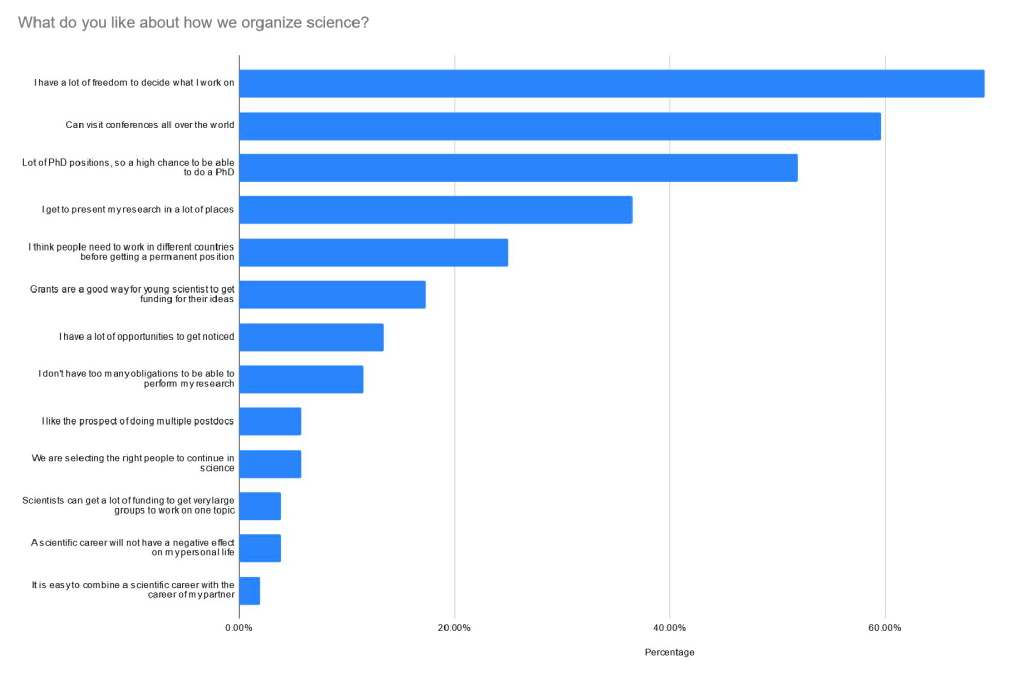
    Another of the questions that were asked as part of this survey were related to the current way in which science is organised. Here there was a higher diversity of options. The aspect that was more highlighted by the respondents was that of the freedom to organise their own work. This freedom is something that e.g. is absent in company world. Being able to travel and meet fascinating people are over the world is (was?) also an aspect well appreciated.

    Positive aspects of the current organisation of science from the perspective of the Nikhef’s PhD students.
    The time flexibility of academia can be a double-edged sword. It is sometimes required to work outside “office hours”, for example to meet a deadline for a paper submission. Image credit: PhD comics.

    Concerning points of attention about the way science is organised, the survey’s respondents indicated two topics as particularly relevant. The first is that from their perspective too many excellent researchers end up leaving science. The second, the complaints about the fact that the current model requires enduring a series of short research gigs in different countries before one can even hope applying for a permanent position. Clearly, the two points are closely related: many outstanding scientists will leave the field if they are not willing (or able) to embark on postdocs gigs, in many cases for good reasons. Note also that as mentioned above the system does not treat all players equally: people with caring responsibilities might find more challenging following the traditional path from PhD to professor, and researchers from wealthier backgrounds or with a bigger support net have important advantages (as one might have noticed, relocating to a different country every couple of years is financially rather taxing). Other suggestions that our students put forward were to improve the possibilities of combining a scientific career with personal life, caring responsibilities, with the careers of their partners. I also note that another of the frequent complaints (too much travel) has been made irrelevant by Corona. Noting that most research activities and scientific life can go on with online remote conferences and meetings, it is unlikely that we go back to the pre-covid situation of almost continuous travel anytime soon. While there is no magic wand to solve these problems instantaneously, one positive recent development is the adoption of the “Recognition and Rewards of Academics” position paper by the Dutch universities, which emphasises that there are many different pathways to become a succesful scientist beyond the traditional one and that these should also be appropriately recognised.

    Points of attention on the same topic: what we can do to improve the way science is organised?

    Let me now finish this post by putting on my (fake) social scientist hat and draw together some general conclusions from the results of this interesting survey:

    • The overwhelming majority of Nikhef’s PhD student are either considering or have already decided to attempt to follow a career in science.
    • Why? Because science is fun, exciting, and intellectually challenging (at least in particle physics 😉 ): this is by far the main reason why our PhD students would attempt a career in academia.
    • But following up a scientific career also brings in many challenges from the personal point of view. Worse, there is no guarantee that all these sacrifices might result in landing one of the few professorial positions available
    • In the current way that science is organised, ECRs benefit of a significant flexibility to pursue their own interests, and of ample opportunities to meet and interact with people all over the world…
    • … but also the current model is affected by a leaky pipeline where many excellent researchers leave and those who remain are not always the best, in most cases due to the challenges to reconcile a scientific career with personal life and caring responsibilities.

    So should you stay or should you go? No one can take this decision for you. What I believe is of utmost importance is to take this decision based on accurate information rather than on rumours or gut feelings, as well as seeking advice from more experienced researchers (of course when doing so one needs to be aware of the Survivor Bias) as well from people that have successfully transitioned to other jobs. Irrespective of the decision, what I want to strongly emphasise is that leaving (academic) science is never a defeat, something to be ashamed of. For many, it is the first step towards a fulfilling and rewarding career, perhaps not the one they had imagined for them when they first started the PhD, but perfectly suited for them nevertheless.

    Some valuable advise on post-PhD career paths, again by the one and only Jorge Cham of PhDcomics.com
  • Blended learning and the future of university teaching

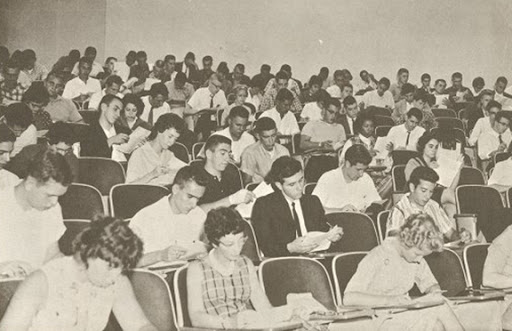
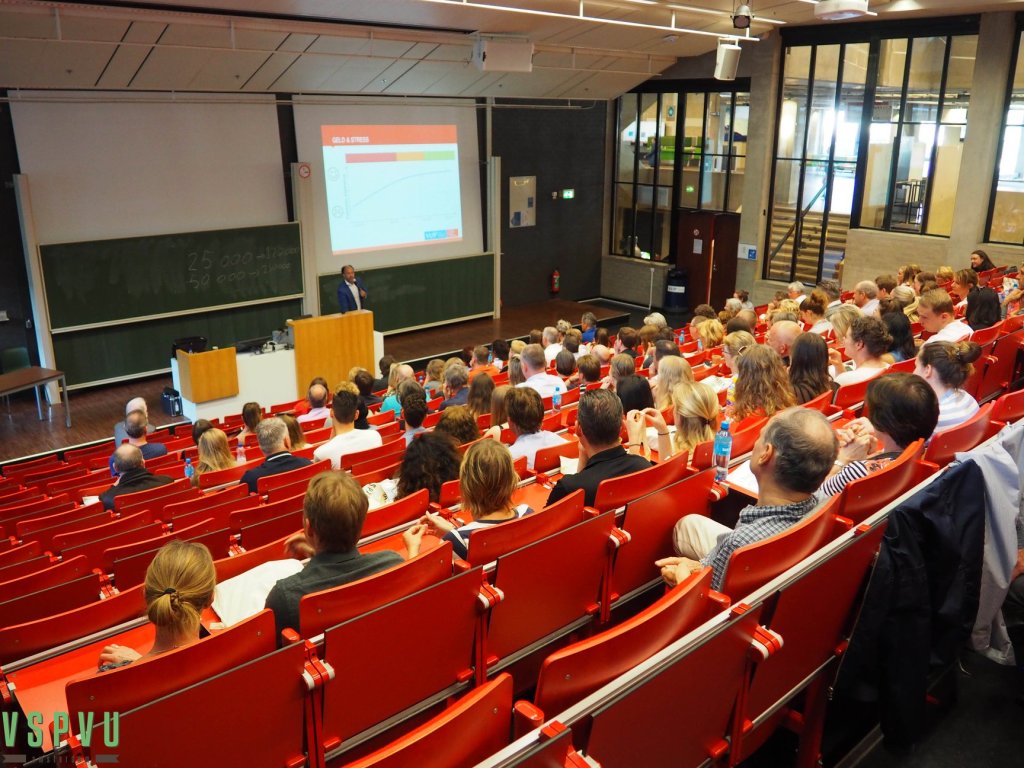
    My parents always liked to tell me about their time as university students, in the Faculty of Law in Barcelona in the 1970s. Those were interesting times, towards the end of General Franco’s dictatorship, when students could be found more often than not trying to get away from the political police after one of the frequent demonstrations against the regime. Among the many anecdotes of that period, among the ones that always struck me the most was the way their lectures took place. Imagine a packed lecture hall, with maybe a couple hundred students or more. The professor would step in at the beginning of the lecture (full three-pieces dark suit, tie or bow-tie, glasses), open his (it was inevitably a he in those times) notes, and start reading them. No blackboard, no fancy support material, no handouts, nothing. Just reading aloud the notes for the whole duration of the lecture, while the students struggled to scribble something before going back to their books in the library. Interestingly, it seems that most professors spent the whole lecture smoking (!), some even cigars, leaving a characteristic smell that filled the classroom and the student clothes for days. A funny detail was that there was no clock to check the time, no alarm to indicate the end of a lesson: once the time was over, the janitor would inevitably enter the class and politely indicate the professor that he was done with his sacred duties. Following this ever-present ritual, the professor would gather his notes and leave the hall, with next-to-none time for discussions or questions (no, there were no student evaluations in those days, why would you ask that?). You might also guess that there were not that many contact hours or tutorial sessions to assist digesting the material.

    A typical university classroom in the 70s, minus the smoke (source).

    Why am I mentioning this anecdote to start the post? Because from several points of view the way we teach university courses today is not that different from what tool place in the seventy’s classrooms. Sure, we don’t have smoke now (thanks Heavens for that), and we use slides, blackboards, provide fancy handouts to our students, and enjoy (struggle?) with an insane amount of different Learning Management Systems, but the big picture nevertheless remains unchanged in many cases. A professor enters the big lecture hall, talks for some time about the topic of the lecture, and tries to engage (often unsuccessfully) with their students, who will be at different times during the class taking notes, fiddling with their phones, eating their sandwiches, or simply looking at cat videos of Youtube (I have even seen students playing StarCraft during lectures as well, in case you are interested, no kidding). Actually, what I said is not completely true, since nowadays few students even take notes, and most stare at you and/or your slides (or their own screens) as if they were focusing in absorbing the delivered knowledge the same way a plant absorbs sunlight to generate energy. The bottom line is that most university lectures, specially in bachelor programs which involve big groups, are taught using the time-proof traditional method of standing up and speaking for a long time in front of the class. And maybe this is a good thing, it might very well be a very succesful teaching strategy. At the end of the day personal contact is crucial to the what might be called the experience of learning. For the last two decades many education gurus have declared the demise of traditional teaching in favour of things like MOOCs (Massive Online Open Courses), but fortunately these gloomy predictions have failed to materialise. However, like it or not, things are going to be quite different in university teaching due to the Corona crisis, certainly for the next academic year, perhaps even in the longer term. Just today the University of Cambridge announced that all lectures will be online-only for the 2020-2021 academic year. The requirements of social distancing impose of course many challenges for higher education, but also offer opportunities that could change the way we teach and learn in the long term.

    Traditional lectures might be out of the question for some time.

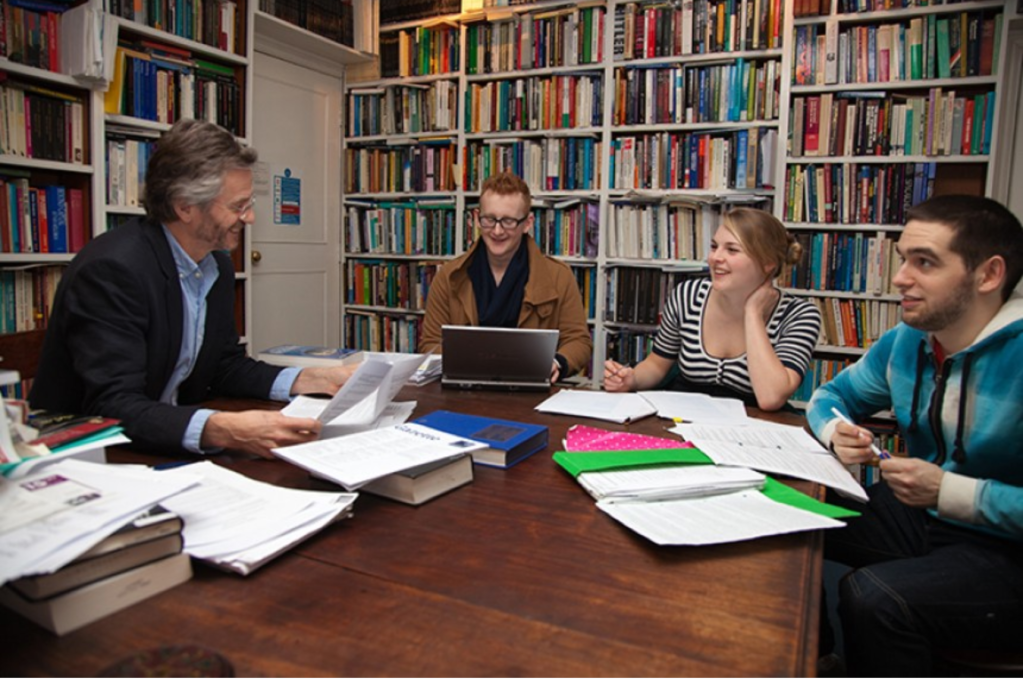
    The position of the Dutch universities in this respect is that for the next months (years?) one should carry out teaching on campus when possible and online when not possible. The former will be affected by severe restrictions to ensure the safety of the students and teachers and prevent further virus propagation, such as scheduling lectures only outside rush ours, keeping the 1.5 meters distance all times also in the labs, and using large lecture halls only for small-group teaching and tutorials. So how can we effectively deliver high-quality teaching while ensuring that all safety rules are satisfied? The answer might be related to something called called blended learning, a big buzzword these days. According to Wikipedia, in blended learning one combines online educational materials and opportunities for interaction online with traditional place-based classroom methods. To cut a long story short, the philosophy is that the core content of a course is provided online (either via live or recorded lectures), followed by self-study by the students, again with the support of online tools and materials, followed when possible by a discussion time, tutorial style, when the instructors assist the students to digest the content of the course, following on open issues and dark spots in their learning rather that on parroting textbook material or lengthly mathematical derivations. This model is not that different e.g. from the tutorial system in place in Oxford and Cambridge, modulo the fact that lectures would be online and that the small-group tutorial discussions require suitable rooms. Of course the Oxford and Cambridge model only works because colleges employ copious numbers of academics for these tutorials, so generalising it to other situations is far from straightforward. Yet, in my personal experience such small-group interactions are by far the most effective way to learn and to communicate knowledge, so what we can learn from this?

    A tutorial session at Oxford’s Oriel college, minus the social distancing (source).

    Now, assume that we cannot have on-site lectures anytime in 2020-2021. What do we do then? Many of my colleagues have made an amazing work turning their courses into online format in a very short notice, but if the situation persists for several months perhaps we can sit down for a while and try to think how we can optimise our efforts. One example that is close to my experience is the teaching of math courses in the hard-sciences degrees, the beta disciplines as they are called in The Netherlands. In principle, one would need say a single Mathematical Methods course, a single Algebra course, a single Statistics course, and so on. Surely enough, now we have a significant degree of repetition of such courses. And for good reasons! The first is that the scheduling of courses and lecture halls is already a nightmare, and you can fit only so many students in a lecture hall, so one needs separate courses for each education program even if the contents are basically the same (I have been told that effective scheduling is one of the titanic problems that could only be solved by a quantum computer, and I for one I am really looking forward to them). The second reason for this duplication is that ideally one wants to tune the content of math courses to the rest of the courses in a given program, for example if one is teaching Statistics for Physics one could use examples of data analysis from particle colliders but if the course is Statistics for Medical Science one might illustrate the same concepts using for instance the procedure to determine whether or not a given treatment is efficient.

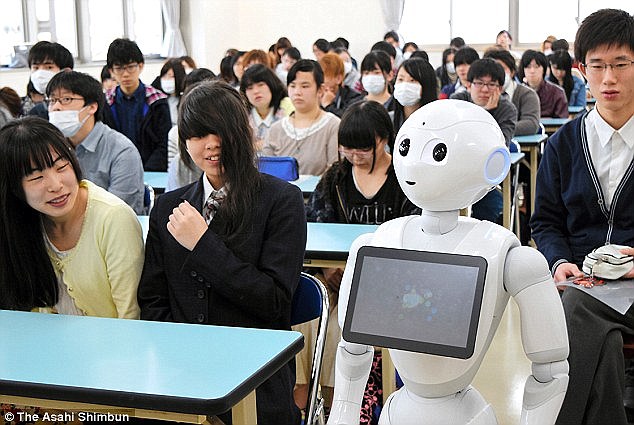
    In this specific example, how could one implement blended learning and deliver an effective education while at the same time improving the efficiency and resource management? One option would be to coordinate the math courses in different education programs and identify which are the core concepts and those more specific to individual programs. Then one could take the core concepts and prepare a set of recorded lectures and the corresponding online support material and exercises. These lectures could be chopped into separate short modules, and instructors would provide a tailored path for the students in the different programs. Further, one could have specific modules for each program, with examples focused on topics of interest for the rest of the courses, to ensure a coherency in the education pathway followed by the students. Now, this sounds great in theory, but the practical implementation requires a ton of work and professional support, if one wants to produce high-quality online educational material. Then, it still needs to be complemented with face-to-face teaching, whether online or on-campus in small groups remains to be seen, so scheduling and personnel allocation are far from trivial. But potentially by combining efforts one could end up with powerful educational resources while at the same time improving the accessibility of our higher education, since students could then adjust their schedule better to their own constraints, for example if they have to juggle study with a temp job. Similar ideas could be applied to other types of courses, think of for example introduction to programming, where actually mostly-online courses are already in place. The key aspect of a succesful implementation of these ideas is to find the appropriate balance between online and face-to-face teaching, since the latter is truly essential for a real educational experience. Technology can never replace the human ingredient in education, so I would not bank on getting replaced by robots anytime soon (but also I missed my chance to invest in Zoom stocks, so who am I to make predictions)!

    The future of higher education might very likely involve a more extensive use of education technologies, though for the time being we will not be replaced by AIs.

    Needless to say, maybe tomorrow a vaccine is discovered and we all go back to the normal times – but as often said making predictions is difficult, specially for the future. Maybe the current situation becomes the new normal for universities and higher education, maybe not. But in any case, we have an opportunity to rethink how we deliver education and find ways of maybe doing things a bit better. It would be naive to think that the way we do things now is the best, this is not written in stone. Crisis are often the starting point of revolutions, and perhaps (?) the current crisis will induce long-term changes in universities so that people will look in awe back to the 2010s in the same way that we now find striking the university classrooms from the 70s. Only time will tell, but in any case these are certainly interesting times for higher ed.

  • HigherEd in the anderhalvemetersamenleving era

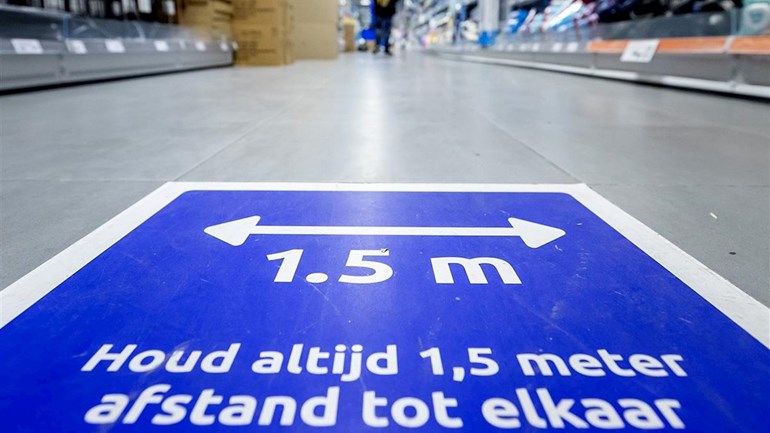
    On Wednesday the Dutch government announced a further softening of the corona-prevention measures. From secondary schools to cinemas, gym centers, cannabis cafes, and sex clubs, there is not a more or less clear roadmap for their calendar towards reopening and trying to recover part of their pre-corona activities. This said of course most the safety measures remain in place, and will do so for the foreseeable future, at least until a vaccine or an appropriate treatment for the virus is found and widely distributed. Perhaps the most important of this measurements, which affects the most how we can and we cannot resume some activities, is the obligation to keep a safety distance of one and a half meters between people to prevent the propagation of the virus. Clearly, such measure changes quite dramatically how we can do things, and thus it makes sense to call the current situation the “one-meter-and-a-half meters society”, or in the delightful way the Dutch have to cluster long arrays into single words, the anderhalvemetersamenleving era.

    Now, what about universities? Unfortunately, in the government’s plans there is little to none guidance about what will happen with the Dutch higher education system in the next months, so it is anyone’s guess. Right now, universities are essentially empty for a couple months now, with all on-site educational activities and most if not all of research work put on hold. Fortunately, despite the claims from some politicians, higher education has adapted itself very efficiently to the ongoing circumstances and moves swiftly to online lectures, tutorials, and examinations. While not ideal, and certainly with hiccups here and there, my evaluation would be that higher ed has successfully adjusted to the challenging situated and kept offering high-quality education to their students. Likewise, while on-site experiments are off the table now, research goes on since a fair amount of scientific work can be done remotely (think data analysis, literature studies, paper writing and so on). Juggling research and online education with in many cases homeschooling small children or caring for relatives has been a tour de force for many of us, but all in all the show has gone on with relatively few disturbances.

    University buildings resemble ghost towns in the corona-times. Here the New University Building of the VU Amsterdam.

    The main question now is how long this situation is going to last, and how higher education is going to look like in the next months and years. The VSNU, the association of Dutch Universities, has published its main strategy for the next months: On campus, if we can, Online, because we can (nice and catchy slogan, by the way). What does it mean? Well, the idea is that for the next months (to be more precise, until an effective vaccine or cure against the virus is found and distributed) there is no way one can go back to packed lecture rooms or crowded university areas. Even if campuses were large enough to accommodate all students in suitable lectures rooms where a safe distance can be kept, which is far from being the case, the strain on public transport and other services might be excessive. So for the being we forced to adopt a blended learning strategy, which is some fancy jargon to denote the simple idea that some things will be done online (think of lectures with large groups) and others will be done on campus (small group tutorials or seminars, lab work and practica, fieldwork, and so on). Several universities and faculties have already announced that until February 2021 most educational activities will be online, and I foresee that this trend will be generalised in the next weeks. Actually, this also means that until a vaccine is found there will be no major changes and so this blended/online strategy might become the new normal of the higher education system (not only in The Netherlands of course, but also in most other countries).

    can we go back to the `normal’ higher education while maintaining all required safety measures? this is the million dollar questions for universities in the Netherlands and other countries.

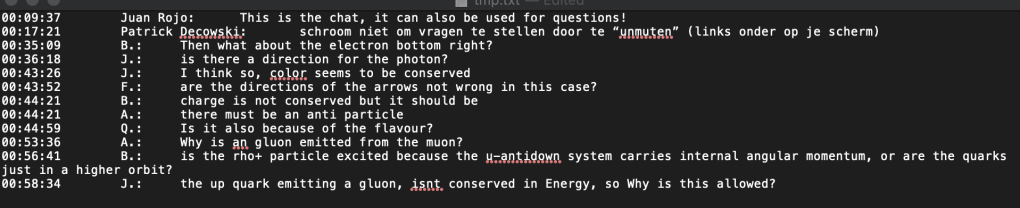
    One advantage as compared to the current situation is that now we have some more time to adapt our courses and examination methods to the new anderhalvemetersamenleving times. We are gaining experience with many (perhaps too many) online videoconference and Learning Management System softwares, for example, and discovering various useful features that facilitate online learning, from tutorial support with breakout rooms to online quizzes and tests. Teaching online brings many challenges but also a great deal of opportunities. If you want to take a look at an example of an online lecture, check here and here for a guest lecture on Feynman diagrams in particle physics that I gave some weeks ago at the UvA/VU bachelor program of physics and astronomy. It was a fun experience and I found that one can keep a rather dynamical interaction with the students: for example they can submit questions via the chat and then I would answer and discuss them on the spot. This was fun and I also had the feeling that students felt a bit more confident in sending written questions via the chat as compared to what they would have done in a real lecture.

    using the chat feature of videoconferencing systems is a useful resource to interact with the students, specially for those that might be more reluctant to ask the questions in person.

    So these are definitely interesting times for higher education, which might change it to its core in a way that can have long-lasting consequences beyond the ongoing corona emergency. Rethinking higher ed in the anderhalvemetersamenleving times is much more than just recycling a traditional course into an online format: is trying to make sure students experience the university life, the friendships and the adventure of growing and learning together as adult; looking for people that might be left out or that do not have the resources to follow effectively an online education; keeping the sense of belonging of the university community; and offering a clear perspective for the future. There is a lot of work on our plate but also a unique opportunity to change and improve higher ed for good. The `normal’ higher ed might never come back, so it could be up to us to define what is the `new normal’!

    As someone who regularly enjoys the massively crowded dutch trains, it is difficult to imagine society rolling back at full steam while keeping the one-meter-and-a-half distances 😉

    Incidentally, these challenging times might also be a good time to lobby for a healthy and renovated higher education system that contributes to the national and international wellbeing and prosperity for a generation. When one study after the other confirm that investing in higher education, research, and innovation is one of the most cost-effective ways that exist to ensure a good economic return, crisis like the present one could also be used for political reasons for a long-term crippling of the higher ed ecosystem. Despite having world-leading universities and research institutions for a relatively modest cost, again and again there are calls to further axe the system, even when multi-billion bailouts and support loans are being offered to many companies. A working document from a group of civil servants of the education ministry suggested a bunch of measures to reduce the cost for the government of higher education, from eliminating the subsidies to master programs (ending up with a UK-like system where a master program can cost up to eur20k or more) to reduce the number of international students, as if foreign students came here to just profit from the local generosity, when it is actually the opposite: the country badly needs highly skilled professionals to boost its knowledge-based economy. So we need to be on the lookout for attacks against higher education and research and proclaim proudly that our contribution to the financial, intellectual, and moral well-being of the country is essential even (or even better, specially) during the ongoing crisis.

  • Rebecca’s induction day: Some thoughts on the academic research funding model I

    Let me introduce you to Rebecca (not a real name). She is an engineer, more precisely a vehicle engineer: someone, an expert, who has been trained to develop and build cars.

    Today is a very exciting day for Rebecca. After a long search and many disappointing refusals, she has finally landed her dream job: she is going to work as senior engineer in one of the worlds leading car manufacturers! Specifically, she has been hired to develop next-generation vehicles: energy-efficient cars, self-driving trucks, you name it. The stakes are high, but Rebecca is ambitious and confident in her skills. After all, her qualifications are flawless and she has done several internships in top-notch companies in her field. In short, she is more than ready to tackle this challenge and start turning her dream designs into real vehicles. She has been preparing all her live for this moment. She cannot wait to meet her new colleagues during her induction day, it will be a moment for sure to remember, she thinks.

    After reporting at the company’s reception, she is brought to the manager’s office. We will call him Branden (again not a real name, for privacy reasons, we cannot afford lawsuits). Branden tells Rebecca how delighted they are that she accepted their offer, that the company sees a great potential in her, and that they will help her as much as possible to develop her exciting designs. After some polite small talk about not very interesting generalities, Rebecca asks Branden the questions that were burning inside her but that she never had the courage to ask when she was interviewed for the job. What follows is an abridged version of that conversion between Rebecca (B) and her manager Branden (B).

    R: Wow, I am really excited, it is a dream to start working here! I have so many ideas, I cannot wait to start turning them into reality.
    B: That’s the spirit! We appreciate your ambition, we need driven and motivated persons like you to make this company a success and to design the cars of the future!
    R: Yes, yes, so exciting! hmm, Mr. Branden, could I ask you something?
    B: Of course Rebecca, we are here to help, please ask me anything!

    R: I was wondering … how many people will I have in my group? I don’t need a huge group to get started, but at least four or five junior engineers and some technicians are the very minimum. I am sure this is a reasonable request, specially for a company as important as this one! And, also, I wanted to ask, how much money will be allocated to my projects every year? This way I can decide which of my designs to prioritise, and which ones I can realise at a later stage. Planning is everything for an engineer, of course!
    B: (suddenly a worried expression appears on his face) Aha, umm, Rebecca, where can I start? I thought that you had already been briefed over our operation mode, but I fear this is not the case … well, I guess that now is a good moment as good as any other to walk you through our business strategy. See, we will pay your salary, of course, needless to day, but alas we don’t have funding to assign anyone else to your project, nor to pay for any related investment or expenses.

    R: (suddenly very confused, perhaps this is some kind of initiation ritual where they prank new employees? What else could this nonsense be?) But Mr. Branden, I am very sorry, I don’t think I understood you. You have hired me to design and build cars, so surely the company is going to provide the means for me to carry out all the task I was hired for? Why would you hire me and then leave me sitting in my desk with nothing to do?
    R: (cheering up, now that the bombshell has been dropped) Well, this is the fantastic secret of our business model! See, we will not have to pay for your research, design and implementation work, but you can nevertheless get access to the money that you need. And how, you will ask? Easy: you need just to apply for funding to the Dutch Automotive Guild (DAG), who supports all vehicle design and construction activities in the Netherlands. You only need to prepare a short application (keep it brief, 30 pages with technical details and references will suffice typically) and a CV, and then very, very likely you will be awarded the money that you need to realise your projects! See, it is a win-win situation for our company: we get to build next-generation cars, while don’t having to pay for them! And this is just one of the many possibilities that you have to support your engineering work: you can also request the support for example of the prestigious European Automotive Council (EAC), who funds the most innovative and promising car design proposals in Europe!
    Really, it is a very well-thought and succesful model.
    R: (relieved now, the system is a bit funny but at least she will get the resources that she needs). Good, thanks for the clarification! This sounds much better. Ok then, I will start to prepare right now my proposals, the sooner I can receive the money to get started to build my cars the better, right? And you said that it is very likely that I will receive the funding, so it is more like a tedious but straightforward bureaucratic step?
    B: (somehow appears to be slightly nervous now, a twitch appears in his left eyebrow) Well, Rebecca, perhaps “very likely” is a bit of an overstatement. In any case, for someone with your skills and experience, being succesful in these applications will be a piece of cake! I am sure you will do great, and you have all the support from our side. R: Thanks Mr, Branden, I appreciate this, but still, I’d like to know, what are the success rates?
    B: Well, umm, I don’t know on top of my head, let me check (fiddles with phone nervously) aha yes, here they are, average recent success rates are, I see, between 10% and 20%. You see, very sensible, nothing to worry about! R: (whose heart has dropped to her feet) Well, umm, that’s, what can I say, slightly unexpected. How come the success rate is not higher?
    B: Well, we are of course not the only company with this business model. All car, motorbike, and truck manufacturers in The Netherlands and in Europe share the same model, so their engineers also need to submit the same applications to get funding for their designs. So yes, you are competing in a pool of extremely well-qualified, motivated, and driven peers. But
    as I mentioned, you are really well prepared, I am sure for you it will be a walk in the park!
    R: (trying to pull herself together) Yes, I guess you are right … Well, let’s get started then! At least until one of these applications is succesful I won’t have much to do, so I can devote all my time to work on them.
    B: (blushes, something appears to be wrong with him today) Sure, well, you have plenty of time, except for a couple of little assignments. First of all, our trainer for Vehicular Artificial Intelligence has just retired, and we wanted to ask you to take over his course. It will be not too time consuming, perhaps, let me check, between 8 or 10 hours per week? And our trainees love the course, so they are always looking for their teacher to ask questions. The only slightly bad news is that good old Mr. Carlson (again, not a real name) was well, old-fashioned, so he never used any supporting material, you will have to prepare everything from scratch.
    R: (gulps and starts to feel dizzy) Ok, ok, so I will have to write all these proposals and teach the AI course, right? Yes, ok, I think I can manage that …
    B: amazing, that’s the spirit! I knew you would really fit in our company! There is only a teeny weeny final thing: we have nominated you to the Dutch Council of Self-Driving Vehicles Engineers. It is a prestigious position, where you will have the pleasure to discuss and decide with extreme detail the official regulations for a whole field. You should be proud on being part of the Council! True, there are eight meetings per month and you will need to digest, edit, and comment on a few policy and regulation documents per meeting, but hey, think about that, you are playing a key role for the future of a whole field!
    R: (thinking that this was not he imagined her dream day) Oh I see, interesting. Many thanks for the information, I am, how could I explain it, overwhelmed with all these interesting news. I think I’ll go to drink some coffee now (turns around and leaves the door, before Mr. Branden can give her any more assignments).
    B: (muttering to himself) yes, yes, that’s the spirit, she will do so well, I am convinced. It is always a pleasure to welcome young engineers to the company, full of dreams and ambitions, and see them grow! Umm, unfortunately I forgot to tell Rebecca that she will also need to replace Dr. Kristin in her Steering 101 course starting tomorrow (she shuold have given us some notice that she was leaving, very inconsiderate from her side). No big deal, I will look for her later, I am sure she will be beyond delighted to hear that she can begin teaching young trainees already in her second day in the company!

    In the subsequent months, Rebecca had to juggle her sudden and unexpected teaching and training responsibilities with an increasing number of management tasks and the ever-increasing number of grant applications. As the first grant rejections started to appear in her inbox, Rebecca became more and more disappointed. How had she ended in that position? How on Earth is possible that her company hires her, a rising star with impeccable credentials, to design and build the best cars in the world, and does not provide her with the means to do so? And, as she discovered with horror, the same business model was indeed shared by all other companies in her field. Each time she meet one of her peer engineers in one of the endless, seemingly pointless, meeting that they were all forced to attend, the conversation was always about the same topics: there is something tremendously wrong with the system. And they shared their amazement that none of the higher ups seemed to notice about the situation, and if they did, they seemed pretty content with the status quo….

    A stellar vehicle engineer as Rebecca should be busy designing and building self-driving cars, not spending all her time in writing proposals about designing and building self-driving cars …. Image credit: Forbes.

    The above story, you would agree, sounds a bit ridiculous: a car company that hires a stellar engineer but then does not provide the means for her to do any of her core work! Well, replace a car company with a university and welcome to Academia. Believe it or not, the situation that early career scientists (e.g. recently hired Assistant Professors) face, is, with some caveats, similar to the story of our unfortunate Rebecca. In a nutshell, you are hired to carry out research but are not given the means to do this research. For this you have to apply for research funding, a competitive and time-consuming system where success is more often than not the exception. And who survives in these academic Hunger Games? The fittest, the luckiest, or the more persistent? This will be the content of the next post …

  • What is this mess about the Van Rijn commission?

    Disclaimer: the following post is going to be a rather dry one about some recent controversies concerning the funding of the higher education system in The Netherlands. Moreover, it is probably going to be incomplete and not fully accurate, both since the discussion is quite complex and also since my understanding of the overall situation (as well as my Dutch skills) is still somewhat limited. In any case, this ongoing argument is something that most likely will directly shape the near and long term future of the Dutch universities and research institutions, so it is definitely worth trying to understand a bit what is going on.

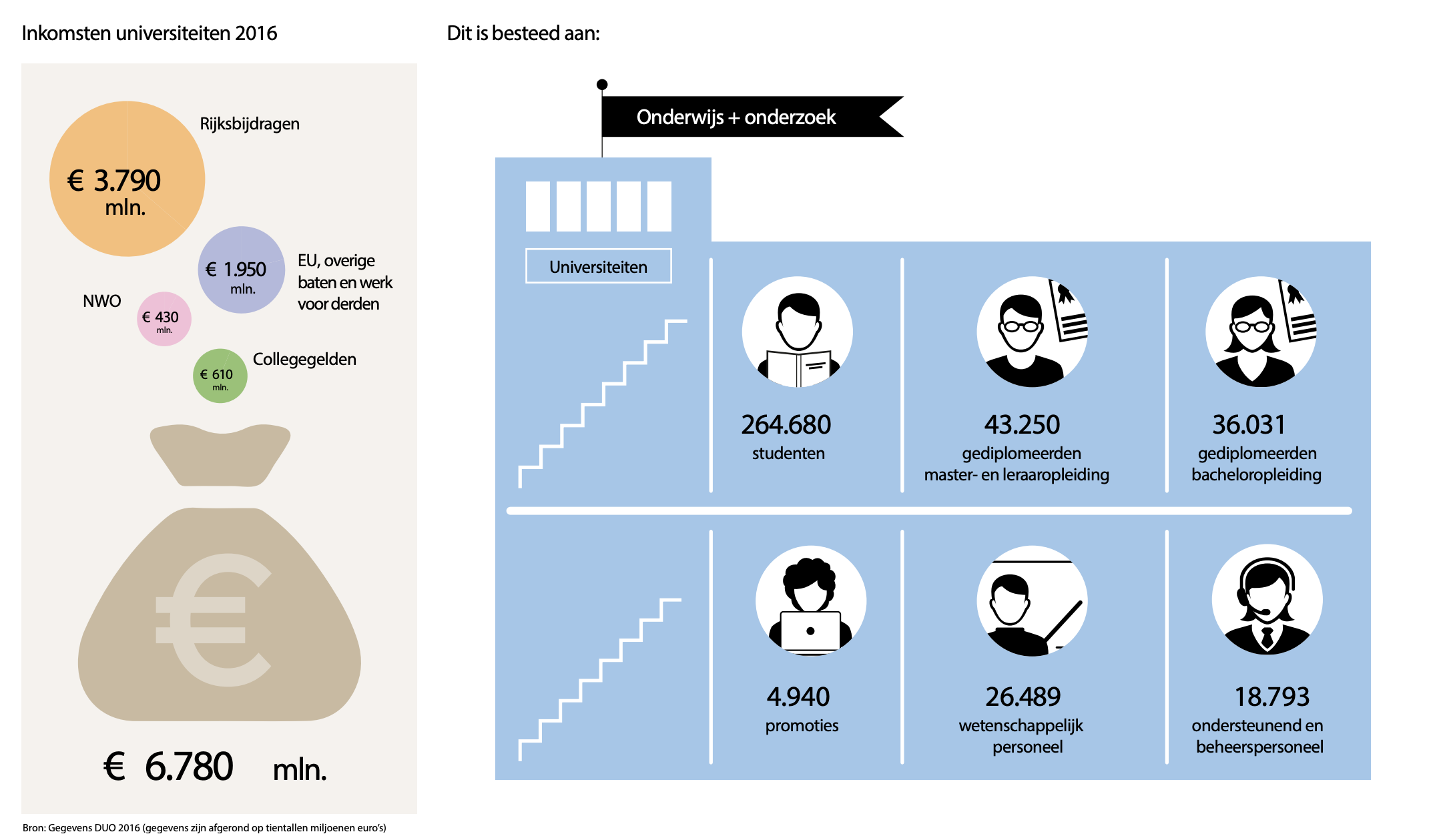
    Let me start with a quick overview of the Dutch higher education system, summarised by the numbers below. The overall yearly budget of the national universities is around EUR6.8G, with most of it (EUR3.8G) coming from directly from the government (the so-called Rijksbijdragen), followed by European (think of ERC for example) and private funding (EUR1.9G) and then in smaller proportion by the NWO, the Dutch Organisation for Scientific Research, and by the student tuition fees (collegegeld). With these means, in 2016 more than 260K students were being educated in one of the Dutch higher education programs by around 25000 academics (where here the tally includes also PhD students and junior teachers). Interestingly, following a similar trend as in other countries, the number of support, management, and policy personnel is now comparable to that of the actual academics.

    A snapshot of the Dutch higher education system, including its various source of funding. Credit: VSNU.

    All this mess about the infamous Van Rijn commission and recommendations has to do with the way the Dutch higher education system is being financed by the government, and a number of proposed changes in this model. As with most other European countries (England excluded of course), also in the Netherlands higher education is reasonably affordable, being heavily subsidised by the state. As show in the map below, The Netherlands falls into the middle category of European countries, with the average yearly tuition rates for EU students being around EUR2K. This of course does not mean that higher education is cheaper here than say in the UK, but rather that a bigger chunk of the cost is financed indirectly via the taxpayers as compared to the upfront costs paid by the students (in terms of the tuition fees).

    Credit: Reddit

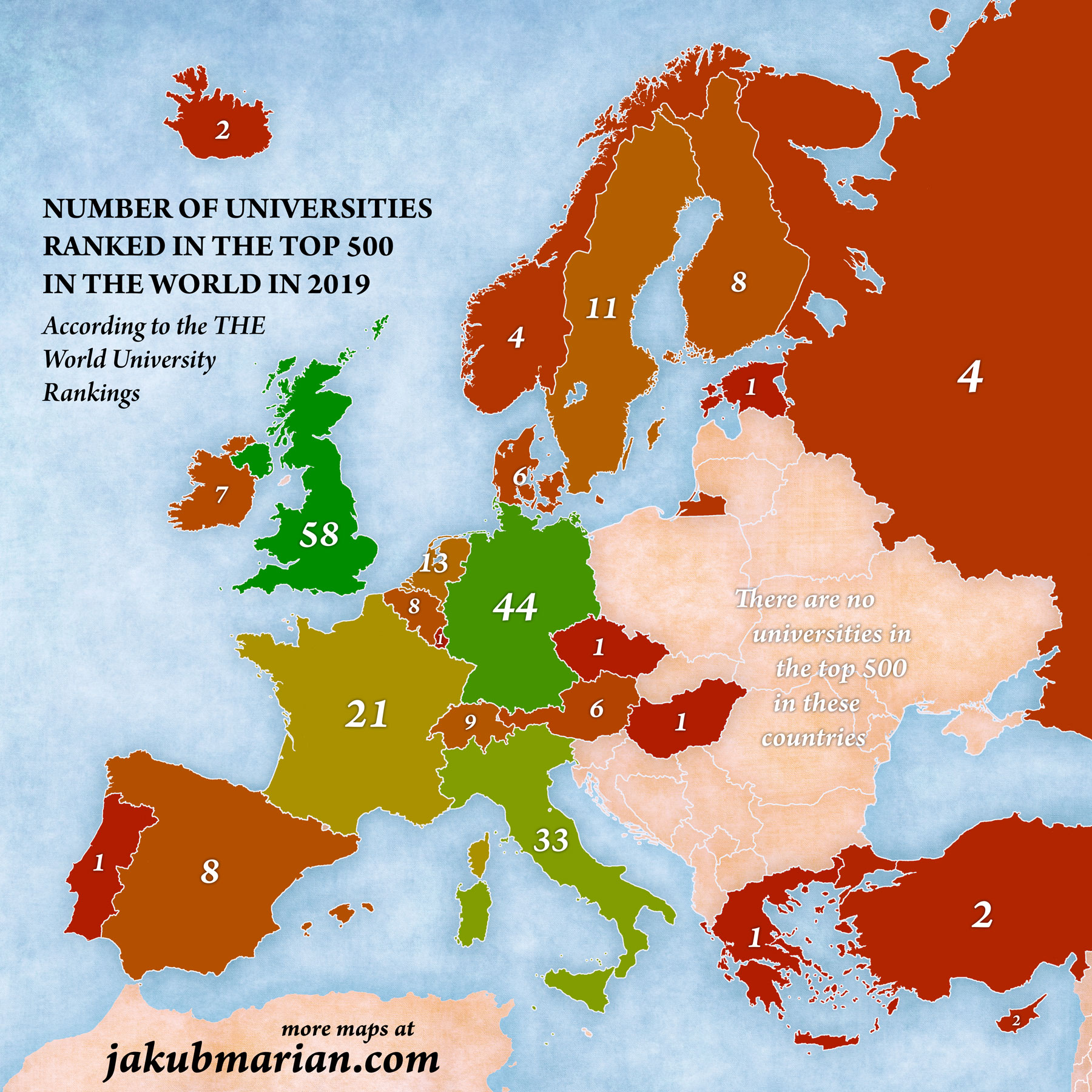
    A very remarkable feature of the lowlands is that, despite being a relatively small country, The Netherlands has an outstanding university system, both in terms of education and of research. For example, according to the THE World University Rankings (insert here all required caveats/rants about rankings before moving on), The Netherlands has 13 universities in the top 500, to be compared with the 21 of France and the 8 of Spain, countries with a significantly larger population. One can also take a look at many other estimators, such as number of scientific papers and their impact, the number of grants from the European Research Council secured by PIs hosted by Dutch institutions, patents, and one could go on for a long time. All these complementary measures tell a consistent story: the Dutch higher education system appears to be in outstanding shape and world-leading science is being carried out at its universities and research institutes.

    Number of top universities by country according to the THE 2019 rankings. Credit: jakubmarian.com.

    Or it this not the case? Actually, there are number of signals that suggest that the situation is far less rosy, and that the position of the Dutch higher education system might be under strong pressure. One reason for this has to do with the way Dutch universities receive their funding for education from the government, the so-called first money stream. In the current system, this source of income depends heavily on the number of students that enrol in a given education program (say a bachelor or a master program) in any given year. This choice of financing model leads to several challenges. First of all, faculties and departments are faced with a significant uncertainty concerning their funding even on a year by year basis: if the number of students decreases in some programs suddenly then might find themselves in red numbers, while if the opposite situation happens they might turn out to be understaffed and have to quickly hire new instructors and teachers, or even have to look for new lecture rooms. The bottom line is that in such situation long term and strategic planning is clearly difficult due to these potentially sudden variations of income. This often leads to an increase in the relative fraction of scientific personnel in temporary contracts, which allows universities to adjust more easily to changes in supply and demand in the education market. Whether this increase in temporary positions as opposed to permanent staff is desirable is a topic for another discussion, but it seems to be that it is a natural consequence of the current financing model.

    Another problem associated to this funding model of Dutch higher education system is that it creates incentives to dump programs with low influx of students and focus on those with high influx. This has lead to the termination of programs with an insufficient number of students, such as the recent example bachelor program in Dutch language at the VU Amsterdam, which created a certain outrage in the media (but again, there is limited wiggle room to tackle this kind of problems within the current funding model). There are also concerns that this system creates perverse incentives to emphasise quantity instead of quality, and boost as much as possible the number of students at any cost. While it is of course important to take into account the preferences of the students (at the end of the dat, it is their own lives which will be affected by such choices) it might seem to be unwise that these choices completely determine which programs are on offer. One can always make strong cases for higher education programs that might be less attractive but are equally important for the society in the long term, and that deserved to be sustained rather than cancelled at the earliest opportunity.

    As far as I understand, at some point the current government realised that the job market required many more graduates with hard natural sciences and engineering degrees that the universities were producing. Moreover, the recent increase in the number of students in these disciplines had lead to a structural underfunding of these programs, specially for the technical universities such as TU Delftt and TU Eindhoven. With this motivation, the Dutch government wanted to increase the funding of the hard natural sciences (which for some obscure reason are known as the Beta-disciplines in Dutch) as well as the engineering degrees. So they installed the so-called Van Rijn commission with the task of finding a way to improve the funding of the beta and technical programs, and here comes the catch, in a budget neutral way. While the devil is in the details, one does not need to be a rocket scientist to figure out that this can only happen if part of the funding which is currently allocated to the social sciences and the humanities, and the medical disciplines (again in the Dutch jargon known as the alpha and gamma disciplines respective) to the exact sciences and the engineering programs. And indeed this is one of the main recommendations of the Van Rijn commission, which has been in most part assumed by the Ministry of Education, Culture, and Science (OCW). While there are many positive aspects of Van Rijn, such us proposing a more stable model less depending on student influx and reducing the competition for research funding in favour of an increase in structural resources, this redistribution both between universities and between disciplines is my far the most controversial measure.

    And while there is a war going on about the numbers (where the government claims that the universities are going to receive actually more money as compared to the current situation and with everyone else claiming the contrary) some projections are extremely disturbing: if implemented, the recommendations of the Van Rijn commission could lead in the next few years to a “redistribution” of teaching and scientific personnel from the alpha/gamma/medical disciplines to the beta/technical ones of rather staggering size: up to 2000 FTE (full time equivalent), which for a country as the Netherlands would be rather devastating. Of course here redistribution is just the jargon that human resources people like to use to soften the blow, but in plain language this simply means that these 2000 FTE will either be fired or their temporary contracts will not be renewed, in order to hire their counterparts in the beta/technical programs. Fun fact: in the Dutch higher education system there is no such thing as being tenure, and even full professors or other scientific staff with permanent contract can be fired if the university management deems it necessary.

    In the table below, one can find a summary of the assessment by the Dutch Association of Universities (VSNU) about the impact of the the implementation of the measures of the Van Rijn commission would have on their short-term financing. While general universities would loose up EUR10K each in terms of structural funds, the technical universities, in particular TU Delft, would strongly benefit from the redistribution. See here for a more extensive discussion of the financial consequences of the implementation of the recommendations of the Van Rijn commission. The universities of Groningen, Maastricht, and Rotterdam would be the ones most severely affected by these cuts.

    The Dutch Association of Universities (VSNU) has assessed the impact of the the implementation of the measures of the Van Rijn commission would have on their short-term financing. While general universities could loose up EUR10K in structural funds, the technical universities, in particular TU Delft.

    If, as it seems to be the case, the government is going to move forward implementing the recommendations from the Van Rijn commission, the general universities will face an almost unsolvable dilemma: or they decides to avoid any redistribution between faculties, making even more severe the under-financing problem of the scientific disciplines, or they redistribute funding and personnel from alpha, gamma, and medical programs to the Beta ones, dealing a very serious blow on otherwise very succesful education programs and compromising their long-term viability. My own university, the VU Amsterdam, has already announced that they will not implement any redistribution in 2020, but at some point in the future some kind of action will need to be taken, an “impossible balancing act” to implement: current estimates imply that due to Van Rijn by 2022 around 120 FTE will need to be “redistributed” from the beta, gamma, and medical disciplines to the beta ones within the VU, where again redistribution means either not renewing the contracts of temporary staff or of directly terminating the contracts of permanent scientific personnel.

    Forcing universities and faculties to battle among themselves (“Divide and conquer”, as the rector of the VUA Vinod Subramanian says) for funding is a terrible idea. Education has been repeatedly demonstrated to deliver the best guaranteed return on investment, so why imposing these unnecessary cuts?

    Perhaps the most mind-blowing aspect of this situation is that The Netherlands is not a poor country with a struggling economy which simply does not afford to invest in higher education. On the contrary, it is a rich country with a booming economy. Indeed, in 2018 the overall budget surplus was of 11 billion euros, that is, around three times the total government contribution to the whole higher education system (see figures above). So there does not seem to be any reasonable financial or budgetary reason to impose this dramatic austerity, other than the deliberate political will of reducing the size of the alpha and gamma sectors in higher education. I might be very well be missing something important here (Dutch politics are almost incomprehensible for the outsider, with a multitude of small parties and a complicated “polder” model for negotiating among them), but it seems to be rather short-sighted in addition to unnecessary.

    Perhaps a key aspect of the whole discussion that politicians might be missing is that investing on education in general, and higher education in particular, is quite different that say building a highway. There you can build one part, stop if you run out of money, and then finish when money comes back, easy peasy, and get the job done. But building a strong, competitive higher education ecosystem takes decades to consolidate but it can be destructed very easily, as the sad example of Spain shows, still reeling from the savage cuts that took place after the economic crisis in 2008. Or perhaps they realise that this is the case, and then everything is done on purpose? The Netherlands is already one of the most effective countries in Europe in terms of research productivity (ratio of output to investment) but further squeezing this lemon might end up cracking the system.

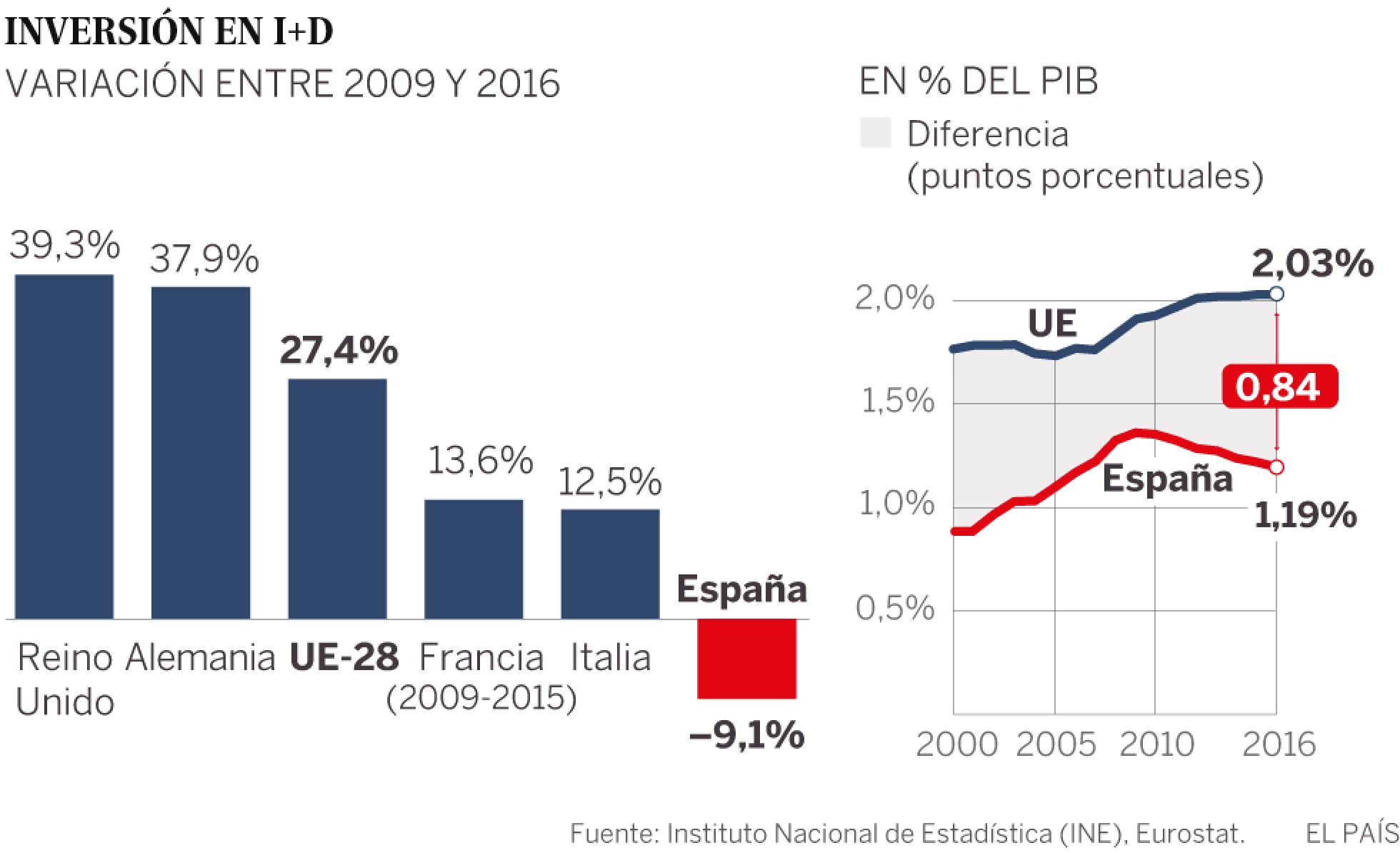
    Following the financial crisis in 2008 and the subsequent austerity measures, the overall investment in I+D (including publicly funded research) fell in Spain by 10%, to be compared with the 30% increase average in the EU, and the 40% increases in Germany and the UK.

    To me, as someone who has just recently joined the Dutch system, the whole discussion seems almost surreal: why a wealthy country would like to unnecessarily damage its highly competitive higher education and scientific ecosystem? In a very competitive world, with powerful emerging economies playing each time a more important role in the global stage, reducing the support for a crucial pillar of the future of a country and its economy such as higher education is really difficult to understand.

  • A game of colliders: is CLIC the Tyrion Lannister of the future collider wars?

    Despite the title, I have never seen a single Game of Thrones episode. I read the first of the books though some time ago, and while the book was interesting and catchy, everyone there was very but very bad and miserable, so I was not really motivated to proceed further. This said, I remember that Tyrion Lannister seemed at a first glance a character that might last a couple of chapters at most, specially given the low survival rate on the GoT universe. But apparently, at least from the Twitter spoilers, he was remarkably still around in the last episodes of the series. So all in all, his strategy was reasonably succesful: starting as an underdog, he became one of the dominant figures of the storyline, which is no small feat taking into account that terrible fire-breathing dragons were also involved. So Tyrion Lannister seemed to me to be a not too bad analogy to discuss some interesting recent developments about the future collider saga, namely the fact that the Compact Linear Collider (CLIC), which for a long time seemed not to be topping the bookies’ predictions , now appears to slowly but surely be gaining traction within the community. I will try to explain in this post why this might be the case.

    Tyrion Lannister provides a good analogy for an underdog unlikely to make it alive even to the next season, yet apparently he somehow managed to stick around until the very end.

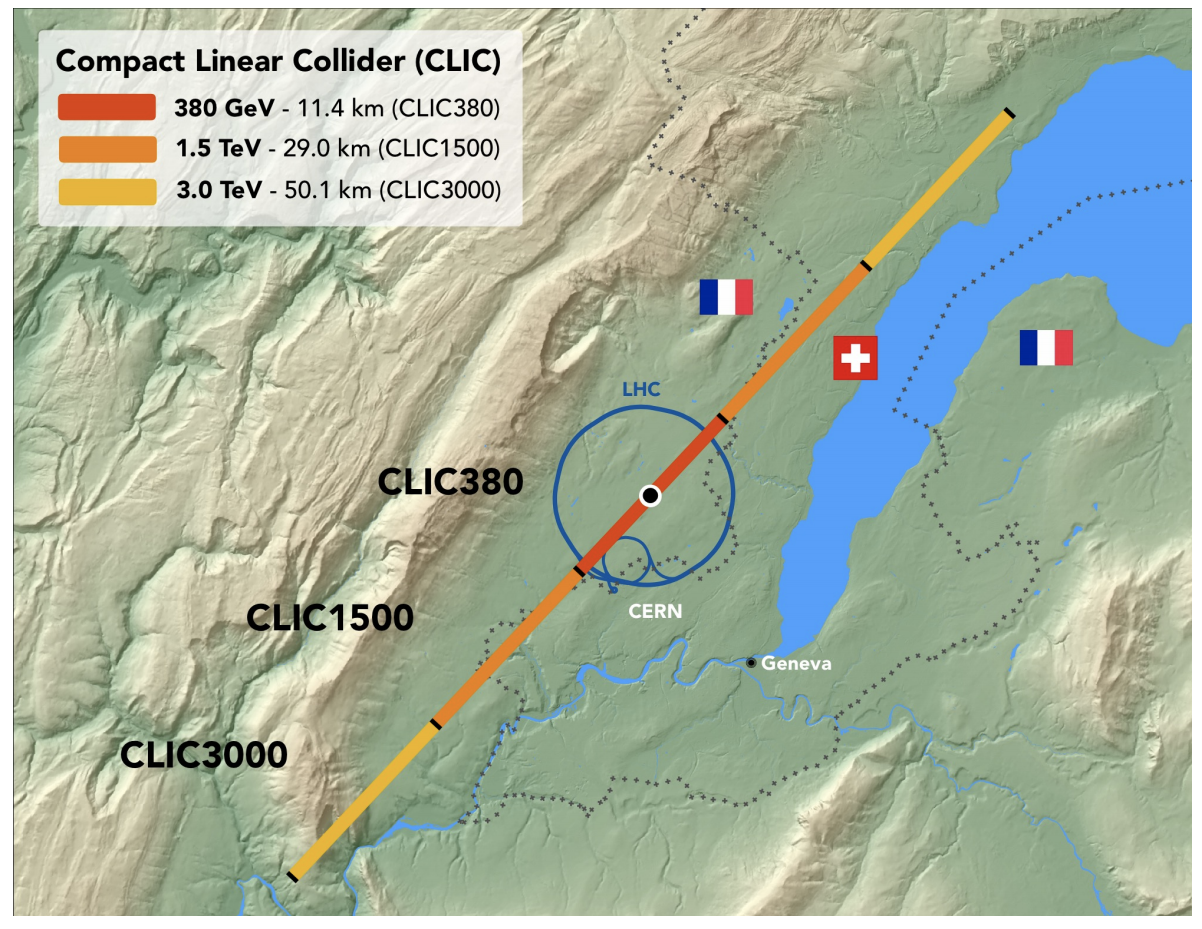
    What is CLIC? A nice summary of this future collider project can be found in the talk that Aidan Robson gave at the Nikhef Colloquium recently. CLIC would be a high-luminosity, multi-TeV electron–positron collider to be built at the CERN site which would operate in three phases. The first one, CLIC-1, would have a center of mass energy of 380 GeV and would focus on precision studies of the Higgs boson and the top quark, which are sensitive to potential new physics beyond the Standard Model (SM) via quantum corrections. Such program is to common to other proposed lepton colliders such as the International Linear Collider (ILC), the FCC-ee or the Chinese CepC. The key difference of CLIC is that it can be be upgraded to CLIC-2 (operating at 1.5 TeV) and then CLIC-3 (at 3 TeV), being thus the only lepton collider over the table that can reach the multi-TeV region. This offers significant advantages, both in terms of guaranteed deliverables (such as the measurement of the Higgs potential) as well as a marked increase in the reach for direct and indirect physics beyond the SM. Moreover, this upgrade program could be adjusted to other center of mass energies after stage-1, provided there is a good scientific motivation for that.

    CLIC is a linear electron-positron collider that would be built on the CERN Geneva site, whose length would vary between 11.4 kilometers for the initial stage and 50 km for the final, high-energy stage.

    Indeed, one of the main physics goals of any future particle collider beyond the high-luminosity LHC should be the precise measurement of the Higgs self-coupling. The strength of the self-interactions of the Higgs boson plays a crucial role in the mechanism that drives electroweak symmetry breaking, and might be related to cosmological phenomena such as the matter-antimatter asymmetry or the phase transitions in the early universe. Some researchers are even proposing that the Higgs boson itself was the responsible for inflation. In this respect, the high-energy stages of CLIC offer the potential of measuring the Higgs self-coupling with a precision of a few percent . Lower energy lepton colliders, in particular the circular FCC-ee and CepC, would not be able to directly access this self-coupling via Higgs pair production though still they could be sensitive to it via quantum corrections to single Higgs production, emphasising the need for a global approach. Note that only for center of mass energies above 500 GeV is a lepton collider able to produce pairs of Higgs bosons at an appreciable rate.

    Feynman diagrams relevant for the production of pairs of Higgs bosons at the LHC.

    CLIC would also be able to extend the HL-LHC reach for searches of new particles and interactions. In the context of such searches for potential new physics beyond the SM, it should be emphasised again that the distinction between direct (where one explicitly produces new heavy particles) and indirect (where quantum effects modify the properties of known particles) constraints is rather arbitrary. Indeed, with both types of searches one is being sensitive to kinematic regions never explored before, which is the main point of a search. To illustrate the potential of indirect searches at lepton colliders such as CLIC, in the figure below I show the expected bounds on the Wilson coefficients of specific dimension-6 operators of the Standard Model Effective Field Theory (the SMEFT) from future colliders, compared to the reach of the HL-LHC. Note from the right y-axis that these bounds can be interpreted as probing energies as high as 50 TeV, depending on the operator, which is much higher that the actual center of mass energy (3 TeV in stage-3 of CLIC). Here the SMEFT is the lower-energy effective theory of any ultraviolet completion of the Standard Model, and is written as a tower of higher-dimensional operators, \mathcal{L}=\mathcal{L}_{\rm SM}+\sum_{i=1}^{N_{d6}}\frac{c_i}{\Lambda^2}\mathcal{O}_i , with $\latex \Lambda$ is the scale of new physics where the effective theory approximation breaks down. This way, with precision measurements of “SM” processes, either at proton-proton or at lepton-colliders, we can thus be sensitive to energy scales way above those of which that probed by direct searches. For these kind of studies the very clean environment of electron-positron collisions, with a high signal to background ratio, is very beneficial.

    Expected bounds on the Wilson coefficients of specific dimension-6 operators of the Standard Model Effective Field Theory from future colliders, compared to the reach of the HL-LHC. Note from the right y-axis that these bounds can be interpreted as probing energies as high as 50 TeV, depending on the operator.

    Ok, so far so good. Now about the challenges: despite the very attractive scientific prospects, the main difficulties to be overcome by CLIC (partly shared with any other future collider proposal) are the costs and the energy footprint. In the table below I show an overview of the (approximate) costs of power consumption for different proposals for future colliders, as summarised in the documents for the European Strategy for Particle Physics update. Assuming that very rough conversion factor that 1 ILCU = 1 CHF = 1 $ hold, then one sees that the costs for the various Higgs factories (ILC, CLIC-1, CEPC) are similar, with the exception of FCC-ee, which would be around a factor 2 more expensive. Note however that the FCC-ee cost includes also the costs of digging the 100 km tunnel.  If the FCC-hh is built afterwards, then its costing would be a further CHF17K, but if FCC-hh is built standalone. one needs to add the CHF7K for the tunnel. This implies that the costings for the FCC-ee and the FCC-hh become more attractive once they are considered as a joint facility, rather than as two single experiments, since then the tunnel digging costs are shared between the two of them. In other words, assuming that the FCC-hh is built afterwards (and this is a big if), then the costings of FCC-ee become comparable to those of CLIC stage-1, ILC250, and CepC.

    Let me also emphasise however that the total costs of these facilities needs to the factored out by its total operation time: this is not a on-off payment but rather a long-term investment in cutting edge fundamental science and technology, with quantifiable returns on investment also in terms of spin-offs, education, and outreach. Another interesting number in this comparison is the power consumption required by these facilities: between stage-1 and stage-3, the power consumption of CLIC would increase by more than a factor 3, where its energy footprint would become comparable to that of the FCC-hh, the 100 TeV future hadron collider.

    Overview of (approximate) costs of power consumption for different proposals for future colliders, as summarised in the documents for the European Strategy for Particle Physics update.

    What is then the gist of the matter? Why, given that its physics potential is comparable or superior to that of other electron-positron high-energy colliders (in particular thanks to its higher in center of mass energy) and that the costs are not particularly worse, CLIC might seem to be the underdog in the future collider wars? One reason has to do with the long-term scientific strategy that CERN will select for its future. Certainly, there is a strong motivation for CERN to plan ahead such that there is a new collider operating on site once the HL-LHC program is completed around 2035. The question, of course, is what type of collider should that be. For example, the advocates of the circular project, FCC-ee, advocate strongly that this project could indeed start by 2035 (provided the construction of the 100 km tunnel starts around 2025) and moreover that it would naturally pave the way towards the 100 TeV hadron collider since the tunnel would already be in place (in the same way as LEP paved the way to the LHC, the argument follows). Most certainly CERN is not going to build two lepton colliders, so if one decides to follow this option (as opposed to say moving directly to a higher energy proton collider), then the choice would be between CLIC and FCC-ee. In this case, the main argument in favour of the FCC-ee as opposed to CLIC is that it facilitates the eventual construction of a 100 TeV (or higher) hadron collider. So CLIC advocates need to (scientifically) fight not only with the FCC-ee aficionados but also with those of the 100 TeV hadron collider.

    This is, however, only a small part of the story, since also the role played by the Asian community will be crucial. In particular, whether or not the Japanese keep pushing the ILC project, in principle with the support of CERN (under active discussion now) and the Chinese move forward with their Higgs factory project CepC (increasingly likely) will affect any decision that CERN takes in this respect. It is clear that the chances of CLIC would increase if the ILC does not move forward, for example, specially since ILC is unlikely to be realised without CERN’s support. Note, in any case, that CLIC, in particular due to its unique reach into the multi-TeV regime, has from many points of view a complementary physics program to that of the Higgs factories. It is therefore a complicated discussion with many actors involved.

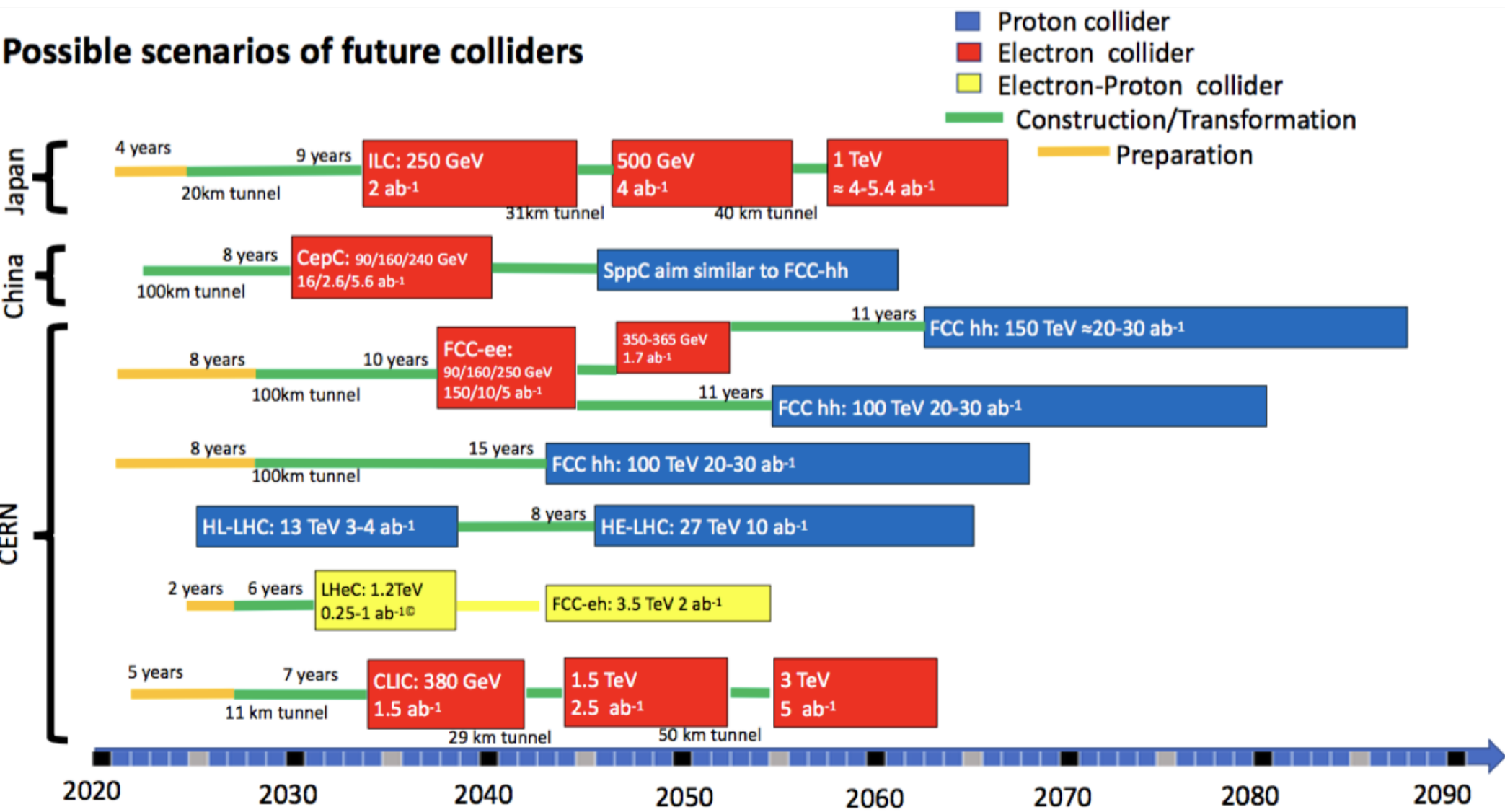
    The question of the timescales is also of paramount importance in this discussion: as mentioned above, ideally one would like the next collider to start operation as soon as HL-LHC is completed (if built on the CERN site) or as soon as possible if it is built in some other location, in Asia for example. According to the timeline below, both CLIC and the ILC could start operation as soon as 2034, with CepC even a few years earlier. FCC-ee would start shortly afterwards, but with as many attractive features as it has, it would also delay the start of the CERN’s 100 TeV hadron collider by up to around 2060 at the earliest. Even by the standards of high energy physics, this is perhaps planning far too long in the future: I will be lucky to be around to see the first 100 TeV collisions, though perhaps I will have uploaded my brain to the cloud by then ;). This is thus another important factor to take into account in the discussion for future colliders: is it wise to plan ahead that far in the future? Maybe, I don’t have the answer for this question. In this context, another of the selling points of CLIC is that its energy can be adjusted to tailor to any new developments on our field, for example, hints or even discoveries of new physics that might be provided by the HL-LHC or evidence for heavy dark matter particles. In this case these new insights could be use to tune the center of mass energy of CLIC after the initial (Higgs and top factory) stage to ensure a maximal scientific return.

    The timeline for different scenarios for future colliders.

    What are then the next steps? If CERN wants to have a new particle collider operative by the time the HL-LHC program is completed, a decision about start digging tunnels (or replacing and producing magnets) needs to be made by 2025 at the latest. This means that the recommendations that will be provided by the current EPPSU, to be presented by 2020, will not be definitive but will anyway be very important to inform the 2025 decision. For example, a recommendation to invest in further R&D for the CLIC accelerator technologies could be understood as a sign that this machine could be the future of CERN. It is not written in stone that the high-energy frontier can only be reached by hadron collisions, and perhaps plasma wakefield acceleration or muon colliders will be the next big breakthrough in particle physics. In the meantime, we want a collider with a bullet-proof physics case, that combines guaranteed deliverables with a wide exploration potential and that is based on demonstrated reliable accelerator technologies. We also want to avoid duplications and overlaps and we should combine global efforts in HEP in an optimal way. The Strategy Group in charge of writing these recommendations has a challenging task in front of them, so we should all stay tuned for developments!

    This is what it must feel for a CLIC advocate to enter into a meeting room full of FCC proponents.

    Correction: I fixed a mistake in the FCC tunnel costings, thanks to Aidan Robson for pointing this to me!

  • The lepton collider battles (only one can remain?)

    As I discussed in a previous post, the precision mapping of the properties of the Higgs boson should be, without the shade of a doubt, one of the main scientific drivers of any future high-energy collider that might operate in the post-LHC era. Powerful as the LHC is, and despite remarkable breakthroughs both from the theory and experimental sides in recent years, there is a limit to how well we can probe the Higgs boson sector at the LHC: proton-proton collisions are messy, and here one is aiming at per-mille level measurements of the Higgs boson interactions, at least an order of magnitude improved as compared to what the LHC can provide. The goal of this post is an attempt to summarise the main pros and cons of one of the possible options to fingerprint the Higgs particle with unprecedented precision: a high-energy, high-luminosity electron-positron collider.

    Artist representation of a section of the superconducting cavities and the beam pipe that would be part of the International Linear Collider: Credit: Iwate & the ILC.

    In this respect, there exist basically two main ways which one can consider to improve our understanding of the mysteries of the Higgs boson, as compared to what will be the legacy results of the LHC (including its upcoming High-Luminosity upgrade). The first way would be to adopt the same strategy of the LHC, namely to collide energetic beams of protons among them, but this time increasing the total available energy as well as the number of collisions that take place in a given interval of time (the so-called luminosity). This approach would ensures that a sufficiently high number of Higgs bosons would be produced, allowing physicists to study its properties in great detail. However, this high-energy hadron collider road is a difficult one to travel, requiring significant investments both in the development of high-field magnet technology and in civil engineering. In the latter case, the reason being that such extreme energies would require a much larger tunnel, of the order of 100 kilometers, dwarfing the already huge LHC tunnel with its 27 km of circumference.

    The option of a high-energy proton-proton collider is being considered both at CERN, in the context of the Future Circular Colliders (FCC) study, and in China, in the framework of the CEPC/SppC collider project. The powerful physics case of the FCC has been spelled out in great detail here, and the one for the Chinese project shares many similarities. In addition to a significantly extended reach for the production of new heavy particles at high energies, these machines have a solid program of guaranteed deliverables, including the demonstration beyond any doubt that the Higgs boson gives mass to the fermions of the second generation and that it interacts with itself as predicted by the Standard Model, discovering or excluding thermally-produced WIMPs (weakly-interacting matter particles) as the dominant component or Dark Matter, and understanding what was the order of the electroweak phase transition of the early Universe.

    The FCC-hh, a 100 TeV proton-proton collider, would operate in gargantuan tunnel of around 100 kilometers of circumference in the Geneva basin and would use the LHC as proton injector as a first step for the subsequent acceleration of its proton beams from 7 TeV to 50 TeV.
    The chinese SppC project would be installed in a tunnel of similar dimensions as that of the FCC-hh, in a location around 300 km east of Beijing.

    As mentioned above, one limitation that affects the ultimate potential of proton-proton colliders for high-precision measurements of the Higgs boson properties is that often the processes of interest (which physicists call their signal) are buried into an overwhelming amount of other processes (known as background or noise) that muddle the interpretation of the results. For example, at the LHC these background processes can be found to happen thousands or even millions of time more frequently that the sought-for signal processes. In particular, the fact that the LHC is actually a quark and gluon collider (protons themselves are not fundamental objects, but instead composed by quarks and gluons) implies that processes driven by the strong interaction will appear frequently, complicating the study of those particles that are produced at a much slower rate such as the Higgs boson.

    The proton is a complex object composed by different types of quarks and by the gluons that keep them tightly together. This is way the collisions involving protons are more challenging to interpret that the much cleaner ones that involve leptons, which do not have such internal structure.

    However, in the collisions between electrons and their antiparticles, the positrons, the situation turns out to be rather different. Electrons and positrons are fundamental particles, without any (at least that we know!) internal substructure. Moreover, electrons and positrons interact only via the electromagnetic and weak forces, implying that the background process arising from the strong force that are ubiquitous at the LHC will be now less important when colliding electrons with positrons. Electrons and positrons, as well as their heavier siblings the muons and tauons and the ghostly neutrinos, belong to the class of so-called lepton particles, from the Greek term for small. Of course, the fact that lepton colliders are excellent machines for particle physics has been known for a long time, and they have a long story of momentous discoveries, such as that of the gluon in DESY’s PETRA accelerator for which we are today celebrating its 40th anniversary.

    CERN’s Large Electron Positron collider (LEP), the predecessor of the LHC, is to date the highest energy lepton collider that has ever operated, reaching a world-record center of mass energy of 209 GeV. I think it is fair to say that LEP discovered the Standard Model (SM) of particle physics, in particular establishing that the structure of the interactions between the W and Z bosons is indeed the one tightly predicted by the gauge symmetries of the SM, and demonstrating beyond any doubt that the strong interactions are indeed described by a quantum field theory, Quantum Chromodynamics (QCD).

    Concerning the production of Higgs bosons at electron-positron colliders, there are different processes that can lead to these elusive particles appearing in the detectors of the experiment. Depending on the specific centre of mass energy of the collision, some of these production modes will dominate with respect to the others. A particularly sweet spot appears at an energy of around 250 GeV (around twice the Higgs mass, which is mH=125 GeV), where the cross-section for the production of a Higgs boson in association with a Z boson has the largest possible value, implying that the number of produced particles will be maximised. This process, depicted schematically in the figure below, is very interesting for many reasons. Perhaps the most important factor is that if one observes a Z boson in the detector with a specific value of its energy, it is possible to determine that also a Higgs boson was produced in the same event, without the need of actually detecting it. This crucial feature allows lepton colliders to carry out unique model-independent measurements of the Higgs properties. One important example of such is to assess whether or not the Higgs boson sometimes decay into invisible particles beyond the Standard Model (something that would be almost impossible in the much messier environment of proton-proton collisions).

    The dominant channel to produce Higgs bosons in electron-positron collisions is the associated production with a Z boson.

    Interestingly, this sweet spot with a collision energy of 250 GeV is only a bit above the 208 GeV that LEP achieved at the end of its operations, and indeed a somewhat more powerful version of LEP might have been able to discover the Higgs boson before ATLAS and CMS did in 2012. Actually, in the last year of LEP’s operations, there were claims that the Higgs boson might already have been observed, and some people even proposed to delay the LHC to further investigate this possibility. As it turned out, these claims were based on a fluke (statistical fluctuations based on low number of events) and with hindsight it was the right decision back then to dismantle LEP to allow the installation of the LHC.

    Given the very strong scientific motivation to build and operate a high-energy lepton collider (first and foremost as a Higgs factory, but also to produce and test at extreme levels the other heavy particles of the Standard Model such as the W and Z bosons and the top quark), several groups and collaborations have put forward more or less detailed plans for such a machine. Perhaps the most advanced proposal is the International Linear Collider (ILC), to be built in Japan and for which the technology is readily available – the ILC tunnel could start to be built tomorrow (to first approximation) if the project was funded. The ILC is now under intense scrutiny by the Japanese government and its scientific agencies, and a final decision about whether or not the project will go ahead or will be scrapped could take place any time now. Given the hefty price tag of the ILC (although not particularly different from other Big Science projects in physics and astronomy), it is highly unlikely that Japan would carry all the financial burden of this project by itself and most likely a cooperation with international parties, CERN in primis, will be required if the ILC is ever to become a reality. The ILC would be a staged collider, starting with an energy of 250 GeV which can be upgraded by up to 1 TeV by increasing the length of its tunnel.

    A cross-section of the International Linear Collider tunnel, where the beam pipe and the accelerating cavities are contained within the yellow pipe.

    As the attentive reader might have noticed, the main difference between LEP and the ILC is the geometrical configurations of their tunnels: while LEP operated in a circular tunnel (again, the same as where the LHC operates now), the ILC would be based on a linear tunnel. Each configuration has pros and cons: circular colliders can achieve higher luminosities and have multiple interaction points (where detectors are actually installed), but the maximum energy they can reach is limited by synchrotron radiation. Linear colliders instead have somewhat smaller luminosities and at most two detectors can be accommodated, but on the other hand they can be easily extended to increase the centre of mass energy.

    Another proposal for a linear collider, similar in spirit to that of the ILC but based on a rather different technology, is the Compact Linear Collider (CLIC). The compact adjective in its name needs to be taken with a (big) grain of salt though, since in its most powerful incarnation, able to collide electrons and positrons at energies of 3 TeV, CLIC would require a 50-kilometer tunnel running alongside the Jura mountains and connecting to first approximation the cities of Geneva and Lausanne. In terms of energy reach, CLIC is by far the most powerful proposal on the table, achieving a factor 10 more energetic collisions that the initial phase of the ILC. This said, unless we discover evidence for new weakly interacting particles at the few TeV scale, for example from the analysis of the LHC data, being able to eventually probe the such high scales might not add much to the overall physics results of the collider. In terms of guaranteed returns, as for the other lepton colliders, the main scientific goals of CLIC would be to accurately probe the behaviour of the Higgs bosons and of the other heavy SM particles such as the top quark.

    CLIC would be a “compact” linear collider that can collide electrons and positrons up to energies of 3 TeV.

    The main alternative to a linear lepton collider would be the circular configuration, which so succesful was at LEP and other previous colliders. However, as mentioned above, at LEP the maximum energy that could be achieved was ultimately limited by a fundamental factor such as synchrotron radiation. This implies in turn that the only way to further increase the energy of a lepton collider in a circular configuration as compared to LEP would be to increase its size rather dramatically, in other words, having some sort of LEP on steroids. One difficulty here is that building a sufficiently large tunnel would have a price tag of several billion Swiss francs, and it is thus an investment which is challenging to justify by itself. This is way the two high-energy circular electron-positron colliders that have been proposed, CERN’s FCC-ee and the Chinese CEPC, would operate in the same 100 km tunnel that would be used subsequently to host a 100 TeV proton-proton machine. Both colliders have a similar physics program as their linear counterparts, and while they benefit from higher luminosities (remember, this is a measure of how many collisions take place in a given time) they are ultimately restricted on how far they can go in energy. According to the proponents of these circular machines, the increase in total luminosity offsets the benefits of an increased center of mass energy that (eventually) can be made available in linear colliders. Indeed, if your main physics goal is to indirectly probe tiny distances by means of precision measurements of the properties of the Higgs and W,Z bosons and of the top quark, a very high number of collisions (the luminosity) matters more than the total energy, provided you are above the corresponding production thresholds.

    This comparison, taken from the Granada EPPSU meeting, shows that circular colliders (CEPC and FCC-ee) lead to a greater luminosity at low values of the energy E but then decrease quite fast, while linear colliders (ILC, CLIC) have a luminosity that increases with the lepton energy instead.

    Taking into account all these various considerations, I would say that there is a clear consensus in the community that a high-energy high-luminosity electron-positron collider is crucial for the future of high-energy physics. The question of course is which one, where, and when? Again, there are pros and cons of each proposal, and the ultimate decision will have to weight not only scientific factors but also financial and political ones. For instance, the FCC-ee proponents advocate that their project paves the way to the 100 TeV hadron collider, since then the tunnel will be already built, and that operations can start as soon as the HL-LHC data-taking is complete, ensuring thus a continuity in the energy-frontier accelerator program at CERN. But the Japanese option could also start construction as soon as the project is approved, and this approval will most likely require investments (either in cash or in kind) of other partners such as CERN. And then one has the Chinese wild card: they might have the financial capability to push forward this project (both the lepton collider CEPC and its hadron successor SppC) on their own, but it remains to be seen that all the required infrastructure (basically recreating CERN from scratch) can be assembled in time. What would then be best option for the global high-energy physics community and for fundamental science in general? This is the million-dollar question, and like all complex questions, there is no easy and quick answer, and all points of views and arguments need to be carefully considered.

    To summarise, the lepton collider debates are a fascinating discussion and we should stay tuned for news, since crucial developments and decisions are expected to take place in the next few months in one direction or the other. In this context, the discussion of the various options is deeply intertwined, since while there is a clear and significant physics potential for building a high-energy lepton collider, once one of such facilities becomes available then the interest for a second one would decrease considerably. Therefore, as in Highlander, I would say that at the end of the day only one of these proposals can remain and be realised (of course, if we end up with more than one it would be even better). Irrespective of what option is ultimately selected, it would be a tremendous success for high-energy physics and for fundamental science that we, as a global community, are able to agree and realise such machine, and thus crack open the mysteries of the Higgs boson and hopefully unlock the way to a deeper theory that addresses some of the shortcomings of the Standard Model.

    As in Highlander, it is likely that only one high-energy lepton collider can be realised. Hopefully the discussion to decide which one will be based on more civilised methods than sword-fighting and beheading.
  • Is being a workaholic a condition for success in science?

    Some relatives of mine have always been obsessed with the details of my work schedule. They were not really interested in the actual content of my research, but kept asking every time we met at what time I was expected to start working in the mornings, when was I allowed to leave work in the afternoon, how many days of holiday did I have per year, and so on. They were not alone: many of my friends, while I was pursuing my PhD, were also puzzled about what exactly I was doing at the university and how I spent my time there during the day.

    So what actually do researchers all day round? How do they distribute their time? What on Earth does actually doing science really mean? Actually, we are pretty busy people, trying carry out at more or less the same time an ever-growing number of activities. To begin with, a researcher, specially if she is embedded into a university, is expected not only to carry out research, write papers, and request and secure external funding, she also has to teach, organise courses, supervise bachelor, master, and PhD thesis students, recruit teaching assistants, contribute to management tasks at the department, faculty, and university level, participate in selection committees of all sorts (hiring, promotion, evaluation, accreditation, curriculum), and one could go on more and more. On top of all this, one needs to add academic travels, participating in workshops and conferences, attending seminars, colloquia, and all kinds of related events. Moreover, note that several of these tasks can be considered on their own full-time jobs. It is thus natural to ask how at all is it possible to juggle all these responsibilities in a minimally efficient way? It would seem almost a mathematical impossibility to fit all of them within a 40-hour week ….

    There are quite significant differences between expectation and truth concerning the time management of university professors.

    These already tricky boundary conditions are rendered even more stressing by the intrinsic inefficiency of some of the core activities that constitute the everyday life of researchers. A prime example of this is applying for research funding. It is very difficult to be able to carry out your research program without first securing external financial support (and in some countries, like in The Netherlands, literally impossible since all grants are to some extent personal). In addition, one of the most important criteria for the stabilisation of tenure trackers and early career researchers is their demonstrated ability to attract external funding. All this would be very reasonable, if not for the fact that the plummeting success rates imply that most of the sizeable amount of effort that researchers invest in writing grant applications is demonstrably wasted time.

    The same considerations apply to other facets of academia. For many of my colleagues, it is not the large workload that represents the most challenging aspect of their job, but rather it is the futility of many parts of it. In other words, it is not the hard work itself, but the pointlessness of some (or many) of our core activities, which is the source of endless frustration. Meetings, needless to say, fall also straight on in this category. It is not uncommon that I have back-to-back meetings the whole day, and I consider myself as someone with a relatively light teaching and management load. While some meetings are useful and productive, and thus necessary, some others are utterly irrelevant – nothing sinks your heart as having to sit through a 2-hour meeting with the certainty that this is time lost forever. Moreover, (many) academics are the kind of people that enjoy listening to themselves, so meetings often become a succession of incoherent interventions rather than a truly productive conversation.

    Useless meetings also represent an effective way to wasting our very limited time, specially in academia where many people seriously enjoy listening to themselves.
    These days, not even the best trained Artificial Intelligences can tell apart parody academic accounts from the genuine ones …

    Given the many pressures of academia, and the limited time available, it is not surprising that one often hears or reads the statement that science cannot be considered as a regular nine-to-five job, and that committed researchers, if they really want to strive for excellence and be successful in their careers, should be able to sustain a workload of say 70 or 80 hours per week during extended period of times. In addition, they should also be able to endure endless travels, attend conferences all over the world for networking and to publicise their results, and accept all possible requests of service and committee memberships that they receive, without forgetting various other important duties such as for example being editors and referees of journals and academic publications. Needless to say again, the same people expect that scientists should also of course check their emails at all times, and reply immediately even late at night or during weekends and holidays. Is it therefore true that only those scientists so devoted to their work that they would deserve the appropriate label of workaholics will attain success and reach the pinnacles of Academia?

    On the one hand, It cannot be denied that being successful in academia in general, and in scientific research in particular, requires to work very hard, to be focused and well organised, and to some extent also to make sacrifices in your personal life. On the other hand, it is a demonstrably false statement that success can only be achieved by systematic working overtime evenings, weekends, and even holidays. Sure, there are times when an extra push is required, for example to meet a deadline, or to finalise a publication, but as a general rule keeping a healthy balance between your work and personal life will in the long term make you a more effective (and thus succesful) scientist, and, even more importantly, a happier person. Moreover, while everyone is free to manage their time as they find more appropriate, those PIs (principal investigators) that impose this workaholism viewpoint to the junior members of their groups and expect nothing else from them than complete devotion with immediate replies to their email requests even on weekends and holidays, in addition to violating labor law, are deliberately putting them in a dangerous situation and making them likely to experience burn-out or be affected by the mental health issues that ravage academia.

    Though deriving conclusions based on a N=1 sample is not very scientific, I have been basically working “office hours” my whole scientific life and I think I can be reasonably happy with the end result. This means in particular I have never worked on weekends and very seldom on evenings, unless there are deadlines that, procrastinators as we are, we struggle to meet at the last minute. And I don’t think for a minute that I would have been more succesful, productive, and happier had I worked overtime systematically, most likely the opposite would be true (not that I had much choice with childcare duties since the end of my PhD!). This said, this does not mean that I switch off my brain to science while I am outside the office, since I fear that I am well past this point. For example, I start putting together grant proposals or papers when doing household chores: in particular I strongly recommend vacuuming for pumping your imagination in case you need a catchy title for your proposal, in my experience this has worked pretty well 😉

    Ok, all this is very nice, but still one has to manage a rather heavy workload. So how does this work in practice? Again speaking from my experience, I would say that they key point is not working more, but in working better and being more efficient and selective. Scientific research is not quite the same as say building a pyramid, where if you spend twice the time you will (hopefully) get twice the job done. There are many cases in which working more leads to diminishing return, and there is plenty of scientific evidence that productivity drops after working a given amount of hours. You simply cannot be productive for 12 hours in a row, no matter how you put it, at least in a systematic way. So with the risk of sounding like a dubious self-help guru, here you have some tips that can help in this respect.

    • Be very selective: attend only the really important seminars and conferences, and drop everything else. Try to ensure as much quality time as possible to write and carry out research, and if this involves not attending every single seminar or colloquia scheduled in your department, then so be it.
    • Say no to things. You don’t need to accept every possible invitation to give a talk abroad, to write an invited chapter or to participate in the organisation of that conference. All these things are important but also time consuming, so prioritise what are the most relevant opportunities and politely decline everything else.
    • Cluster you days in coherent groups of activities. For example, one can have days where all the meetings in the week are scheduled, including student supervision, or the days where one focuses only on writing papers or preparing lectures. You can have “teaching days”, “management days”, “research days”, and likewise, and in those days focus only on that activity and postpone everything else.
    • Do not check email compulsively. Check email maybe every hour or two hours, and only answer the really urgent ones. You can then answer the less urgent emails at a later stage. A very succesful physicists whom I know very well never checks his email during the week and only checks it and replies on Fridays (of course this person has an administrative assistant so please do not take him as example, but you see my point).
    • Choose carefully your research projects and collaborators. Toxic, inefficient, or absent collaborators can delay significantly the completion of a project and the production of scientific results, subtracting that much-needed time from other urgent tasks.
    • Never be afraid of dumping projects if at some point you see that it is leading nowhere. Cut your losses and move on, never get stuck just trying to finish something for the sake of it.

    Many more could be said, but you get the idea. Work hard, but also work smart. Be selective and focus on what is important. And never postpone “real life” because of science, since then it might be difficult (or even impossible) to recover the lost time.

  • It’s all about that Higgs, that Higgs, ….

    When discussing about the various options concerning the future of particle physics, in particular in the context of the Update of the European Strategy for Particle Physics, the Higgs boson plays certainly a most important role. The Higgs is truly a unique beast, whose mysterious properties we have just started to unveil. Therefore, also motivated by some recent discussions on Twitter, I though it would be appropriate to write something about why moving forward with the ongoing charting of the Higgs boson sector should be the cornerstone for any future development in particle physics, and in particular why such study is immensely more important for our fundamental understanding of Nature, and represents a much higher goal than a mere bureaucratic rubber-stamping of the Standard Model.

    The Higgs is indeed a zeptospace microscope: pinning down its properties provides direct and indirect access to scales far beyond those that we can access directly at particle colliders.

    Let me try to motivate why the Higgs boson is a particle like no one humankind has ever encountered before. To begin with, the Higgs boson is the first and only elementary scalar particle ever found. In quantum theory, all elementary particles carry a quantum number known as spin, which can be understood as some form of intrinsic angular momentum (picture a ball spinning around some axis, but now this ball is point-like, with a vanishing radius). Before the LHC discovery of the Higgs boson in 2012, we had found either spin-1/2 particles (such as the quarks and the electrons) or spin-1 particles (such as the photon), but never spin-0 particles. And the implications of this seemingly innocuous property are actually vast: while spin-1/2 and spin-1 particles have masses that are protected from large quantum corrections due to symmetry principles, spin-0 particles such as the Higgs boson do not, implying that in principle they can be sensitive to extremely high scales. This delicate sensitivity, called sometimes the hierarchy problem, is not a conceptual limitation of the theory, but it represents a rather dramatic breakdown of the extremely successful principle of separation of scales. This principle tells us, in a nutshell, that for example we don’t need to know about the existence of the strong force to describe the chemistry of molecules, since the two phenomena act at well-separated energies and distances. Unless there are new particles around, currently unknown, the Higgs boson mass actually depends on the physics that take place at very large energies, which is quite weird and unexpected.

    Artist illustration of the Higgs boson (actually its huggable version, available from Particle Zoo).

    Another facet of the unique character of the Higgs boson stems from the fact that it also drives the only fundamental interaction which is not determined by the gauge principle. Putting gravity aside (that can also be written in the form of a gauge theory), the three fundamental interactions (the electromagnetic, strong, and weak forces) follow the same basic principles, and their behaviour is fixed by tight symmetry principles. The Yukawa couplings between the Higgs boson and the quarks and charged leptons thus represents a rather startlingly different type of fundamental force, which deserves intense scrutiny. It is worth mentioning here that, while the ATLAS and CMS measurements have demonstrated that the Higgs boson is the responsible for the mass of the heavier fermions (the bottom and top quarks, and the tau lepton), we still have no evidence that this is also the case for the lighter muon and charm quark, let alone for the up and down quarks and the electron that constitute the nucleon and thus the overwhelming majority of all visible mass in the Universe! For all we know, the humble electron could receive its mass from a completely different mechanism that the one in the Standard Model. Thus trying to pin down the interplay between the Higgs mechanism and the masses of the lighter fermions is also a topic of utmost importance for our understanding of elementary particles and their interactions.

    Indeed, as opposed to the gauge sector of the Standard Model, whose properties are exquisitely determined by elegant symmetry principles, the Higgs sector is truly a “model”, more than a theory. In its current formulation, it is a combination of ad hoc ingredients and minimality, not following any symmetry principle, and leads to a large number of free parameters to be extracted from the experimental data. It is simple and it seems to work, but we really don’t have an understanding of why this is the case in terms of deeper principles. So conceptually this situation is very unsatisfactory. We are thus still a long way to elucidate the mystery of electroweak symmetry breaking, in other words, the underlying reason of why elementary particles acquire any mass at all rather than being massless. This is why it has been argued that the Higgs sector of the Standard Model is likely to be an effective description of a more sophisticated theory at high energies, in the same way as how the Landau phenomenological model of superconductivity was eventually replaced by the more fundamental BCS theory.

    Electroweak symmetry could very well be broken by another mechanism rather than the Brout-Englert-Higgs one of the Standard Model, and that would lead to similar phenomenology, consistent with the experimental observations collected so far.

    Another of the major unknowns of the Higgs sector, and actually of the Standard Model itself, is given by the strength (or even the very existence) of the self-interactions of the Higgs boson. Given that the self-coupling of a fundamental scalar particle represents a truly new type of force, different from anything we’ve found before, the quest for the Higgs self-interactions is one the central goals of the LHC program. Moreover, a measurement of the Higgs self-coupling would provide crucial information on the electroweak symmetry breaking mechanism, probe the underlying strength of the Higgs interactions at high energies, such as testing the composite nature of the Higgs boson, and might be related to the matter-antimatter asymmetry of the Universe in the context of electroweak baryogenesis scenarios. A precise determination of the Higgs boson self-interaction would be, almost by itself, a strong enough justification for a future collider.

    The Higgs self-coupling \lambda can be probed in two different ways, as shown schematically below. On the one hand, one can access \lambda via double Higgs production, where a pair of Higgs bosons is produced simultaneously. On the other hand, the Higgs self-coupling can also be accessed indirectly via virtual corrections to single Higgs production. In this latter case, one needs to measure very precisely differential distributions of single-Higgs production and compare them with theory calculations that include these higher order effects to constrain the Higgs self-interactions. These two pathways to probe the Higgs self-coupling are complementary: one is more direct but is less frequent, while the other is indirect but benefits from a higher abundance of events.

    The Higgs self-coupling can be probed either from the production of a pair of Higgs bosons (left diagram) or by means of the quantum corrections to single Higgs production (right diagram).

    For all these various reasons, elucidating the properties of the Higgs boson offers an ideal probe to search for novel particles and interactions that might lie beyond the Standard Model. In addition, the Higgs could very well act as a portal to address some of the biggest mysteries in particle physics and cosmology such as the explanation of the tiny neutrino masses, the nature of dark matter, or the origin of the matter-antimatter asymmetry in the Universe. The Higgs is indeed a unique probe of the zeptouniverse, the microscope with the highest resolution conceivable so far. Thus the detailed understanding of its various properties should be one of the drivers for both short- and long-term efforts in high-energy physics.

    It is also worth emphasising that we do not aim to measure more precisely the properties of the Higgs boson just for the sake of it, to know what number occupies the fifth decimal place in some coupling. The key observation in this respect is that in quantum field theory, the mathematical language that describes elementary particles, precision often gives you indirect access to energies and distances far beyond those that you can probe directly at particle colliders. This feature is nicely illustrated in this summary plot below, produced in the context of the ESPPU, that highlights how, when interpreted in the effective field theory context, the measurements of the Higgs boson properties and couplings at future colliders can provide access up to and above 50 TeV in specific scenarios (recall that the LHC center-of-mass energy is currently 13 TeV). In other words, the precision characterisation of the Higgs boson properties provides an extremely powerful microscope that allows us to study the fundamental laws of Nature at very small distances and extreme energies.

    The precision measurement of the properties of the Higgs boson provides indirect access of energies way above those that can be directly probed at the LHC.

    Of course you don’t need to only take my word for the crucial importance of the Higgs boson in modern particle physics: you can watch how a selected group of notorious particle physicists play and sing it! The video below is the of the theme songs of the biannual Physics at TeV Colliders workshop, which gathers LHC physicists in an iconic venue in Les Houches in the French Alps, to discuss recent progress in collider physics and work in collaborative projects. You can even find the whole lyrics here. It’s all about that Higgs, ’bout that Higgs, ….

    It’s all about that Higgs, bout that HIiggs, no SUSY, …
  • Who teaches the teachers?

    Universities, the temples of higher education, are supposed to deliver excellent, flawless teaching. University professors should always be, at least according to PR leaflets and websites, inspiring, motivated teachers, and devoted mentors that guide their students through the fascinating adventure of learning. However, while there are of course a large number of outstanding university professors who truly drive their students’ learning, there are many others that struggle when put in front of a classroom. How can this be the case? Who teachers the teachers? This is a bit of a chicken-and-egg question, but it is worth asking ourselves what kind of extensive training and preparation do university professors undergo before they start teaching.

    Upon a brief moment of reflection, it should be not too difficult to realise that there exist several reasons for why university professors are not necessarily that good at what should be one of the core duties of their job. First of all, few university staff are recruited solely on the basis of their pedagogical skills. In most cases, there are other factors that carry much more weight in the selection and hiring procedure, such as their research productivity and impact, and even more important lately, their demonstrated ability and potential to attract external funding (assuming that any such a thing is real). So, when looking for a job in academia, early career scholars and scientists have all incentives to boost their research portfolio, and little to devote their limited time to teaching, even less to investigate, pursue, and implement new educational approaches.

    Moreover when hired, for instance at the Assistant Professor level, most scientists have had only a rather reduced exposure to teaching. Perhaps they have taken care of small-group tutorials, or have been in charge of supervisions, but few have experienced the burden of coordinating and teaching a large bachelor course with say more than one hundred students. Indeed, unbeknown to many people, teaching involves much (but really, like a lot) more than the mere time spent in the lecture room with the chalk in hand. It also requires setting up a bunch of detailed documents such as the syllabi and the study guides, determine and produce the evaluation and assessment methods, prepare material including lecture notes, handouts and slides, and all this checking that the various university regulations (and there are a lot of these) have been religiously obeyed. Then one has the marking, addressing the students’ questions and doubts, being available for office time and the like. In a nutshell, it is not a walk in the park, and in most cases the only way to prepare for the job by talking to your peers, trial and error, and of course by actually doing it.

    It is a fundamental law of nature, on the same footing the General Relativity, that no matter how detailed and exhaustive is the information on the syllabus students will still ask the same questions. Source: PhD Comics.

    A second reason why excellence in teaching is not as frequent in our universities as one might naively think has to do with the fact that, for all the many devoted and enthusiastic teachers around, there are also many professors who simply don’t care much about the students in front of them in the classroom. For many scientists, teaching is a disruption from their really important activities such as doing experiments, writing papers, and requesting (and securing) funding, while students represent a nuisance that should be avoided as much as possible. At most, they can be tolerated as an eventual source of personnel for their labs, but that is as far as it gets. The fact that many university departments reward their more successful staff with significant teaching reductions is a further sign highlighting the underlying priorities.

    A third possible reason of why even highly successful researchers can become rather lousy teachers arises from the fact that, for an activity that is supposed to represent an integral part of our job, we receive surprisingly little training on how to become a good instructor. Mostly, we are supposed to learn the trade by imitation, and we tend to spend much less time thinking about what works and what not in education as compared to what we do in our research activities. Even between those of us that devote our efforts to the hard sciences there is often little interest to investigate what actually works and what not, at the quantitative level, from the pedagogical and educational perspective.

    Such position can be inefficient or even dangerous for several reasons. First of all, it often assumes that all students are more or less like ourselves, and that we should teach them using the same methodology as that of our own favourite teachers. But this is far from being the case: the fact that I would definitely enjoy a heavy lecture with lengthy mathematical derivations does not necessarily mean that my students will also benefit, even less enjoy, from a similar type of lecture (and this is as it should be!). There exist many different types of learners, and focusing on a single type based on our own preferences is definitely a pedagogical bias that we should strive to avoid. Statistically speaking, our students are very different from ourselves, and this should be seen as an opportunity rather than as a drawback. Moreover, there exist a large degree of variation in interest, skills, and receptivity in our student population, and tailoring our teaching methods to a specific subset of this population (perhaps to the one that we consider to be composed by the ideal students) is not only rather pedagogically inefficient, it is also unfair with the rest of our students. As access to higher education widens up and our students become more and more diverse, we should be more careful in considering who do we have in front of us and what are the strategies that could work best to assist them in their learning, as opposed to those that we, subjectively, believe to be the best ones.

    Ok, then you might ask, perhaps we should start teaching some teachers how to do their job better?  Well, the good news is that more often than not one does not need to implement burdensome measures or to motivate our staff to undergo extensive training: there are many simple, cost-effective measures that can lead to significant improvements in student learning. The first is perhaps really obvious, but one can never underestimate its vital importance: talking a lot. Talk to the students to check how the course is going, what works and what not, what are the points they find more challenging and where do they struggle. In my experience, student feedback represents a useful resource to improve the courses, and one should not wait until it is too late to gather it. Talk also to fellow teachers and instructors, gather statistics about their experiences, their ideas, what has been successful for them. Everyone enjoys doing their job better, and stubborn as academics can be, when presented with ideas that work they are the first to take them on board. And talk also with the management, with people that have a broad view of the local education ecosystem, with program and education directors. Be of course also critical with the input that you receive from them, but also be open to learn new things that eventually will make you a better teacher.

    A second low-cost measure to improve students’ learning is to find the most efficient methods to communicate knowledge. For example, one of my little personal crusades is to reduce the use (and abuse) of slides and powerpoints in the classroom, especially for foundational courses. While using slides might be justified in some contexts, for example in large classrooms, I strongly believe that nothing beats a good old blackboard (whiteboards are also fine though!). Sure, you will cover less material, but this is fine: the main goal of a lecture is that the students learn something, as opposed to everything. Moreover, using blackboards naturally slows you down, so for students is easier to follow, take notes, and in general feel more engaged with the lecture. Well, many people often object, but I do have a horrible handwriting, or I don’t know how to draw graphs, or I am messy with the blackboard. Again, this is fine: just provide handouts or lecture notes, all the relevant information will still be available, and the most important process of all, which is the knowledge transfer between the teacher and the students, will have happened anyway. Someone once told me that in some countries the use of slides is banned for bachelor courses. While being perhaps too extreme (every course, instructor, and students are different so flexibility is important) I believe that such a measure goes into the right direction.

    Not all students react to incentives in the expected way. Source: PhD Comics.

    Of course, at the end of the day there is no substitute for passion. All pedagogical theories and technological support pale in front of a motivated, engaging teacher who loves to communicate knowledge and to educate students. But supplementing this passion with a few of mostly common-sense tips can go a very long way in significantly improving the teaching and learning experience in our universities, both for the instructors and for the students.