Category: Blog

  • At the Heart of Matter: the Inner Life of the Amazing Proton

    (It had been a while since I managed to find the time to write something worth posting in the blog. Since I had to anyway write a speech for my inaugural lecture at the VU Amsterdam, let me post it here and hopefully motivate me to write more frequently. The slides and the recording of the lecture can be found in the talks page)

    Dear Dean of the Faculty of Science, Professor Aletta Kraneveld, dear colleagues of the Vrije Universiteit Amsterdam and of Nikhef, dear friends and family,

    Many thanks to everyone for joining this inaugural lecture. Today I wanted to tell you about the incredible inner life of the humble yet amazing proton, the building block of all matter around us. But before delving into the proton, I wanted first to briefly reflect on the highly non-trivial fact that we can actually be here, discussing the fine details of something that is so far away from our everyday experience as the internal structure of subatomic particles.

    Since the dawn of time, when mankind first developed self-conscience, we keep repeatedly asking ourselves questions such as who are we? What are we made of? What is the stuff around us made of, and can we transform it? Looking up and contemplating the heavens, we have admired their immensity and beauty, and asked ourselves what is our place in this cosmos. The asymmetry between our apparent fragility and the immensity of the universe has been recognised and addressed in various ways by cultures and religions across history.

    This breathtaking picture was taken recently by the James Webb Space Telescope, and is popularly known as the Pillars of Creation. It illustrates the vertigo that contemplating and trying to make sense of our Universe may induce. Psalm 8 of the Old Testament summarises beautifully this tension, by writing

    When I consider your heavens, the work of your fingers, the moon and the stars, which you have set in place, what is mankind that you are mindful of them, human beings that you care for them?

    Innumerable answers have been provided to this or variations of the same question. The Judeo-Christian tradition provides a possible answer, since the psalmist continues by writing

    You have made them a little lower than the angels and crowned them with glory and honor

    To me, the message here is that humanity has been given a most amazing and unexpected gift: the ability of rationally comprehending how our world works. Indeed, Nature is not described in terms of the capricious wishes of warring gods, or by some chaotic concatenation of unrelated phenomena, but rather by universal laws which we can formulate, discover, verify, and generalise. Modern science is built upon the realisation that, first, careful observation and measurements are instrumental to identify these universal laws, and, second, that mathematics is the language in which these laws should be expressed.

    Let me move from the beautiful Space Telescope pictures to the somewhat more austere set up of particle physics, in this case the muon g − 2 experiment at Fermilab. While you are unlikely to hang this picture in the wall of your living room, in a sense it is embedded with a beauty as compelling as the one from the Pillars of Creation. Why? In this experiment, scientists measure with an extremely high precision proper- ties of elementary particles, something called the anomalous magnetic moment of the muon. In parallel, after many years of computing some formidable integrals, we can achieve a theory prediction of comparable precision. To give you an idea of what is being achieved here, the analog of the precision reached both in the experiment and in the theory calculation is that of measuring the Earth-Moon distance and trying to get the answer right at the millimeter level. In this case, data disagrees with the experiment by a tiny yet significant amount, which could point to yet-to-be discovered phenomena.

    Being able to make sense of such abstruse properties of elementary particles, so far away from our everyday experience, induces an amazement which to me is no different from that that prompted the Psalmist to reflect upon our place in the universe. The same considerations drove the physicist Eugene Wigner to write his famous treatise where he stated that

    The deep unreasonable efficiency of mathematics in science is a gift that we neither understand nor deserve.

    This gift, this language that we can use to talk to Nature, is indeed one of the most beautiful ones mankind has ever received, as Bertrand Russell wrote

    Mathematics possesses not only truth, but supreme beauty, cold and austere, like that of sculpture … The true spirit of delight, the exaltation, the sense of being more than Man, which is the touchstone of the highest excellence, is to be found in mathematics as surely as in poetry.

    Modern science blossoms in this combination of experimental observation and mathematical modelling, and the study of elementary particles is no exception. The goal of this lecture is to guide you through the world of proton structure, so that you can join us in the amazement of the many remarkable surprises that we will encounter in the way.

    Look around you. What do you see? An extremely complex world, full of different objects, colors, textures, materials. It seems, naively, a most peculiar hypothesis to state that the fish, the lake, the house, the human, and the camera itself used to take this picture are just made up of exactly the same building blocks.

    Indeed, our modern understanding of Nature as composed by different configurations of the same building blocks, namely atoms, which in turn are obtained by combining protons, neutrons, and electrons, is so highly non-trivial that the famous physicist Richard Feynman once stated that:

    If, in some cataclysm, all of scientific knowledge were to be destroyed, and only one sentence passed on to the next generation, what statement would contain the most information in the fewest words? I believe it is the atomic hypothesis that all things are made of atoms.

    To begin, we can take a closer look at the water in the lake. If we look real close, we eventually see that at some point water is composed by identical molecules of the form shown here, with one oxygen atom attached to two hydrogen atoms. Hence, all properties of water, including their melting and boiling points which ultimately determine that Earth can accept living forms like ourselves, depend on the specific arrangement of these three atoms. And what is then an atom? We learn in high school that a hydrogen atom is some kind of miniature solar system, with a nucleus made of a proton and with an electron orbiting gracefully around it. Hence: when we look closely at water, we can identify individual water molecules, when we look closely at water molecules, we can tell apart hydrogen from oxygen atoms, and when we look closely at hydrogen atoms, we can separate protons from electrons.

    Can this Matrioska doll construction go on forever? What happens if now we aim to look deeper into the proton? As you know, to be able to visualize small objects we need good microscopes. The question is: what kind of microscope should I use to image an object as tiny as a proton?

    The first optical microscope was invented by a fellow Dutch scientist, Antoni van Leeuwenhoek, actually within walking distance of the first apartment that we rented in Delft when we moved to The Netherlands. However, optical microscopes can resolve cells and bacteria, but to image matter with higher resolution we need to use electrons, rather than light, as a probe. For instance, using a Transmission Electron Microscope, one can image individual atoms, in this case of a graphene monolayer. But even these powerful microscopes are not able to resolve the inner structure of protons, for which I need a very different type of microscope. And what this can be?

    In particle physics, we use something called “particle colliders” as the world’s most powerful microscopes. Particle colliders are based on the somehow unimaginative but always successful concept of brutally smash- ing things together to break them and see what was inside. The most powerful of such colliders ever built by humankind is the Large Hadron Collider, underneath the beautiful outskirts of Geneva and hosted by CERN, the European Laboratory for Particle Physics, where VU and Nikhef colleagues play leading roles in several of its experiments.

    How does this “proton microscope” work? The principle is conceptually simple, but realising it is devilishly complicated. We take a large number of protons, compress them into a bunch no greater than a bacterium, accelerate them to almost the speed of light within a tunnel of 27 kilometers, and then we make them collide head on. And this is no easy feat: you need to keep a tiny bunch of subatomic particles, mov- ing at almost the speed of light, perfectly aligned while covering three times the length of the Amsterdam North-South metro line.

    This animation displays a simulation of a collision from the ATLAS experiment. First of all, we must go 200 meters underground, where we find the LHC tunnel. In this tunnel, we encounter the proton beam pipe, where superconducting magnets are responsible for accelerating and steering the protons. As we see in this animation, protons are composite objects, and the behaviour of these constituents will determine the outcome of the collision. Protons are accelerated until eventually they move to almost the speed of light, and then we made them collide. By reconstructing the debris of these spectacular collisions, scientists can learn what are the rules dictating the behaviour of elementary particles at the smallest distances we have ever resolved, millions of times smaller than the size of an atom itself.

    Accumulating data from the LHC and other experiments, we have developed a reasonably good picture of the proton. Going back to our Matrioska construction, if we “open” a proton, what do we find? The short answer is “it’s complicated”. In technical jargon, what a proton contains depends on the type of mea- surement and in particular on the resolution with which you are imaging it. First, we see that the proton contains three particles known as “quarks”, with the peculiar property that their electric charge is a fraction of than of an electron. Demonstrating once again that physicists are hopeless in branding, these quarks were denoted by the unimaginative names of “up” and “down” quarks. If we look more closely, we also find other types of quarks in the proton, generated by the sea of quantum fluctuations, as well as “gluons”, these little springs that keep the quarks bound together within the proton. And if we look even deeper, corresponding to particle collisions of yet higher energy, we can find that the proton contains photons, weak gauge bosons, or even Higgs bosons. The proton thus reveals itself as a fascinating micro-universe, with its own rich inner life.

    Let us try to visualize this micro-universe that the proton is. This animation shows how the structure of the proton varies as a function of a variable called Bjorken-x, which is the fraction of the proton energy which is carried by a specific quark or gluon. First, we have relatively small values of x, which corresponds to proton constituents that carry a small amount of the total energy. In this configuration, the proton appears to be dominated by an immense sea of matter and antimatter quarks, as well as of gluons. As we move towards higher energy fractions, the density of constituents decreases, and we start identifying dominant components. For large values of Bjorken-x, three quarks (two up and one down) share the totality of the proton’s energy, so there is little “space” for other types of constituents.

    By combining experimental data with precise theoretical calculations and cutting-edge statistical meth- ods, we can therefore scrutinise the proton with a two-fold motivation. On the one hand, we want to address fundamental open questions about Quantum Chromodynamics, the quantum theory of the strong nuclear force. These questions include: How does the mass and spin of protons arise in terms of its constituents? What is the antimatter content of protons? Under which conditions a proton behaves as purely gluonic matter? On the other hand, we also want to use the proton as an instrument, as a tool to achieve scientific goals such as searching for yet-unknown particles at the LHC, detecting neutrinos from the cosmos, and studying the quark-gluon plasma, the hot and dense medium that permeated the early Universe.

    Proton structure is an area of research that has delivered many exciting results in the recent years. These include evidence that the gluon contributes to the proton spin, that all-order gluon resummation is required to describe electron- proton scattering at high energies, and that the proton contains constituents heavier than itself. Beyond its recognition by the academic community, I also find a positive development that newspapers and science media outlets acknowledge that the proton is something worth writing about – and that the public loves to learn about. And I think this interest is fully justified: after all, the proton is, together with the electron, the building block of all matter surrounding us.

    I will come back to one of this recent discoveries, namely that of charms quark in the proton, in a few minutes. But before, I wanted to tell you about how we use Artificial Intelligence to learn about the behaviour of the proton constituents, and use this opportunity to reflect on the role of failure and delayed reward in the scientific enterprise.

    My fascination for high-energy physics began 21 years ago, in a lecture about Elementary Particles at the University of Barcelona. My soon-to-be PhD advisor, Professor Jos ́e Ignacio Latorre, had just written down in the blackboard the Lagrangian of Quantum Electrodynamics, the theory that combines electromagnetism with Quantum Mechanics. I remember that he stared for a few seconds at these equations, and then he told us that:

    The beauty of these equations may not be appreciated upon a first glance, but what happens with the equations of particle physics is no different from truly enjoying a masterpiece by Beethoven: you need a sufficient degree of maturity to be able to truly appreciate their deep elegance.

    This quote is a personal recollection, so very likely I have embellished it over the years, yet it led me to realise that this kind of research was exactly what I wanted to do as a PhD: to admire the beauty and the order of the world of fundamental particles. And indeed, a few months afterwards, I started my PhD trajectory in the group of Jose Ignacio Latorre.

    However, in contrast with my naive expectations, the project that I was proposed appeared to me particularly ugly: to use some obscure numerical technique called “neural networks” to “learn” the properties of the proton from the data. So while all my graduate school colleagues were enjoying PhD projects in fancy topics like black holes, string theory, super-symmetry, of extra dimensions, I was stuck writing thousands upon thousands of lines of Fortran 77 trying to get these neural networks to learn the data on a rather boring and down-to-earth particle as the proton. Spoiler alert: this initial assessment was completely misguided.

    The idea of my PhD project, which has been at the core of my research program since then, was the following. Assume that you would like to predict the outcome of a specific process arising at the LHC, in order to compare our current best theories with the data. The outcome of such prediction depends on the properties exhibited by the quarks and gluons inside the proton. For example, assume that we want to produce a W boson, which is a sort of heavier sibling of the photon. Producing this particle requires finding, inside of the two colliding protons, an up quark and a down antiquark carrying specific fractions of the proton energy. Therefore, to predict the number of W particles that the LHC will produce I need to know the probabilities of finding up quarks and down antiquarks in the proton with the appropriate amount of energy. These probabilities are described mathematically by objects known as parton distribution functions, or PDFs for short. It is not possible, with current technology, to directly compute these PDFs and we have to extract them from the data.

    The traditional approach was to assume some model for these PDFs, say a relatively simple functional form, and then to fit its parameters from the data. This approach was far from ideal, essentially due to the bias introduced: the results one obtained were heavily influenced by unjustified assumptions about the chosen PDF model. And this was not a merely academic consideration: by the time I started this research, two large experiments had already claimed evidence for new phenomena that were later revealed to be artefacts of a mismodeling of the proton structure.

    To bypass these limitations, the solution we adopted was to use machine learning techniques, in particular feed-forward neural networks, to parametrise the proton PDFs. Why neural networks? Because of a remarkable property known as the universal approximation theorem, which states that sufficiently flexible neural networks can reproduce any behaviour encoded in the data, no matter how complex. With this strategy, PDFs are determined by combining neural networks with QCD calculations and broad dataset composed by thousands of independent measurements. Our Neural Network PDF approach, or NNPDF for short, enables the model-independent determination of the behaviour of the quarks and gluons in the proton, which is then used to inform theory predictions of interesting processes at the LHC and elsewhere.

    Let me show you our most updated picture of the quarks and gluons inside the proton, while at the same time illustrating how neural networks are trained to reproduce the data. In this animation, you see many curves describing the up antiquark (in blue), the up quark (in orange) and the gluon (in green). Each of these curves corresponds to a possible solution of the PDFs, and their spread reflects the associated uncertainty. At the beginning of the training, the neural network has never seen the data, so there is a very large spread among the candidate solutions. As the training advances, the network learns that some solutions are disfavoured by the data and are hence discarded. We can see how the spread decreases, even if some outlier solutions, far from the bulk, remain. At the end of a satisfactory training, the curves for each PDF are reasonably similar. Our goal is to reduce this spread as much as possible, since this would lead to more precise predictions for LHC processes.

    This NNPDF approach has been continuously improved across the years, both in terms of the underlying data and theoretical calculations, as well as in terms of the machine learning techniques implemented. It has also been applied to new fields beyond its original scope. Some recent achievements made possible with this strategy are highlighted here. We found evidence that the proton contains charm quarks, constituents heavier than itself, as I will explain in the last part of the lecture. We have shown that when protons are embedded into heavy nuclei, such as lead, a rich pattern of nuclear modifications such as shadowing arises. We have connected the LHC with cosmic neutrino detectors by using QCD and PDFs as a theoretical bridge. And we have quantified how the structure of the proton is modified in the presence of new fundamental interactions, beyond those of the Standard Model of particle physics .

    Looking back, one of the achievements I am most proud of is that our NNPDF results were used for the theory predictions entering the ATLAS and CMS Higgs discovery papers in 2012. I was actually a research fellow at CERN at the time, and after queuing for hours I managed to be present in the conference room for the big announcement, close to Peter Higgs himself. It felt amazing to be part of history being written, and also knowing that we have provided our modest yet non-negligible contribution to this milestone discovery. It is also illustrative to visualize the cumulative impact of our results by assessing how frequently the LHC experiments use them. From this overview, one reads that more than half of the hundreds or even thousands of ATLAS and CMS analyses presented so far use NNPDF results. Actually, the NNPDF3.0 determination [12] is the highest cited paper written in particle physics based on applications of machine learning.

    Why am I emphasizing here this impact? Because remember, we began with this project way before Artificial Intelligence became the world-changing technology that it is now. Back then, research in this topic was called at best “niche”, and at worst irrelevant and “not even physics”. That meant research which was ignored by peers, where it was challenging to get published, and which ended up with my conference talks in the typical session where the conveners bundle the topics they don’t know where else to put. In hindsight, Jos ́e Ignacio Latorre’s choice of my PhD topic was both far-sighted and very risky, and during many years I could not resist the nagging feeling that I had made a wrong choice.

    We can now be rightly proud of these nice achievements, but a disclaimer is essential: this “success story” has only been possible following many years of rejection, frustration, and un-rewarded hard work. It all started with an unlikely, peculiar, and far-fetched idea at odds with the hype and low-hanging fruit that often dominates scientific research. It took us no less than 10 years to reach the level in which our results became competitive with those from other groups, and those years were definitely not a fun walk in the park.

    We live in a culture that primes immediate satisfaction, and science funding is no exception with short-term, low-hanging returns often being prioritised. But in many cases, there are just no short cuts, and the path less traveled is indeed the one we should follow. I am therefore immensely grateful to my PhD advisor, Professor Jose Ignacio Latorre, for proposing me to take this road, even when it often felt like traveling across a barren wasteland. He was right all along, and even more, like he always told me, the best was yet to come.

    The final topic I wanted to discuss in this lecture is our recent study of charm quarks in the proton. For this topic I will switch to Dutch: after all, I deem it only fair that part of my inaugural lecture as professor in a Dutch university takes place in the language of the country that has so amazingly welcomed me

    Een van de grootse raadsels in de wereld van elementaire deeltjes is het feit dat er bestaan drie zogenaamde “generaties” van materiedeeltjes. Ik bedoel: we hadden al over up en down quarks (die zijn de eerste generatie), maar men heeft ontdekt ook “strange” en “charm” quarks (tweede generatie) en ook “bottom” en “top” quarks (derde generatie). De drie generaties van quarks delen identieke eigenschappen, bijvoorbeeld up, charm, en top quarks hebben hetzelfde elektrische lading. Het enige verschil is hun massa: up en down zijn lichter, bottom en top zijn zwaarder. Waarom drie generaties, en niet een of twintig? Waarom een topquark is veertigduizend keer zwaarder dan een up quark? We hebben geen flauwe idee, helaas.

    Maar wat heeft dit te maken met het proton, ik hoor jullie denken? Nou, een proton weegt ongeveer een giga-elektronvolt. Een giga-elektronvolt is een handig meeteenheden in de wereld van elementaire deeltjes. Een charm quark, die “zwaardere neef” van het up quark, weegt ongeveer 40% meer dan een proton. Het zou best gek zijn als protonen bevatten charm quarks, toch?

    Stel, jij ontvangt een pakketje, en die pakketje weegt een kilo. Valt mee, niet zo zwaar. Maar opeens, als je het pakketje opendoet, de inhoud weegt 2 kilo’s! Hoe kan dat? Zo’n vreemde situatie is uiteraard verboden in ons dagelijkse leven, maar het komt voor in de opmerkelijke wereld van de kwantummechanica.

    Waarom? De beroemde gedankenexperiment van de kat van Schroedinger mag ons hier misschien helpen. Stel, je neem en kat, of zelf een poes, en die wordt opgesloten in een doosje. Binnen het doosje is er en mechanisme met gif dat heeft 50% kans om de arme kat te doden. Let op: die zijn verzonnen katten, geen poes heeft geleden tijdens dit gedankenexperiment. Nou, volgens het principe van de kwantumsuperpositie, voordat een waarnemer het doosje opendoet, het kat zit in een superpositie van leven en dood. Pas op: de kat is niet leven OF dood, maar daadwerkelijk leven EN dood tegelijkertijd.

    Hetzelfde redenering zou voor charm quarks binnen het proton gelden. Het proton zou misschien een kwantum superpositie zijn van staten zonder charm quarks (lichter, met grote kans) en van staten met charm quarks (zwaarder, maar met een piepkleine kans, anders de massa van het proton zou niet kloppen). Dit aanname heet “intrinsic charm” en werd voorgesteld meer dat 40 jaar geleden. Kleine probleempje: tot nu toe, er was geen hard bewijs voor die staten van het proton met charm quarks, en er was dus werk aan de winkel voor ons.

    Met die motivatie, vorige jaar voerden wij een analyse en probeerden wij de charm inhoud van het proton te bepalen. Heel kort samengevat: wij hebben alle beschikbare metingen vanuit de LHC en andere experimenten gecombineerd met de meest nauwkeurig theorie berekeningen, en in het bijzonder hebben we verwijderd effecten waar charm quarks komen niet uit het proton, maar worden geproduceerd via stralingsemissie.

    Het resultaat van ons kunstmatige intelligentie analyse was dat, inderdaad, het lijkt dat charm quarks zitten in het proton. Verder, de statistische significantie van ons resultaten waren hoog genoeg om te bew- eren dat we hebben evidence (bewijs) van intrinsic charm gevonden. Heel toevallig, wanneer we waren ons analyse aan het afronden, kregen wij een onverwachte bevestiging. Volledig onafhankelijke metingen van het process “Z+charm” vanuit het LHCb experiment bij CERN, waar ook VU-collega’s zijn nauw betrokken, blootleggen dat zonder intrinsic charm (groene puntje) die metingen kloppen helemaal niet. Integendeel, wanneer rekening wordt gehouden met intrinsieke charm, er is een goede overeenkomst tussen data en theorie.

    Dus ja, na een zoektocht, of beter gezegd een speurtocht, van 40 jaar, hebben we nu eindelijk bewijs dat charm quarks bestaan binnen het proton. In technische begrippen: zoals we zie in dit animatie, het proton is een kwantumsuperpositie: het zit meestal in een up-up-down configuratie, maar soms, heel kort, er ontsta een fluctuatie naar een up-up-down-charm-anticharm configuratie. Dit resultaat is zeker te gek, onze dagelijkse ervaring schreeuwt “dat kan niet”, maar het is gewoon toegestaan in de kwantum wereld. Sterker nog, en nog belangrijker, dit bevinding is in goede overeenstemming met de experimentelle data, en in de wetenschap die zijn altijd de hoogste rechter.

    Ons resultaten kregen best wat aandacht binnen en buiten de deeltjesfysica gemeenschap, en zelfs Ned- erlandse outlets zoals De Volkskrant of New Scientist hebben over gehad. En ik vind dat zo’n interesse is terecht: niet iedere dag ontdekt men een nieuw onderdeel van een van de belangrijkste deeltjes in het Universum: het proton. En zoals gebruikelijk in de wetenschap, goede resultaten leiden tot nog meer vragen. Bijvoorbeld, nu zijn wij bezig met het studeren of er is een asymmetrie tussen intrinsic charm quarks en antiquarks binnen het proton, en of er bestaan nog steeds zwaardere quarks, zoals intrinsic bottom quarks. Dus als wij zeggen altijd, stay tuned.

    I would like to conclude this lecture by briefly highlighting some possible directions for future research on proton structure. First of all, the Large Hadron Collider will continue its operations for two more decades while significantly increasing its luminosity, offering unique opportunities for particle physics. An accurate understanding of proton structure becomes more important than ever in this high-luminosity LHC era. For instance, high-precision measurements such as the W boson mass, for which there is a startling discrepancy between LHC and Tevatron measurements, are most sensitive to the modelling of proton structure. PDFs are also relevant for direct and indirect searches for new phenomena, and we should be careful that we do not misinterpret as New Physics effects that can be explained by proton structure, as could happen for the forward-backward asymmetry in high-mass Drell-Yan production.

    Furthermore, LHC proton collisions also produce an immense amount of ghostly particles known as neutrinos. Neutrinos are extremely difficult to detect because of their very feeble interactions, and until recently they simply escaped the LHC detectors and were hence lost for science. With the discovery, two months ago, of LHC neutrinos, whole new directions for particle physics open up. High in my to-do list is to exploit this neutrino beam to probe the proton in unexplored regions, and in particular to identify new states of matter entirely dominated by gluons.

    Another exciting opportunity will be provided the Electron-Ion Collider, to be built in the US and start operations in the coming decade. The clean environment of lepton-proton and lepton-nucleus collisions will offer an unprecedented perspective on hadron structure and on heavy nuclear dynamics. In particular, the EIC enables the first universal determination of quantum correlation functions, integrating unpolarised and polarised proton PDFs with nuclear PDFs and fragmentation functions.

    With this perspective ahead of us, it is clear that we have enough to keep us very busy in the coming years in our quest to achieve a deeper understanding of the proton, and in doing so tackling some of the most pressing open questions in particle physics.

    I could not end this lecture without expressing my infinite gratitude to all my collaborators with whom I have worked together along the years in the various projects that I discussed in this lecture. Special thanks are due to my PhD co-supervisor, Professor Stefano Forte, whose brave leadership of the NNPDF Collaboration has been instrumental in its success, and who has been always for me the highest example of passion, excellence, and integrity. All the results presented here are truly the outcome of team effort, and I have been blessed to work always with such outstanding and motivated researchers, specially the many incredible PhDs and postdocs whose energy has driven many of the projects. Despite the popular misconception of a scientist as a lone genius, science is today, more than ever, a team effort, with excellence thriving in collaboration, rather than in competition.

    My final words are for Professor Piet Mulders, the previous holder of the Chair in Theoretical Physics which I now occupy. Professor Mulders is one of the founding fathers of the modern science of hadron structure, and his research has been extremely influential to shape our field. It is for me a great honor to follow the steps of a giant such as Piet, who trusted and supported me from day one, and I am really grateful that he is present today with us.

    With this, I would like to conclude my inaugural lecture. Professor Kraneveld, colleagues, friends, and family: many thanks for your attention, and please stay tuned for exciting news about the proton.

  • Should I stay or should I go (after the PhD)? Some reflections on the post-PhD life in particle physics.

    These are certainly complicated times for early career researchers (ECRs) in all domains of science. To begin with, the ongoing COVID-19 pandemic has slowed, when not ground to a halt, a significant fraction of all research activities, and has affected in particular laboratory-based work. These COVID-related restrictions will inevitably cause important delays in the ECR careers, whom by definition struggle with temporary contracts and job insecurity. A delay of a few months (in the best case) might leave students without the necessary research time to wrap up their PhD theses or to prevent postdocs to publish that landmark paper that would increase their chances of finding the next academic position. To make things worse, many universities and research institutions have put in place a staff hiring freeze that could remain for months or years. Such hiring freeze further diminishes the chances of landing one of the few, extremely competitive, and coveted tenure-track positions available. And this goes without mentioning the associated travel restrictions, which might make attending a job interview all but impossible depending on the countries involved.

    And it does not end up here. Despite all the praise and commendation about the crucial role that research and innovation should play to address the ongoing pandemic (and to prevent the next one) as well as to contribute to the economic rebound by bolstering a knowledge-based society, R&D investments remain far from being a top priority for politicians at all levels. This unfortunate state of affairs has been again confirmed recently by the output of the negotiations for the new EU budget, which have slashed the R&D spending by an unprecedented amount, with potential long-lasting consequences for the European research and innovation ecosystem. While these dismal developments hurt of course the whole scientific community, they are specially harmful for ECRs, whom more often than not rely on external funding to kick-start their careers as independent PIs and to carry out their research programs. The plummeting success rate of grant applications is already one of the major problems affecting science, and this problem is bound only to get only worse in Europe, at least if the proposed cuts to the EU research budget are not reverted by the European Parliament.

    Given this apparently gloomy situation, why on Earth would someone attempt to pursue a career in science? What is this motivation that still pushes brilliant and energetic students to start a PhD and then follow a scientific career? What are the reasons that justify such decision and overcome the many concerns related to the dismal prospects of the academic job market and the ever-thinning chances of being able to secure research funding?

    I thought that this was the kind of question that we as scientists should attempt to answer in a (somehow) quantitative way. Fortunately, a valuable statistical sample was already available that provided some interesting information about the question raised in the title of this post. In December 2019, during the traditional yearly get-together of Nikhef (the Dutch Institute of Subatomic Physics), also known as the Nikhef Jamboree, the members of the PhD council arranged an interesting survey among our student population. The goal of this survey was to collect their views over the perspectives (or the lack thereof) of a career in science, the pleasures and pitfalls of the PhD supervision process, and their perspectives concerning the general picture of science organisation nowadays.

    The Nikhef community in full during its last year general assembly, the Jamboree, back in those by now almost-forgotten times where hanging out together in densely-packed gatherings was the traditional convention about how this kind of scientific meetings should be held.

    With the authorisation of the Nikhef PhD Council, I reproduce here some of the representative results of this survey and comment on their main findings, together with some personal reflections based on my experience and anecdotal evidence (needless to say, this is not an scholarly analysis, so bear with me for the lack of references 😉 ). More than half of our large student population answered the survey, which provides some sensible degree of representativeness to the results (I have seen published scientific papers with smaller sample sizes!). While of course this sample corresponds to a very specific research field (particle physics), I believe that the general conclusions would not be too different were PhD students of other disciplines to be consulted.

    The first question was the money question: would you like to continue in science after your PhD? Traditionally, such question would have seemed laughable, since the only reason one would ever do a PhD was to attempt a subsequent career in science. The situation is completely different nowadays, with follow-up careers in (academic) science being the exception rather than the norm for PhD graduates. While around 40% of the surveyed students declared an interest to continue in science after their graduation, 18% on the other hand were done with research and planned to do something else. Everyone else, 42% of our PhD students, was still undecided, which implies that they were still considering academic research as a sensible way forward for their careers. All in all, for more than 80% of the respondents there was the possibility of (scientific) life after the PhD.

    When asked about the reasons for why they would like to stay in science (note that multiple answers were allowed), more than 75% of the respondents replied that the love of physics was the main driver of their decision. And this is not completely unsurprising: with all the challenges and difficulties associated to the scientific adventure, being able to peer every day into the inner fabric of the Universe, discover genuinely new aspects of the fundamental laws of Nature, and contribute to the corpus of legacy human knowledge is certainly a most exhilarating experience. In short, science is fun, and the results of the survey indicate clearly that most of Nikhef’s PhD students thoroughly enjoy what they do for a living (at least so far). Other reasons that motivate a possible post-PhD career in science for which a majority of the survey respondents agreed were the intellectual challenges provided by their research environment and the flexibility of the working hours. Interestingly enough, grandiose (and pompous) visions of being the next Einstein (or its more realistic equivalent of ending up as a university professor with their own research group) were by far less popular. So in summary, physics is cool, intellectually challenging, and benefits from a freedom of inquiry that also brings logistical freedom to organise their own work.

    Physics is cool and challenging are the two main reasons why Nikhef’s PhD students would consider a follow-up career in research.

    From the answers above, I find particularly interesting that our PhD students mentioned the intellectual challenges of their research work as one of the main reasons that motivates them to attempt to stay in science. I raise this point since I often talk to former colleagues that have transitioned from academia to a career in consulting or commercial data science, and it is frequently pointed out to me that they miss the challenges of working in the really difficult problems, at the boundaries of human knowledge, literately trying to get where no one has reached before. Due to fully understandable constraints, data science work in companies (as an example of a popular non-academic career for STEM PhD graduates) often focuses on low-lying fruits and on lines of research that can provide quantifiable returns in the near (rather than the asymptotically far) future. Which is perfectly fine, and as far as the people I know one can pursue an extremely satisfactory and fulfilling career as commercial data scientist, but it is also true that the spark and thrill of discovering little by little new fundamental aspects of Nature is missing in that context.

    Remarkably, the importance of this factor (the intellectual challenge) to attract the best scientific minds (and thus achieve real breakthroughs) appears to have also been picked up by big companies such as Google, Facebook, or Amazon. Indeed, these behemoths are since recently basically recruiting shooting stars of the academic world (from AI to quantum computing) and paying them (a lot) to pursue their own research interests, with little to none restrictions from the upper management. The idea here being that if you have really brilliant and motivated (and of course also well funded) people around, the best way to ensure benefits for your company is leaving them alone to pursue what they believe is scientifically most interesting, and avoiding at all costs to micromanage them.

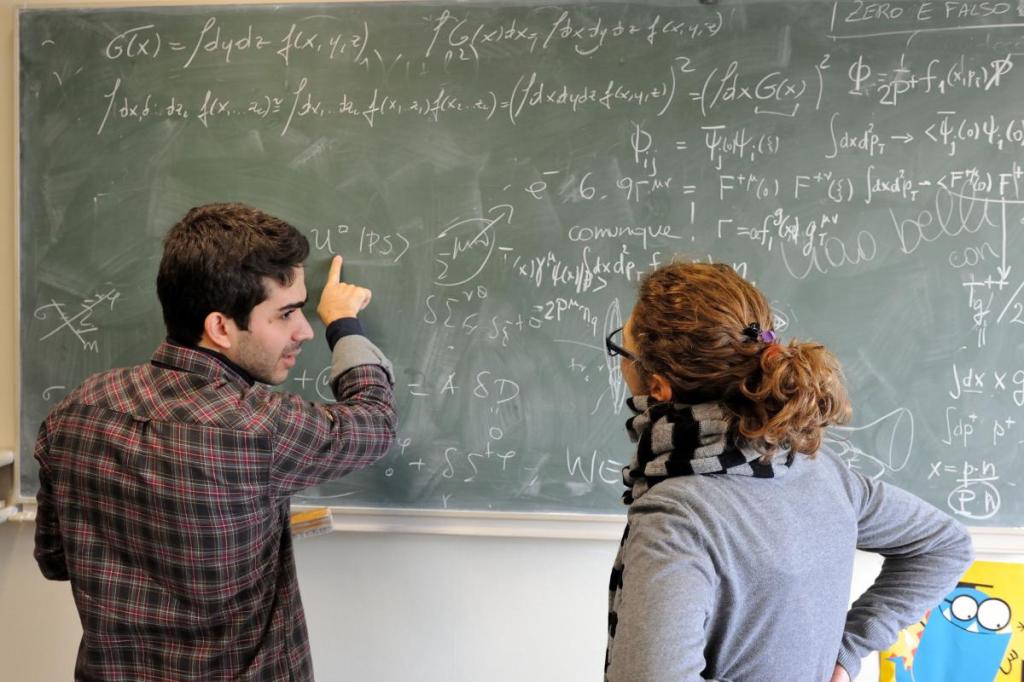
    Nothing embodies the idea of fun for (theoretical) particle physicists as lengthy scientific discussions in front of a large blackboard. Stereotypes notwithstanding, this is actually true. Photo credit: Nikhef.

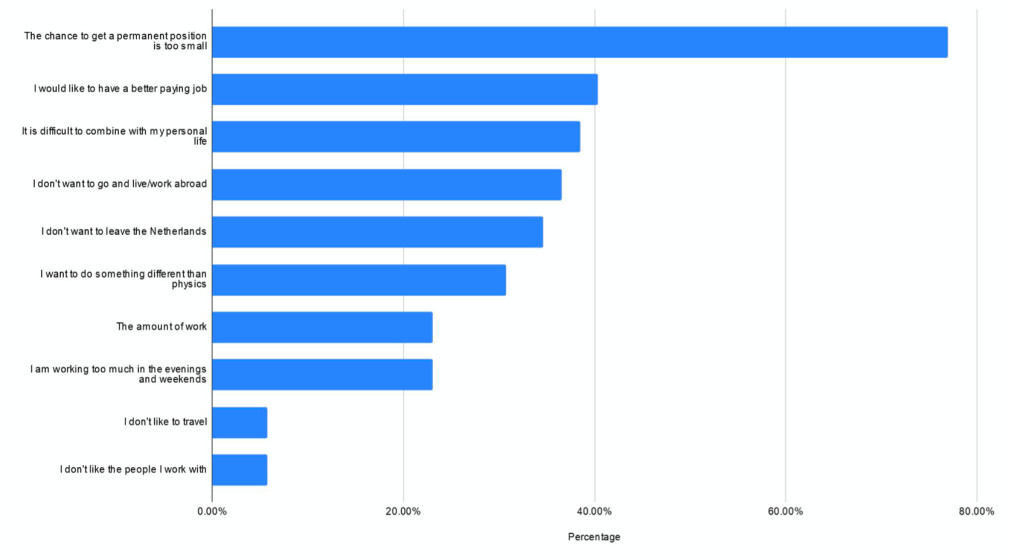
    Now, the above considerations applied for those of our PhD students that were planning to try to stay in science. What about, on the contrary, those 20% of students that had already decided to quit science as soon as they were done with their PhD, or perhaps earlier? Unsurprisingly, the overwhelming justification quoted by the respondents is the sheer lack of career perspectives in academia, namely the very limited chances of eventually securing a permanent job in science. And this is of course a very sensible consideration. Given that the number of tenure-track jobs has more or less remained unchanged (and in some countries even decreased) while the number of PhD graduates has been growing steadily, basic maths tells you that the competition for academic jobs is becoming fiercer and fiercer.

    What are the reasons PhD students have decided to drop science? First and foremost, the lack of career perspectives.

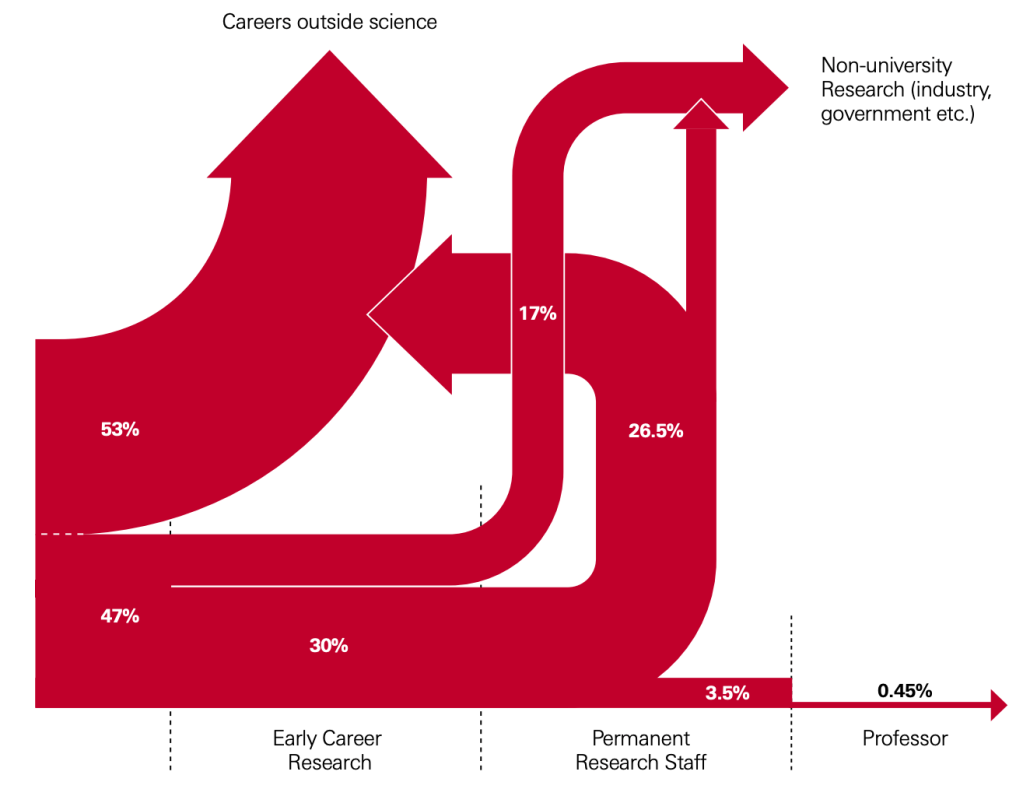
    There are different estimates and large variations by country and discipline (see also the Royal Society chart below) about the chances of getting a permanent job. However, one sensible ball park estimate is that no more than 10% of the PhD graduates will end up landing a permanent research position, and perhaps only 2% or 3% will ever each the university professor level. The fact that chances are not that great rings true even for graduates of world-leading universities: a survey of PhD graduates from the theoretical condensed matter group of the University of Oxford revealed that less than one third of their students ended up in academic jobs (source: informal discussions with a local academic colleague while we monitored our kids playing in the park). Actually, these career perspectives are even gloomier if one considers that after the PhD comes typically a long string of temporary research gigs (postdocs) often involving moving country before one can eventually land a tenure-track faculty job. So it not only that chances are small, also that, irrespective of the outcome, you are expected to spend several years in temporary jobs in different institutions. Further, not everyone plays under the same rule in this game: caring responsibilities and financial considerations often unfairly disadvantage some scientists at this stage of their careers. Again and again, the dismal situation of the academic job market and the lack of compatibility with personal situations and constraints are mentioned as the one of the main reasons to drop science after the PhD.

    A survey of the Royal Society based on the UK system revealed that PhD graduates end up overwhelmingly in careers outside science, and that the chances of landing a permanent research staff job at a university were at the few percent level at most.

    The second most frequent consideration pointed out by the respondents concerning the reasons to drop science was aiming to a better salary. I have to say that was a bit surprised to see this result in a survey from Dutch PhD students, which enjoy in comparison with most other countries very generous employment conditions and benefits. As someone who never earned more than 1000 euros per month (without benefits) during my PhD, the Netherlands offers outstanding work conditions for PhD students, though perhaps it is true that graduates can land better paying jobs outside academia. In this context, perhaps one should also point out that no one complained about physics being dull or boring or that the Nikhef research environment was not supportive. So even the reasons for leaving science are quite telling, imho, about the reasons why these respondents accepted starting a PhD to begin with, if one considers also the “missing” answers.

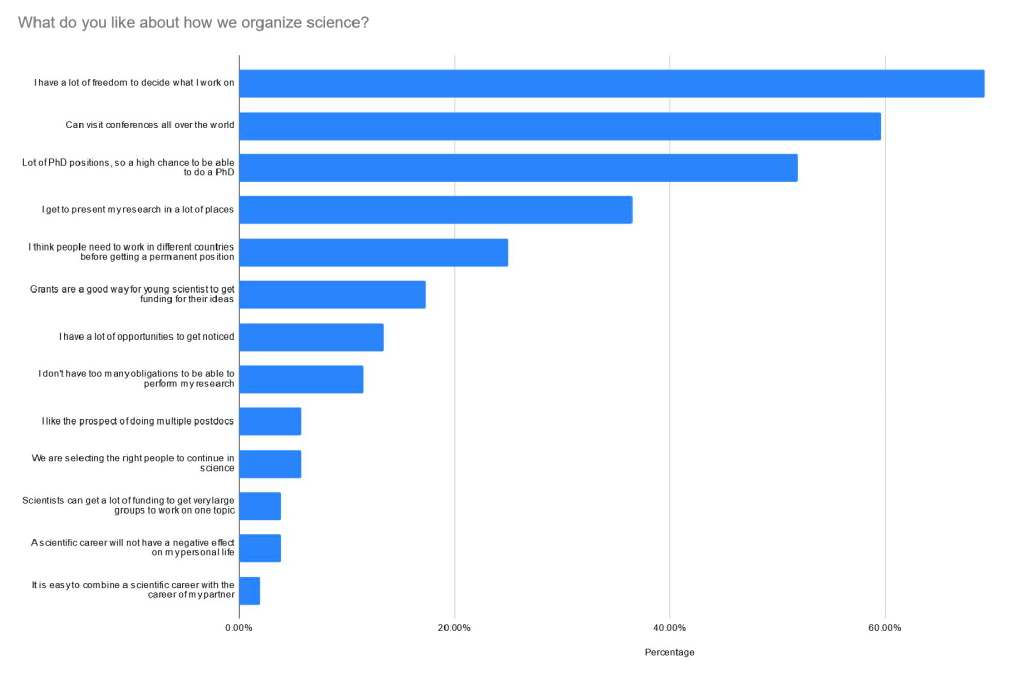
    Another of the questions that were asked as part of this survey were related to the current way in which science is organised. Here there was a higher diversity of options. The aspect that was more highlighted by the respondents was that of the freedom to organise their own work. This freedom is something that e.g. is absent in company world. Being able to travel and meet fascinating people are over the world is (was?) also an aspect well appreciated.

    Positive aspects of the current organisation of science from the perspective of the Nikhef’s PhD students.
    The time flexibility of academia can be a double-edged sword. It is sometimes required to work outside “office hours”, for example to meet a deadline for a paper submission. Image credit: PhD comics.

    Concerning points of attention about the way science is organised, the survey’s respondents indicated two topics as particularly relevant. The first is that from their perspective too many excellent researchers end up leaving science. The second, the complaints about the fact that the current model requires enduring a series of short research gigs in different countries before one can even hope applying for a permanent position. Clearly, the two points are closely related: many outstanding scientists will leave the field if they are not willing (or able) to embark on postdocs gigs, in many cases for good reasons. Note also that as mentioned above the system does not treat all players equally: people with caring responsibilities might find more challenging following the traditional path from PhD to professor, and researchers from wealthier backgrounds or with a bigger support net have important advantages (as one might have noticed, relocating to a different country every couple of years is financially rather taxing). Other suggestions that our students put forward were to improve the possibilities of combining a scientific career with personal life, caring responsibilities, with the careers of their partners. I also note that another of the frequent complaints (too much travel) has been made irrelevant by Corona. Noting that most research activities and scientific life can go on with online remote conferences and meetings, it is unlikely that we go back to the pre-covid situation of almost continuous travel anytime soon. While there is no magic wand to solve these problems instantaneously, one positive recent development is the adoption of the “Recognition and Rewards of Academics” position paper by the Dutch universities, which emphasises that there are many different pathways to become a succesful scientist beyond the traditional one and that these should also be appropriately recognised.

    Points of attention on the same topic: what we can do to improve the way science is organised?

    Let me now finish this post by putting on my (fake) social scientist hat and draw together some general conclusions from the results of this interesting survey:

    • The overwhelming majority of Nikhef’s PhD student are either considering or have already decided to attempt to follow a career in science.
    • Why? Because science is fun, exciting, and intellectually challenging (at least in particle physics 😉 ): this is by far the main reason why our PhD students would attempt a career in academia.
    • But following up a scientific career also brings in many challenges from the personal point of view. Worse, there is no guarantee that all these sacrifices might result in landing one of the few professorial positions available
    • In the current way that science is organised, ECRs benefit of a significant flexibility to pursue their own interests, and of ample opportunities to meet and interact with people all over the world…
    • … but also the current model is affected by a leaky pipeline where many excellent researchers leave and those who remain are not always the best, in most cases due to the challenges to reconcile a scientific career with personal life and caring responsibilities.

    So should you stay or should you go? No one can take this decision for you. What I believe is of utmost importance is to take this decision based on accurate information rather than on rumours or gut feelings, as well as seeking advice from more experienced researchers (of course when doing so one needs to be aware of the Survivor Bias) as well from people that have successfully transitioned to other jobs. Irrespective of the decision, what I want to strongly emphasise is that leaving (academic) science is never a defeat, something to be ashamed of. For many, it is the first step towards a fulfilling and rewarding career, perhaps not the one they had imagined for them when they first started the PhD, but perfectly suited for them nevertheless.

    Some valuable advise on post-PhD career paths, again by the one and only Jorge Cham of PhDcomics.com
  • Blended learning and the future of university teaching

    My parents always liked to tell me about their time as university students, in the Faculty of Law in Barcelona in the 1970s. Those were interesting times, towards the end of General Franco’s dictatorship, when students could be found more often than not trying to get away from the political police after one of the frequent demonstrations against the regime. Among the many anecdotes of that period, among the ones that always struck me the most was the way their lectures took place. Imagine a packed lecture hall, with maybe a couple hundred students or more. The professor would step in at the beginning of the lecture (full three-pieces dark suit, tie or bow-tie, glasses), open his (it was inevitably a he in those times) notes, and start reading them. No blackboard, no fancy support material, no handouts, nothing. Just reading aloud the notes for the whole duration of the lecture, while the students struggled to scribble something before going back to their books in the library. Interestingly, it seems that most professors spent the whole lecture smoking (!), some even cigars, leaving a characteristic smell that filled the classroom and the student clothes for days. A funny detail was that there was no clock to check the time, no alarm to indicate the end of a lesson: once the time was over, the janitor would inevitably enter the class and politely indicate the professor that he was done with his sacred duties. Following this ever-present ritual, the professor would gather his notes and leave the hall, with next-to-none time for discussions or questions (no, there were no student evaluations in those days, why would you ask that?). You might also guess that there were not that many contact hours or tutorial sessions to assist digesting the material.

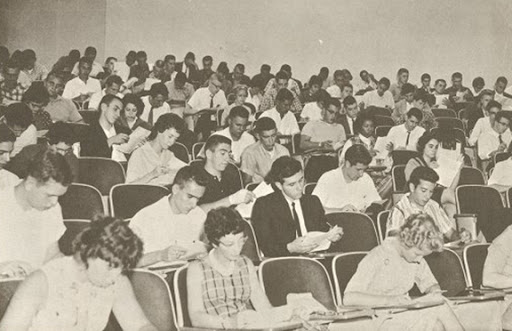
    A typical university classroom in the 70s, minus the smoke (source).

    Why am I mentioning this anecdote to start the post? Because from several points of view the way we teach university courses today is not that different from what tool place in the seventy’s classrooms. Sure, we don’t have smoke now (thanks Heavens for that), and we use slides, blackboards, provide fancy handouts to our students, and enjoy (struggle?) with an insane amount of different Learning Management Systems, but the big picture nevertheless remains unchanged in many cases. A professor enters the big lecture hall, talks for some time about the topic of the lecture, and tries to engage (often unsuccessfully) with their students, who will be at different times during the class taking notes, fiddling with their phones, eating their sandwiches, or simply looking at cat videos of Youtube (I have even seen students playing StarCraft during lectures as well, in case you are interested, no kidding). Actually, what I said is not completely true, since nowadays few students even take notes, and most stare at you and/or your slides (or their own screens) as if they were focusing in absorbing the delivered knowledge the same way a plant absorbs sunlight to generate energy. The bottom line is that most university lectures, specially in bachelor programs which involve big groups, are taught using the time-proof traditional method of standing up and speaking for a long time in front of the class. And maybe this is a good thing, it might very well be a very succesful teaching strategy. At the end of the day personal contact is crucial to the what might be called the experience of learning. For the last two decades many education gurus have declared the demise of traditional teaching in favour of things like MOOCs (Massive Online Open Courses), but fortunately these gloomy predictions have failed to materialise. However, like it or not, things are going to be quite different in university teaching due to the Corona crisis, certainly for the next academic year, perhaps even in the longer term. Just today the University of Cambridge announced that all lectures will be online-only for the 2020-2021 academic year. The requirements of social distancing impose of course many challenges for higher education, but also offer opportunities that could change the way we teach and learn in the long term.

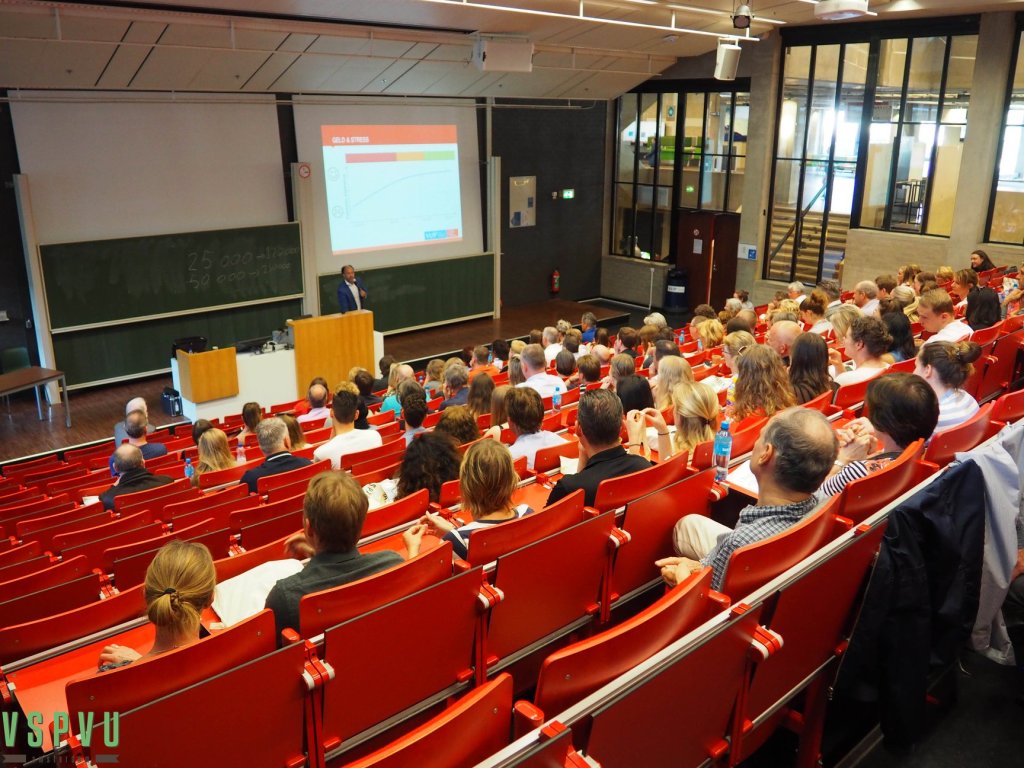
    Traditional lectures might be out of the question for some time.

    The position of the Dutch universities in this respect is that for the next months (years?) one should carry out teaching on campus when possible and online when not possible. The former will be affected by severe restrictions to ensure the safety of the students and teachers and prevent further virus propagation, such as scheduling lectures only outside rush ours, keeping the 1.5 meters distance all times also in the labs, and using large lecture halls only for small-group teaching and tutorials. So how can we effectively deliver high-quality teaching while ensuring that all safety rules are satisfied? The answer might be related to something called called blended learning, a big buzzword these days. According to Wikipedia, in blended learning one combines online educational materials and opportunities for interaction online with traditional place-based classroom methods. To cut a long story short, the philosophy is that the core content of a course is provided online (either via live or recorded lectures), followed by self-study by the students, again with the support of online tools and materials, followed when possible by a discussion time, tutorial style, when the instructors assist the students to digest the content of the course, following on open issues and dark spots in their learning rather that on parroting textbook material or lengthly mathematical derivations. This model is not that different e.g. from the tutorial system in place in Oxford and Cambridge, modulo the fact that lectures would be online and that the small-group tutorial discussions require suitable rooms. Of course the Oxford and Cambridge model only works because colleges employ copious numbers of academics for these tutorials, so generalising it to other situations is far from straightforward. Yet, in my personal experience such small-group interactions are by far the most effective way to learn and to communicate knowledge, so what we can learn from this?

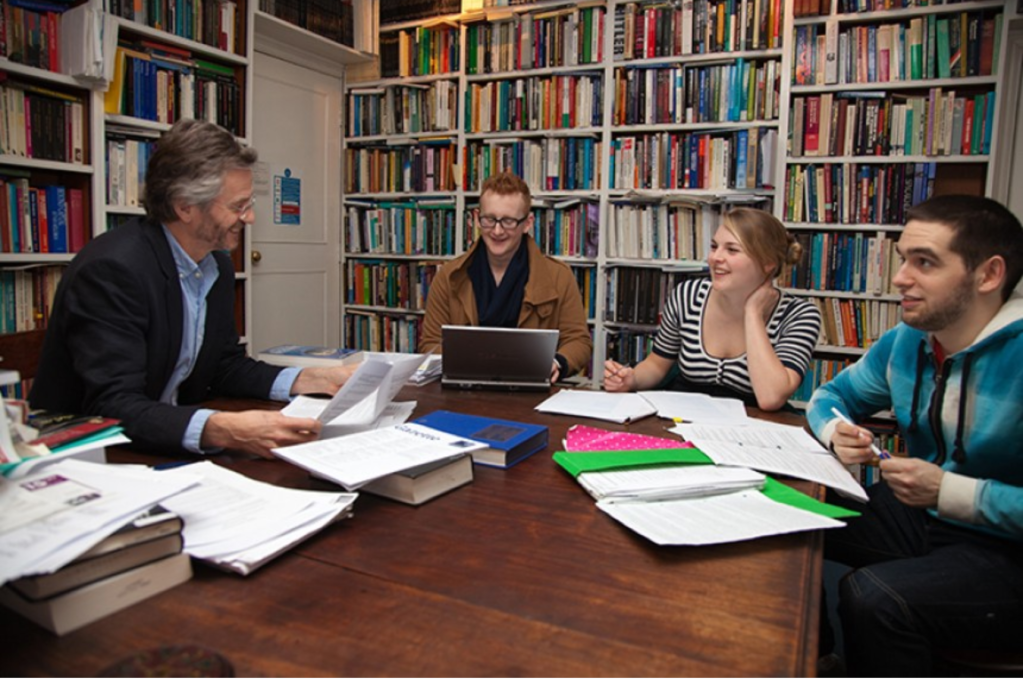
    A tutorial session at Oxford’s Oriel college, minus the social distancing (source).

    Now, assume that we cannot have on-site lectures anytime in 2020-2021. What do we do then? Many of my colleagues have made an amazing work turning their courses into online format in a very short notice, but if the situation persists for several months perhaps we can sit down for a while and try to think how we can optimise our efforts. One example that is close to my experience is the teaching of math courses in the hard-sciences degrees, the beta disciplines as they are called in The Netherlands. In principle, one would need say a single Mathematical Methods course, a single Algebra course, a single Statistics course, and so on. Surely enough, now we have a significant degree of repetition of such courses. And for good reasons! The first is that the scheduling of courses and lecture halls is already a nightmare, and you can fit only so many students in a lecture hall, so one needs separate courses for each education program even if the contents are basically the same (I have been told that effective scheduling is one of the titanic problems that could only be solved by a quantum computer, and I for one I am really looking forward to them). The second reason for this duplication is that ideally one wants to tune the content of math courses to the rest of the courses in a given program, for example if one is teaching Statistics for Physics one could use examples of data analysis from particle colliders but if the course is Statistics for Medical Science one might illustrate the same concepts using for instance the procedure to determine whether or not a given treatment is efficient.

    In this specific example, how could one implement blended learning and deliver an effective education while at the same time improving the efficiency and resource management? One option would be to coordinate the math courses in different education programs and identify which are the core concepts and those more specific to individual programs. Then one could take the core concepts and prepare a set of recorded lectures and the corresponding online support material and exercises. These lectures could be chopped into separate short modules, and instructors would provide a tailored path for the students in the different programs. Further, one could have specific modules for each program, with examples focused on topics of interest for the rest of the courses, to ensure a coherency in the education pathway followed by the students. Now, this sounds great in theory, but the practical implementation requires a ton of work and professional support, if one wants to produce high-quality online educational material. Then, it still needs to be complemented with face-to-face teaching, whether online or on-campus in small groups remains to be seen, so scheduling and personnel allocation are far from trivial. But potentially by combining efforts one could end up with powerful educational resources while at the same time improving the accessibility of our higher education, since students could then adjust their schedule better to their own constraints, for example if they have to juggle study with a temp job. Similar ideas could be applied to other types of courses, think of for example introduction to programming, where actually mostly-online courses are already in place. The key aspect of a succesful implementation of these ideas is to find the appropriate balance between online and face-to-face teaching, since the latter is truly essential for a real educational experience. Technology can never replace the human ingredient in education, so I would not bank on getting replaced by robots anytime soon (but also I missed my chance to invest in Zoom stocks, so who am I to make predictions)!

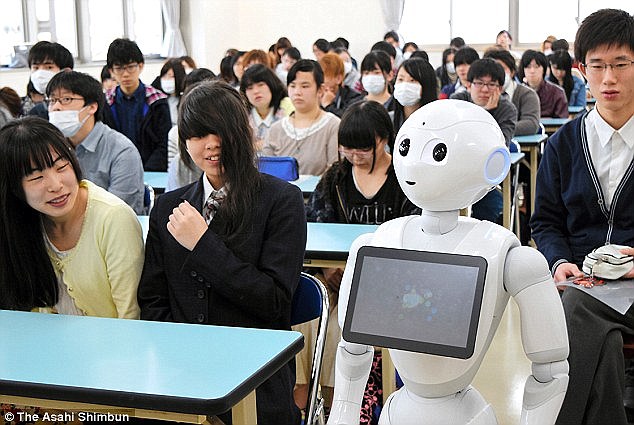
    The future of higher education might very likely involve a more extensive use of education technologies, though for the time being we will not be replaced by AIs.

    Needless to say, maybe tomorrow a vaccine is discovered and we all go back to the normal times – but as often said making predictions is difficult, specially for the future. Maybe the current situation becomes the new normal for universities and higher education, maybe not. But in any case, we have an opportunity to rethink how we deliver education and find ways of maybe doing things a bit better. It would be naive to think that the way we do things now is the best, this is not written in stone. Crisis are often the starting point of revolutions, and perhaps (?) the current crisis will induce long-term changes in universities so that people will look in awe back to the 2010s in the same way that we now find striking the university classrooms from the 70s. Only time will tell, but in any case these are certainly interesting times for higher ed.

  • HigherEd in the anderhalvemetersamenleving era

    On Wednesday the Dutch government announced a further softening of the corona-prevention measures. From secondary schools to cinemas, gym centers, cannabis cafes, and sex clubs, there is not a more or less clear roadmap for their calendar towards reopening and trying to recover part of their pre-corona activities. This said of course most the safety measures remain in place, and will do so for the foreseeable future, at least until a vaccine or an appropriate treatment for the virus is found and widely distributed. Perhaps the most important of this measurements, which affects the most how we can and we cannot resume some activities, is the obligation to keep a safety distance of one and a half meters between people to prevent the propagation of the virus. Clearly, such measure changes quite dramatically how we can do things, and thus it makes sense to call the current situation the “one-meter-and-a-half meters society”, or in the delightful way the Dutch have to cluster long arrays into single words, the anderhalvemetersamenleving era.

    Now, what about universities? Unfortunately, in the government’s plans there is little to none guidance about what will happen with the Dutch higher education system in the next months, so it is anyone’s guess. Right now, universities are essentially empty for a couple months now, with all on-site educational activities and most if not all of research work put on hold. Fortunately, despite the claims from some politicians, higher education has adapted itself very efficiently to the ongoing circumstances and moves swiftly to online lectures, tutorials, and examinations. While not ideal, and certainly with hiccups here and there, my evaluation would be that higher ed has successfully adjusted to the challenging situated and kept offering high-quality education to their students. Likewise, while on-site experiments are off the table now, research goes on since a fair amount of scientific work can be done remotely (think data analysis, literature studies, paper writing and so on). Juggling research and online education with in many cases homeschooling small children or caring for relatives has been a tour de force for many of us, but all in all the show has gone on with relatively few disturbances.

    University buildings resemble ghost towns in the corona-times. Here the New University Building of the VU Amsterdam.

    The main question now is how long this situation is going to last, and how higher education is going to look like in the next months and years. The VSNU, the association of Dutch Universities, has published its main strategy for the next months: On campus, if we can, Online, because we can (nice and catchy slogan, by the way). What does it mean? Well, the idea is that for the next months (to be more precise, until an effective vaccine or cure against the virus is found and distributed) there is no way one can go back to packed lecture rooms or crowded university areas. Even if campuses were large enough to accommodate all students in suitable lectures rooms where a safe distance can be kept, which is far from being the case, the strain on public transport and other services might be excessive. So for the being we forced to adopt a blended learning strategy, which is some fancy jargon to denote the simple idea that some things will be done online (think of lectures with large groups) and others will be done on campus (small group tutorials or seminars, lab work and practica, fieldwork, and so on). Several universities and faculties have already announced that until February 2021 most educational activities will be online, and I foresee that this trend will be generalised in the next weeks. Actually, this also means that until a vaccine is found there will be no major changes and so this blended/online strategy might become the new normal of the higher education system (not only in The Netherlands of course, but also in most other countries).

    can we go back to the `normal’ higher education while maintaining all required safety measures? this is the million dollar questions for universities in the Netherlands and other countries.

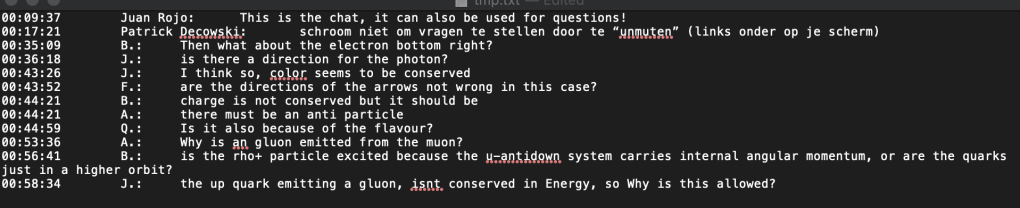
    One advantage as compared to the current situation is that now we have some more time to adapt our courses and examination methods to the new anderhalvemetersamenleving times. We are gaining experience with many (perhaps too many) online videoconference and Learning Management System softwares, for example, and discovering various useful features that facilitate online learning, from tutorial support with breakout rooms to online quizzes and tests. Teaching online brings many challenges but also a great deal of opportunities. If you want to take a look at an example of an online lecture, check here and here for a guest lecture on Feynman diagrams in particle physics that I gave some weeks ago at the UvA/VU bachelor program of physics and astronomy. It was a fun experience and I found that one can keep a rather dynamical interaction with the students: for example they can submit questions via the chat and then I would answer and discuss them on the spot. This was fun and I also had the feeling that students felt a bit more confident in sending written questions via the chat as compared to what they would have done in a real lecture.

    using the chat feature of videoconferencing systems is a useful resource to interact with the students, specially for those that might be more reluctant to ask the questions in person.

    So these are definitely interesting times for higher education, which might change it to its core in a way that can have long-lasting consequences beyond the ongoing corona emergency. Rethinking higher ed in the anderhalvemetersamenleving times is much more than just recycling a traditional course into an online format: is trying to make sure students experience the university life, the friendships and the adventure of growing and learning together as adult; looking for people that might be left out or that do not have the resources to follow effectively an online education; keeping the sense of belonging of the university community; and offering a clear perspective for the future. There is a lot of work on our plate but also a unique opportunity to change and improve higher ed for good. The `normal’ higher ed might never come back, so it could be up to us to define what is the `new normal’!

    As someone who regularly enjoys the massively crowded dutch trains, it is difficult to imagine society rolling back at full steam while keeping the one-meter-and-a-half distances 😉

    Incidentally, these challenging times might also be a good time to lobby for a healthy and renovated higher education system that contributes to the national and international wellbeing and prosperity for a generation. When one study after the other confirm that investing in higher education, research, and innovation is one of the most cost-effective ways that exist to ensure a good economic return, crisis like the present one could also be used for political reasons for a long-term crippling of the higher ed ecosystem. Despite having world-leading universities and research institutions for a relatively modest cost, again and again there are calls to further axe the system, even when multi-billion bailouts and support loans are being offered to many companies. A working document from a group of civil servants of the education ministry suggested a bunch of measures to reduce the cost for the government of higher education, from eliminating the subsidies to master programs (ending up with a UK-like system where a master program can cost up to eur20k or more) to reduce the number of international students, as if foreign students came here to just profit from the local generosity, when it is actually the opposite: the country badly needs highly skilled professionals to boost its knowledge-based economy. So we need to be on the lookout for attacks against higher education and research and proclaim proudly that our contribution to the financial, intellectual, and moral well-being of the country is essential even (or even better, specially) during the ongoing crisis.

  • The lepton collider battles (only one can remain?)

    As I discussed in a previous post, the precision mapping of the properties of the Higgs boson should be, without the shade of a doubt, one of the main scientific drivers of any future high-energy collider that might operate in the post-LHC era. Powerful as the LHC is, and despite remarkable breakthroughs both from the theory and experimental sides in recent years, there is a limit to how well we can probe the Higgs boson sector at the LHC: proton-proton collisions are messy, and here one is aiming at per-mille level measurements of the Higgs boson interactions, at least an order of magnitude improved as compared to what the LHC can provide. The goal of this post is an attempt to summarise the main pros and cons of one of the possible options to fingerprint the Higgs particle with unprecedented precision: a high-energy, high-luminosity electron-positron collider.

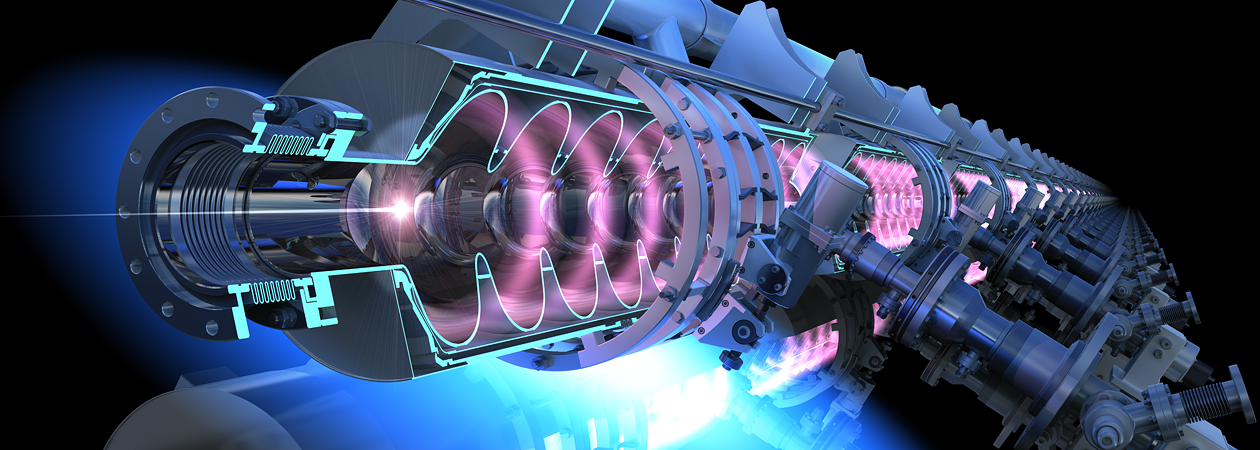
    Artist representation of a section of the superconducting cavities and the beam pipe that would be part of the International Linear Collider: Credit: Iwate & the ILC.

    In this respect, there exist basically two main ways which one can consider to improve our understanding of the mysteries of the Higgs boson, as compared to what will be the legacy results of the LHC (including its upcoming High-Luminosity upgrade). The first way would be to adopt the same strategy of the LHC, namely to collide energetic beams of protons among them, but this time increasing the total available energy as well as the number of collisions that take place in a given interval of time (the so-called luminosity). This approach would ensures that a sufficiently high number of Higgs bosons would be produced, allowing physicists to study its properties in great detail. However, this high-energy hadron collider road is a difficult one to travel, requiring significant investments both in the development of high-field magnet technology and in civil engineering. In the latter case, the reason being that such extreme energies would require a much larger tunnel, of the order of 100 kilometers, dwarfing the already huge LHC tunnel with its 27 km of circumference.

    The option of a high-energy proton-proton collider is being considered both at CERN, in the context of the Future Circular Colliders (FCC) study, and in China, in the framework of the CEPC/SppC collider project. The powerful physics case of the FCC has been spelled out in great detail here, and the one for the Chinese project shares many similarities. In addition to a significantly extended reach for the production of new heavy particles at high energies, these machines have a solid program of guaranteed deliverables, including the demonstration beyond any doubt that the Higgs boson gives mass to the fermions of the second generation and that it interacts with itself as predicted by the Standard Model, discovering or excluding thermally-produced WIMPs (weakly-interacting matter particles) as the dominant component or Dark Matter, and understanding what was the order of the electroweak phase transition of the early Universe.

    The FCC-hh, a 100 TeV proton-proton collider, would operate in gargantuan tunnel of around 100 kilometers of circumference in the Geneva basin and would use the LHC as proton injector as a first step for the subsequent acceleration of its proton beams from 7 TeV to 50 TeV.
    The chinese SppC project would be installed in a tunnel of similar dimensions as that of the FCC-hh, in a location around 300 km east of Beijing.

    As mentioned above, one limitation that affects the ultimate potential of proton-proton colliders for high-precision measurements of the Higgs boson properties is that often the processes of interest (which physicists call their signal) are buried into an overwhelming amount of other processes (known as background or noise) that muddle the interpretation of the results. For example, at the LHC these background processes can be found to happen thousands or even millions of time more frequently that the sought-for signal processes. In particular, the fact that the LHC is actually a quark and gluon collider (protons themselves are not fundamental objects, but instead composed by quarks and gluons) implies that processes driven by the strong interaction will appear frequently, complicating the study of those particles that are produced at a much slower rate such as the Higgs boson.

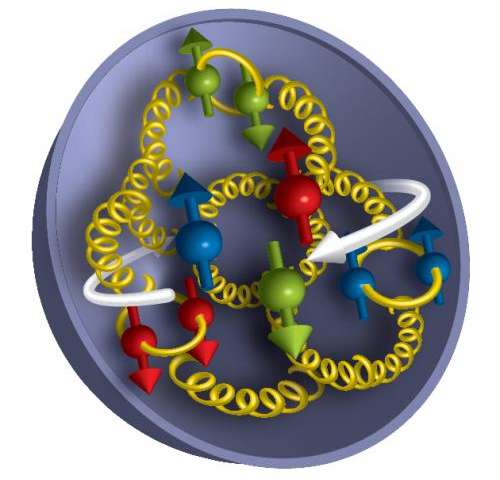
    The proton is a complex object composed by different types of quarks and by the gluons that keep them tightly together. This is way the collisions involving protons are more challenging to interpret that the much cleaner ones that involve leptons, which do not have such internal structure.

    However, in the collisions between electrons and their antiparticles, the positrons, the situation turns out to be rather different. Electrons and positrons are fundamental particles, without any (at least that we know!) internal substructure. Moreover, electrons and positrons interact only via the electromagnetic and weak forces, implying that the background process arising from the strong force that are ubiquitous at the LHC will be now less important when colliding electrons with positrons. Electrons and positrons, as well as their heavier siblings the muons and tauons and the ghostly neutrinos, belong to the class of so-called lepton particles, from the Greek term for small. Of course, the fact that lepton colliders are excellent machines for particle physics has been known for a long time, and they have a long story of momentous discoveries, such as that of the gluon in DESY’s PETRA accelerator for which we are today celebrating its 40th anniversary.

    CERN’s Large Electron Positron collider (LEP), the predecessor of the LHC, is to date the highest energy lepton collider that has ever operated, reaching a world-record center of mass energy of 209 GeV. I think it is fair to say that LEP discovered the Standard Model (SM) of particle physics, in particular establishing that the structure of the interactions between the W and Z bosons is indeed the one tightly predicted by the gauge symmetries of the SM, and demonstrating beyond any doubt that the strong interactions are indeed described by a quantum field theory, Quantum Chromodynamics (QCD).

    Concerning the production of Higgs bosons at electron-positron colliders, there are different processes that can lead to these elusive particles appearing in the detectors of the experiment. Depending on the specific centre of mass energy of the collision, some of these production modes will dominate with respect to the others. A particularly sweet spot appears at an energy of around 250 GeV (around twice the Higgs mass, which is mH=125 GeV), where the cross-section for the production of a Higgs boson in association with a Z boson has the largest possible value, implying that the number of produced particles will be maximised. This process, depicted schematically in the figure below, is very interesting for many reasons. Perhaps the most important factor is that if one observes a Z boson in the detector with a specific value of its energy, it is possible to determine that also a Higgs boson was produced in the same event, without the need of actually detecting it. This crucial feature allows lepton colliders to carry out unique model-independent measurements of the Higgs properties. One important example of such is to assess whether or not the Higgs boson sometimes decay into invisible particles beyond the Standard Model (something that would be almost impossible in the much messier environment of proton-proton collisions).

    The dominant channel to produce Higgs bosons in electron-positron collisions is the associated production with a Z boson.

    Interestingly, this sweet spot with a collision energy of 250 GeV is only a bit above the 208 GeV that LEP achieved at the end of its operations, and indeed a somewhat more powerful version of LEP might have been able to discover the Higgs boson before ATLAS and CMS did in 2012. Actually, in the last year of LEP’s operations, there were claims that the Higgs boson might already have been observed, and some people even proposed to delay the LHC to further investigate this possibility. As it turned out, these claims were based on a fluke (statistical fluctuations based on low number of events) and with hindsight it was the right decision back then to dismantle LEP to allow the installation of the LHC.

    Given the very strong scientific motivation to build and operate a high-energy lepton collider (first and foremost as a Higgs factory, but also to produce and test at extreme levels the other heavy particles of the Standard Model such as the W and Z bosons and the top quark), several groups and collaborations have put forward more or less detailed plans for such a machine. Perhaps the most advanced proposal is the International Linear Collider (ILC), to be built in Japan and for which the technology is readily available – the ILC tunnel could start to be built tomorrow (to first approximation) if the project was funded. The ILC is now under intense scrutiny by the Japanese government and its scientific agencies, and a final decision about whether or not the project will go ahead or will be scrapped could take place any time now. Given the hefty price tag of the ILC (although not particularly different from other Big Science projects in physics and astronomy), it is highly unlikely that Japan would carry all the financial burden of this project by itself and most likely a cooperation with international parties, CERN in primis, will be required if the ILC is ever to become a reality. The ILC would be a staged collider, starting with an energy of 250 GeV which can be upgraded by up to 1 TeV by increasing the length of its tunnel.

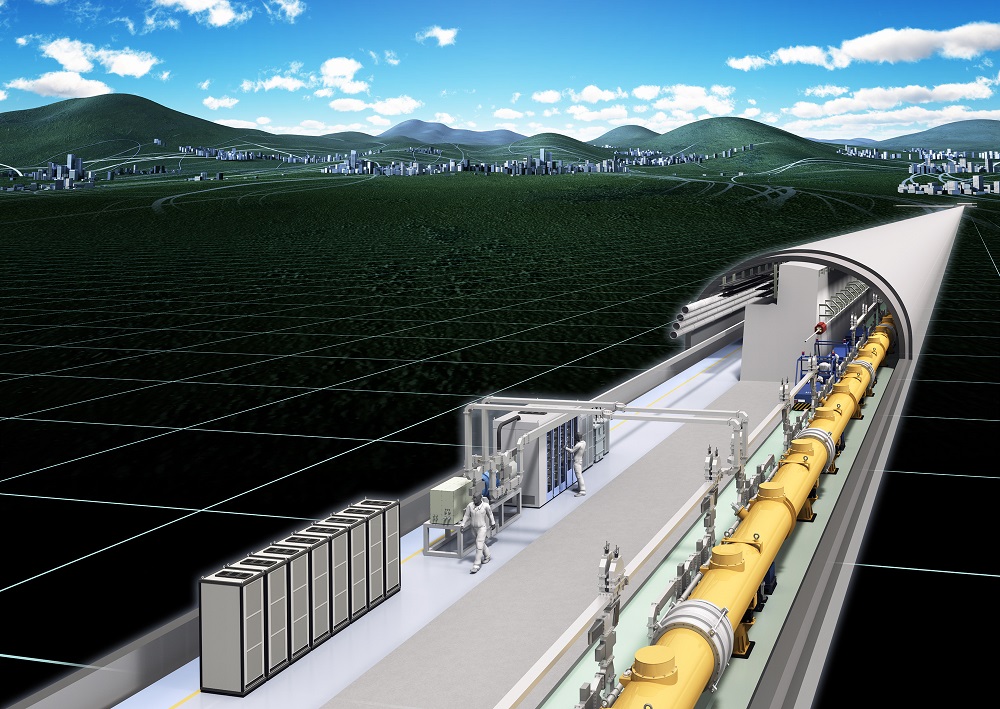
    A cross-section of the International Linear Collider tunnel, where the beam pipe and the accelerating cavities are contained within the yellow pipe.

    As the attentive reader might have noticed, the main difference between LEP and the ILC is the geometrical configurations of their tunnels: while LEP operated in a circular tunnel (again, the same as where the LHC operates now), the ILC would be based on a linear tunnel. Each configuration has pros and cons: circular colliders can achieve higher luminosities and have multiple interaction points (where detectors are actually installed), but the maximum energy they can reach is limited by synchrotron radiation. Linear colliders instead have somewhat smaller luminosities and at most two detectors can be accommodated, but on the other hand they can be easily extended to increase the centre of mass energy.

    Another proposal for a linear collider, similar in spirit to that of the ILC but based on a rather different technology, is the Compact Linear Collider (CLIC). The compact adjective in its name needs to be taken with a (big) grain of salt though, since in its most powerful incarnation, able to collide electrons and positrons at energies of 3 TeV, CLIC would require a 50-kilometer tunnel running alongside the Jura mountains and connecting to first approximation the cities of Geneva and Lausanne. In terms of energy reach, CLIC is by far the most powerful proposal on the table, achieving a factor 10 more energetic collisions that the initial phase of the ILC. This said, unless we discover evidence for new weakly interacting particles at the few TeV scale, for example from the analysis of the LHC data, being able to eventually probe the such high scales might not add much to the overall physics results of the collider. In terms of guaranteed returns, as for the other lepton colliders, the main scientific goals of CLIC would be to accurately probe the behaviour of the Higgs bosons and of the other heavy SM particles such as the top quark.

    CLIC would be a “compact” linear collider that can collide electrons and positrons up to energies of 3 TeV.

    The main alternative to a linear lepton collider would be the circular configuration, which so succesful was at LEP and other previous colliders. However, as mentioned above, at LEP the maximum energy that could be achieved was ultimately limited by a fundamental factor such as synchrotron radiation. This implies in turn that the only way to further increase the energy of a lepton collider in a circular configuration as compared to LEP would be to increase its size rather dramatically, in other words, having some sort of LEP on steroids. One difficulty here is that building a sufficiently large tunnel would have a price tag of several billion Swiss francs, and it is thus an investment which is challenging to justify by itself. This is way the two high-energy circular electron-positron colliders that have been proposed, CERN’s FCC-ee and the Chinese CEPC, would operate in the same 100 km tunnel that would be used subsequently to host a 100 TeV proton-proton machine. Both colliders have a similar physics program as their linear counterparts, and while they benefit from higher luminosities (remember, this is a measure of how many collisions take place in a given time) they are ultimately restricted on how far they can go in energy. According to the proponents of these circular machines, the increase in total luminosity offsets the benefits of an increased center of mass energy that (eventually) can be made available in linear colliders. Indeed, if your main physics goal is to indirectly probe tiny distances by means of precision measurements of the properties of the Higgs and W,Z bosons and of the top quark, a very high number of collisions (the luminosity) matters more than the total energy, provided you are above the corresponding production thresholds.

    This comparison, taken from the Granada EPPSU meeting, shows that circular colliders (CEPC and FCC-ee) lead to a greater luminosity at low values of the energy E but then decrease quite fast, while linear colliders (ILC, CLIC) have a luminosity that increases with the lepton energy instead.

    Taking into account all these various considerations, I would say that there is a clear consensus in the community that a high-energy high-luminosity electron-positron collider is crucial for the future of high-energy physics. The question of course is which one, where, and when? Again, there are pros and cons of each proposal, and the ultimate decision will have to weight not only scientific factors but also financial and political ones. For instance, the FCC-ee proponents advocate that their project paves the way to the 100 TeV hadron collider, since then the tunnel will be already built, and that operations can start as soon as the HL-LHC data-taking is complete, ensuring thus a continuity in the energy-frontier accelerator program at CERN. But the Japanese option could also start construction as soon as the project is approved, and this approval will most likely require investments (either in cash or in kind) of other partners such as CERN. And then one has the Chinese wild card: they might have the financial capability to push forward this project (both the lepton collider CEPC and its hadron successor SppC) on their own, but it remains to be seen that all the required infrastructure (basically recreating CERN from scratch) can be assembled in time. What would then be best option for the global high-energy physics community and for fundamental science in general? This is the million-dollar question, and like all complex questions, there is no easy and quick answer, and all points of views and arguments need to be carefully considered.

    To summarise, the lepton collider debates are a fascinating discussion and we should stay tuned for news, since crucial developments and decisions are expected to take place in the next few months in one direction or the other. In this context, the discussion of the various options is deeply intertwined, since while there is a clear and significant physics potential for building a high-energy lepton collider, once one of such facilities becomes available then the interest for a second one would decrease considerably. Therefore, as in Highlander, I would say that at the end of the day only one of these proposals can remain and be realised (of course, if we end up with more than one it would be even better). Irrespective of what option is ultimately selected, it would be a tremendous success for high-energy physics and for fundamental science that we, as a global community, are able to agree and realise such machine, and thus crack open the mysteries of the Higgs boson and hopefully unlock the way to a deeper theory that addresses some of the shortcomings of the Standard Model.

    As in Highlander, it is likely that only one high-energy lepton collider can be realised. Hopefully the discussion to decide which one will be based on more civilised methods than sword-fighting and beheading.
  • Celebrating Jose Ignacio Latorre

    Today a very special event took place in Barcelona: the LatorreFest, a celebration of Jose Ignacio Latorre’s 60 birthday. Jose Ignacio is of course a very important person in both my scientific and personal history, having been my PhD supervisor and then collaborator and friend for almost 20 years now. So together with two other former PhD students of Jose Ignacio, Antonio Acin from ICFO and Roman Orus from the Donostia International Physics Center  from the Donostia International Physics Center, we decided to invite a number of the many friends and collaborators of Jose Ignacio to celebrate together not just an anniversary, which is just an excuse, but more a friendship and an adventure in science.

    The talks covered a very wide range of topics, which are just a small but representative sample of Jose Ignacio’s ample interests. We started with Pedro Echenique, the president of the Donostia International Physics Center Foundation and Professor of Physics at the University of the Basque Country, and one of the founding fathers of the Spanish physics community. Pedro gave a beautiful and inspiring talk about the role of beauty in science, highlighting how for example Maxwell’s equations represent one of the pinnacles of the human endeavour. He was also careful to emphasise that while beauty can be a guiding principle no theory can be so beautiful that it deserves to the true, and that in science it is experiment the ultimate referee to decide whether or not a scientific theory, either beautiful or ugly, describes our natural world.

    Pedro Echenique and Maxwell’s equations.

    Pedro’s talk was followed by Luis Alvarez-Gaume, a former staff member of the Theory group at CERN and since a few years  the director of the Simons Center for Geometry and Physics at Stony Brook. Then we had a superb talk by Ignacio Cirac from the Max Plank Institute, who provide an extensive and hype-less overview of the present status and future challenges in quantum information and computation. Cirac, who many predict will receive a Nobel Prize for his foundational work in quantum computation, highlighted the many potentialities of quantum computation, and that while we are still far from truly groundbreaking quantum computers we are already in the position to attack many non-trivial problems, many of which with direct societal and commercial applications.

    Ignacio Cirac and the many problems that a quantum computer could attack.

    Other speakers of the LatorreFest included Stefano Forte from Milan, who emphasized the rile of Jose Ignacio as a visionary, in particular suggesting the crucial role that neural networks and machine learning tools could have in high energy physics well before this techniques were as commonplace as they are now; German Sierra from IFT Madrid, who discussed another of Jose Ignacio’s passions which is number theory and in particular what we can learn about the properties of prime numbers using quantum computers; and Manuel Asorey from the University of Zaragoza, who presented another of Jose Ignacio’s main achievements and that has been a driver for excellent science both in Spain and worldwide: the now-famous Benasque Center for Science.

    The last talk of this excellent event was given by Juan Fuster from IFIC in Valencia, who discussed the future of high-energy physics and particle accelerators. And he also presented another of Jose Ignacio’s many passions, namely wine-making! Quite possibly the wine that Jose Ignacio, Juan, and their collaborators produce every year is the most scientific one ever made, and is arguably the only wine I am aware of that is directly inspired in quantum mechanics. Juan presented a strong case for a future high energy particle collider, emphasising that the exploration of the energy frontier is far from a job done and the role of a global approach to built such machine as soon as possible, ideally to ensure a smooth transition with the operations of the high-luminosity LHC.

    Quantum is arguably the only brand of wine ever made that is directly inspired by the principles of quantum mechanics.

    It was a most enjoyable day and a beautiful opportunity to celebrate together a prolific friendship. In a time where toxic dynamics of power, harassment, and exploitation in the scientific world are so in the spotlight, I feel truly privileged by having had such a selfless, devoted, and inspired PhD advisor as Jose Ignacio. Many congratulations, and remember that the best is yet to come!

    Amazing lineup of speakers at the LatorreFest60, almost modern version of the famous Solvay conference picture ….